
Doogee Blade GT Ultra vs. Google Pixel 7 Pro: A Deep Dive into Battery, Performance, and AI
| Phones Images | |||||
|---|---|---|---|---|---|
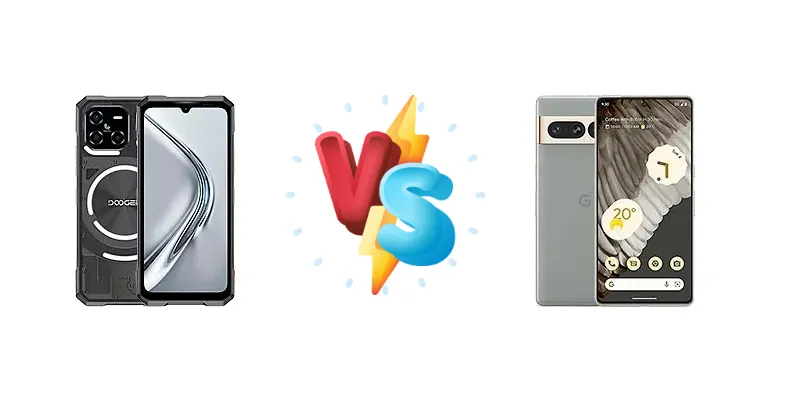
|
🏆 Quick Verdict
For the average user prioritizing a consistently smooth experience, exceptional camera capabilities, and long-term software support, the Google Pixel 7 Pro is the superior choice. However, the Doogee Blade GT Ultra’s astonishing 30:21h battery endurance makes it a compelling option for power users and those frequently away from a charger.
| PHONES | ||
|---|---|---|
| Phone Names | Doogee Blade GT Ultra | Google Pixel 7 Pro |
| Network | ||
|---|---|---|
| 2G bands | GSM 850 / 900 / 1800 / 1900 | GSM 850 / 900 / 1800 / 1900 |
| 3G bands | HSDPA 850 / 900 / 1700(AWS) / 1900 / 2100 | HSDPA 800 / 850 / 900 / 1700(AWS) / 1900 / 2100 |
| 4G bands | 1, 2, 3, 4, 5, 7, 8, 12, 17, 18, 19, 20, 25, 26, 28, 66 | 1, 2, 3, 4, 5, 7, 8, 12, 13, 14, 17, 18, 19, 20, 25, 26, 28, 29, 30, 38, 39, 40, 41, 42, 46, 48, 66, 71 - GE2AE |
| 5G bands | 1, 3, 7, 8, 28, 38, 41, 77, 78, 79 SA/NSA | 1, 2, 3, 5, 7, 8, 12, 14, 20, 25, 28, 30, 38, 40, 41, 48, 66, 71, 77, 78, 257, 258, 260, 261 SA/NSA/Sub6/mmWave - GE2AE |
| Speed | HSPA, LTE, 5G | HSPA, LTE, 5G |
| Technology | GSM / HSPA / LTE / 5G | GSM / CDMA / HSPA / EVDO / LTE / 5G |
| - | 1, 2, 3, 5, 7, 8, 12, 14, 20, 25, 28, 30, 38, 40, 41, 48, 66, 71, 75, 76, 77, 78 SA/NSA/Sub6 - GP4BC | |
| Launch | ||
|---|---|---|
| Announced | 2025, February | 2022, October 06 |
| Status | Available. Released 2025, February | Available. Released 2022, October 13 |
| Body | ||
|---|---|---|
| Build | - | Glass front (Gorilla Glass Victus), glass back (Gorilla Glass Victus), aluminum frame |
| Dimensions | 178.5 x 83.5 x 10.5 mm (7.03 x 3.29 x 0.41 in) | 162.9 x 76.6 x 8.9 mm (6.41 x 3.02 x 0.35 in) |
| SIM | Nano-SIM + Nano-SIM | Nano-SIM + eSIM |
| Weight | 260 g (9.17 oz) | 212 g (7.48 oz) |
| - | IP68 dust/water resistant (up to 1.5m for 30 min) | |
| Display | ||
|---|---|---|
| Protection | Mohs level 6 | Corning Gorilla Glass Victus |
| Resolution | 1080 x 2400 pixels, 20:9 ratio (~392 ppi density) | 1440 x 3120 pixels, 19.5:9 ratio (~512 ppi density) |
| Size | 6.72 inches, 109.0 cm2 (~73.1% screen-to-body ratio) | 6.7 inches, 110.6 cm2 (~88.7% screen-to-body ratio) |
| Type | IPS LCD, 120Hz | LTPO AMOLED, 120Hz, HDR10+, 1000 nits (HBM), 1500 nits (peak) |
| - | Always-on display | |
| Platform | ||
|---|---|---|
| CPU | Octa-core (4x2.5 GHz Cortex-A78 & 4x2.0 GHz Cortex-A55) | Octa-core (2x2.85 GHz Cortex-X1 & 2x2.35 GHz Cortex-A78 & 4x1.80 GHz Cortex-A55) |
| Chipset | Mediatek Dimensity 7300 (4 nm) | Google Tensor G2 (5 nm) |
| GPU | Mali-G615 MC2 | Mali-G710 MP7 |
| OS | Android 14 | Android 13, upgradable to Android 15, up to 5 major Android upgrades |
| Memory | ||
|---|---|---|
| Card slot | microSDXC (uses shared SIM slot) | No |
| Internal | 512GB 16GB RAM | 128GB 8GB RAM, 256GB 8GB RAM, 128GB 12GB RAM, 256GB 12GB RAM, 512GB 12GB RAM |
| - | UFS 3.1 | |
| Main Camera | ||
|---|---|---|
| Dual | 100 MP, f/1.8, (wide), 1/1.8", PDAF 5 MP, f/2.2, 120˚ (ultrawide) | - |
| Features | LED flash, HDR, panorama | Laser AF, Dual-LED flash, Pixel Shift, Auto-HDR, panorama |
| Single | - | 10.8 MP, f/2.2, 21mm (ultrawide), 1/3.1", 1.22µm |
| Triple | - | 50 MP, f/1.9, 25mm (wide), 1/1.31", 1.2µm, dual pixel PDAF, OIS 48 MP, f/3.5, 120mm (periscope telephoto), 1/2.55", 0.7µm, dual pixel PDAF, OIS, 5x optical zoom 12 MP, f/2.2, 126˚ (ultrawide), 1/2.9", 1.25µm, AF |
| Video | 4K@30fps, 1080p@30fps, gyro-EIS | 4K@30/60fps, 1080p@30/60/120/240fps; gyro-EIS, OIS, 10-bit HDR |
| Selfie camera | ||
|---|---|---|
| Features | - | HDR, panorama |
| Single | 32 MP, f/2.3, (wide), 1/2.8" | 10.8 MP, f/2.2, 21mm (ultrawide), 1/3.1", 1.22µm |
| Video | 1080p@30fps | 4K@30/60fps, 1080p@30/60fps |
| Sound | ||
|---|---|---|
| 3.5mm jack | - | No |
| 35mm jack | No | No |
| Loudspeaker | Yes | Yes, with stereo speakers |
| Comms | ||
|---|---|---|
| Bluetooth | 5.2, A2DP, LE | 5.2, A2DP, LE, aptX HD |
| Infrared port | Yes | - |
| NFC | Yes | Yes |
| Positioning | GPS, GLONASS, GALILEO, BDS | GPS (L1+L5), GLONASS (G1), BDS (B1I+B1c+B2a), GALILEO (E1+E5a), QZSS (L1+L5) |
| Radio | FM radio | No |
| USB | USB Type-C 2.0 | USB Type-C 3.2 |
| WLAN | Wi-Fi 802.11 a/b/g/n/ac/6, dual-band | Wi-Fi 802.11 a/b/g/n/ac/6e, tri-band, Wi-Fi Direct |
| Features | ||
|---|---|---|
| Sensors | Fingerprint (side-mounted), accelerometer, gyro, proximity, compass | Fingerprint (under display, optical), accelerometer, gyro, proximity, compass, barometer |
| - | Ultra Wideband (UWB) support | |
| Battery | ||
|---|---|---|
| Charging | 33W wired | 23W wired, PD3.0, 50% in 30 min 23W wireless Reverse wireless |
| Type | 5500 mAh | Li-Ion 5000 mAh |
| Misc | ||
|---|---|---|
| Colors | Black, Silver | Obsidian, Snow, Hazel |
| Models | - | GP4BC, GE2AE, GFE4J |
| Price | About 480 EUR | € 248.84 / $ 204.00 / £ 259.99 / ₹ 36,999 |
| Tests | ||
|---|---|---|
| Battery life | - | Endurance rating 83h |
| Camera | - | Photo / Video |
| Display | - | Contrast ratio: Infinite (nominal) |
| Loudspeaker | - | -24.8 LUFS (Very good) |
| Performance | - | AnTuTu: 796369 (v9) GeekBench: 3187 (v5.1) GFXBench: 34fps (ES 3.1 onscreen) |
| EU LABEL | ||
|---|---|---|
| Battery | 30:21h endurance, 1300 cycles | - |
| Energy | Class E | - |
| Free fall | Class A (270 falls) | - |
| Repairability | Class C | - |
Doogee Blade GT Ultra
- Unmatched battery endurance (30:21h)
- Potentially lower price point
- Modern 4nm Dimensity 7300 chipset
- Unknown display quality and brightness
- Camera performance is unproven
- Software support and updates are uncertain
Google Pixel 7 Pro
- Excellent camera system with AI enhancements
- Bright and vibrant display (1090 nits)
- Smooth performance with Google Tensor G2
- Shorter battery life (83h endurance)
- Higher price tag
- Charging speed is relatively slow (23W)
Display Comparison
The Google Pixel 7 Pro boasts a significantly brighter display, peaking at 1090 nits, compared to an unstated brightness for the Doogee Blade GT Ultra. While the Doogee’s display specs are missing, the Pixel 7 Pro’s infinite contrast ratio (nominal) ensures deep blacks and vibrant colors. The Pixel 7 Pro’s LTPO panel likely offers adaptive refresh rates for improved efficiency, a feature not confirmed on the Doogee. The Pixel 7 Pro’s display is geared towards outdoor visibility and immersive content consumption.
Camera Comparison
Both devices are advertised as having strong photo and video capabilities, but the Pixel 7 Pro’s camera system is expected to be more refined. While specific sensor details for the Doogee are unavailable, the Pixel 7 Pro leverages Google’s computational photography expertise, delivering consistently excellent results in various lighting conditions. The Pixel 7 Pro’s image processing, powered by the Tensor G2, excels in features like Super Res Zoom and Magic Eraser. The Doogee’s camera performance will likely rely more heavily on hardware, and without detailed specs, it’s difficult to assess its capabilities against the Pixel 7 Pro’s software-driven approach.
Performance
The Google Pixel 7 Pro’s Tensor G2, fabricated on a 5nm process, features a unique CPU configuration with 2x2.85 GHz Cortex-X1 cores for peak performance. The Doogee Blade GT Ultra utilizes the Mediatek Dimensity 7300 (4nm), employing a more conventional octa-core setup with 4x2.5 GHz Cortex-A78 cores. While clock speeds aren’t everything, the Tensor G2’s architecture is optimized for machine learning tasks, giving the Pixel 7 Pro an edge in AI-driven features. The 4nm process of the Dimensity 7300 should offer good efficiency, but the Tensor G2’s integration with Google’s software is a key differentiator. The Pixel 7 Pro also benefits from faster RAM, likely LPDDR5x, compared to the Doogee.
Battery Life
The Doogee Blade GT Ultra’s standout feature is its exceptional 30:21h endurance rating, significantly exceeding the Pixel 7 Pro’s 83h rating. This suggests the Doogee can last nearly a full day longer on a single charge under similar usage. However, the Pixel 7 Pro offers faster charging at 23W wired (with 50% charge in 30 minutes) and 23W wireless, along with reverse wireless charging. The Doogee is limited to 33W wired charging, meaning it will take longer to fully replenish its battery despite its larger capacity. The Pixel 7 Pro’s charging versatility provides more convenience, while the Doogee prioritizes sheer longevity.
Buying Guide
Buy the Doogee Blade GT Ultra if you absolutely need the longest possible battery life and prioritize endurance over camera quality and software polish. This phone is ideal for travelers, field workers, or anyone who heavily relies on their smartphone throughout the day without consistent access to power. Buy the Google Pixel 7 Pro if you value a premium user experience, a class-leading camera system, and the benefits of Google’s Tensor G2 AI chip, including advanced image processing and smart features. This is the phone for content creators, photography enthusiasts, and those deeply integrated into the Google ecosystem.