
Doogee Blade GT Ultra vs. Asus ROG Phone 7 Ultimate: A Deep Dive Comparison
| Phones Images | |||||
|---|---|---|---|---|---|
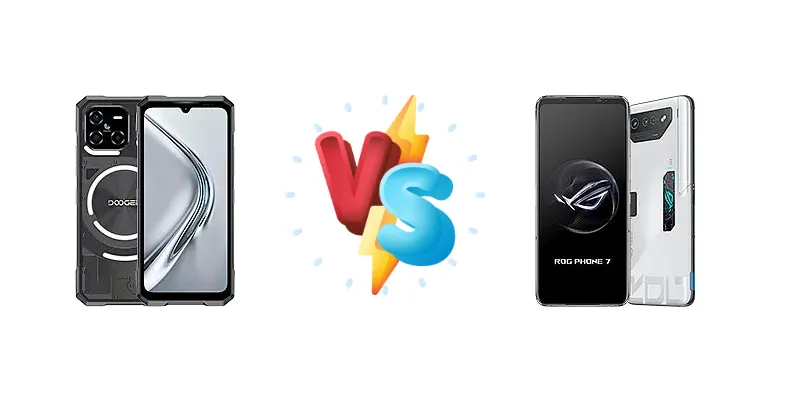
|
🏆 Quick Verdict
For the average user prioritizing longevity and value, the Doogee Blade GT Ultra emerges as the winner. Its remarkable 30:21h endurance significantly outpaces the ROG Phone 7 Ultimate’s 131h, making it ideal for heavy users. However, gamers demanding peak performance will find the Asus ROG Phone 7 Ultimate’s Snapdragon 8 Gen 2 a more compelling choice.
| PHONES | ||
|---|---|---|
| Phone Names | Doogee Blade GT Ultra | Asus ROG Phone 7 Ultimate |
| Network | ||
|---|---|---|
| 2G bands | GSM 850 / 900 / 1800 / 1900 | GSM 850 / 900 / 1800 / 1900 |
| 3G bands | HSDPA 850 / 900 / 1700(AWS) / 1900 / 2100 | HSDPA 800 / 850 / 900 / 1700(AWS) / 1900 / 2100 |
| 4G bands | 1, 2, 3, 4, 5, 7, 8, 12, 17, 18, 19, 20, 25, 26, 28, 66 | 1, 2, 3, 4, 5, 7, 8, 12, 17, 18, 19, 20, 25, 26, 28, 32, 34, 38, 39, 40, 41, 42, 43, 48, 66 - International |
| 5G bands | 1, 3, 7, 8, 28, 38, 41, 77, 78, 79 SA/NSA | 1, 2, 3, 5, 7, 8, 12, 18, 20, 25, 26, 28, 38, 40, 41, 48, 66, 77, 78, 79 SA/NSA/Sub6 - International |
| Speed | HSPA, LTE, 5G | HSPA, LTE (Up to 7CA), 5G |
| Technology | GSM / HSPA / LTE / 5G | GSM / CDMA / HSPA / LTE / 5G |
| - | 1, 3, 5, 8, 28, 41, 77, 78, 79 SA/NSA/Sub6 - China | |
| Launch | ||
|---|---|---|
| Announced | 2025, February | 2023, April 13 |
| Status | Available. Released 2025, February | Available. Released 2023, May |
| Body | ||
|---|---|---|
| Build | - | Glass front (Gorilla Glass Victus), glass back (Gorilla Glass 3), aluminum frame |
| Dimensions | 178.5 x 83.5 x 10.5 mm (7.03 x 3.29 x 0.41 in) | 173 x 77 x 10.3 mm (6.81 x 3.03 x 0.41 in) |
| SIM | Nano-SIM + Nano-SIM | Nano-SIM + Nano-SIM |
| Weight | 260 g (9.17 oz) | 239 g (8.43 oz) |
| - | Built-in motorized cooling air vent (AeroActive Portal) IP54 water resistant 2" OLED display (on the back) Pressure sensitive zones (Gaming triggers) | |
| Display | ||
|---|---|---|
| Protection | Mohs level 6 | Corning Gorilla Glass Victus |
| Resolution | 1080 x 2400 pixels, 20:9 ratio (~392 ppi density) | 1080 x 2448 pixels (~395 ppi density) |
| Size | 6.72 inches, 109.0 cm2 (~73.1% screen-to-body ratio) | 6.78 inches, 109.5 cm2 (~82.2% screen-to-body ratio) |
| Type | IPS LCD, 120Hz | AMOLED, 1B colors, 165Hz, HDR10+, 1000 nits (HBM), 1500 nits (peak) |
| Platform | ||
|---|---|---|
| CPU | Octa-core (4x2.5 GHz Cortex-A78 & 4x2.0 GHz Cortex-A55) | Octa-core (1x3.2 GHz Cortex-X3 & 2x2.8 GHz Cortex-A715 & 2x2.8 GHz Cortex-A710 & 3x2.0 GHz Cortex-A510) |
| Chipset | Mediatek Dimensity 7300 (4 nm) | Qualcomm SM8550-AB Snapdragon 8 Gen 2 (4 nm) |
| GPU | Mali-G615 MC2 | Adreno 740 |
| OS | Android 14 | Android 13, up to 2 major Android upgrades |
| Memory | ||
|---|---|---|
| Card slot | microSDXC (uses shared SIM slot) | No |
| Internal | 512GB 16GB RAM | 512GB 16GB RAM |
| - | UFS 4.0 NTFS support for external storage | |
| Main Camera | ||
|---|---|---|
| Dual | 100 MP, f/1.8, (wide), 1/1.8", PDAF 5 MP, f/2.2, 120˚ (ultrawide) | - |
| Features | LED flash, HDR, panorama | LED flash, HDR, panorama |
| Triple | - | 50 MP, f/1.9, 24mm (wide), 1/1.56", 1.0µm, PDAF 13 MP, f/2.2, 13mm, 120˚ (ultrawide) 5 MP (macro) |
| Video | 4K@30fps, 1080p@30fps, gyro-EIS | 8K@24fps, 4K@30/60fps, 1080p@30/60/120/240fps, 720p@480fps; gyro-EIS, HDR10+ |
| Selfie camera | ||
|---|---|---|
| Features | - | Panorama, HDR |
| Single | 32 MP, f/2.3, (wide), 1/2.8" | 32 MP, f/2.5, 29mm (wide), 1/3.2", 0.7µm |
| Video | 1080p@30fps | 1080p@30fps |
| Sound | ||
|---|---|---|
| 3.5mm jack | - | Yes |
| 35mm jack | No | Yes |
| Loudspeaker | Yes | Yes, with stereo speakers (2 amplifiers) |
| - | 32-bit/384kHz audio | |
| Comms | ||
|---|---|---|
| Bluetooth | 5.2, A2DP, LE | 5.3, A2DP, LE, aptX HD, aptX Adaptive, aptX Lossless |
| Infrared port | Yes | - |
| NFC | Yes | Yes |
| Positioning | GPS, GLONASS, GALILEO, BDS | GPS (L1+L5), GLONASS (L1), BDS (B1I+B1c+B2a), GALILEO (E1+E5a), QZSS (L1+L5), NavIC (L5) |
| Radio | FM radio | No |
| USB | USB Type-C 2.0 | USB Type-C 3.1 (side), DisplayPort 1.4; USB Type-C 2.0 (bottom), OTG, accessory connector |
| WLAN | Wi-Fi 802.11 a/b/g/n/ac/6, dual-band | Wi-Fi 802.11 a/b/g/n/ac/6e/7, tri-band, Wi-Fi Direct |
| Features | ||
|---|---|---|
| Sensors | Fingerprint (side-mounted), accelerometer, gyro, proximity, compass | Fingerprint (under display, optical), accelerometer, gyro, proximity, compass |
| Battery | ||
|---|---|---|
| Charging | 33W wired | 65W wired, PD3.0, QC5, 100% in 42 min 10W reverse wired |
| Type | 5500 mAh | Li-Po 6000 mAh |
| Misc | ||
|---|---|---|
| Colors | Black, Silver | Storm White |
| Price | About 480 EUR | About 780 EUR |
| Tests | ||
|---|---|---|
| Battery life | - | Endurance rating 131h |
| Camera | - | Photo / Video |
| Display | - | Contrast ratio: Infinite (nominal) |
| Loudspeaker | - | -25.5 LUFS (Very good) |
| Performance | - | AnTuTu: 1325105 (v9) GeekBench: 5139 (v5.5), 5567 (v6) GFXBench: 107fps (ES 3.1 onscreen) |
| EU LABEL | ||
|---|---|---|
| Battery | 30:21h endurance, 1300 cycles | - |
| Energy | Class E | - |
| Free fall | Class A (270 falls) | - |
| Repairability | Class C | - |
Doogee Blade GT Ultra
- Exceptional battery life (30:21h endurance)
- High battery cycle count (1300 cycles)
- More affordable price point (likely)
- Less powerful processor (Dimensity 7300)
- Limited camera details available
- Slower charging speed (33W)
Asus ROG Phone 7 Ultimate
- Flagship Snapdragon 8 Gen 2 performance
- Faster 65W charging with PD3.0/QC5
- Brighter display (1095 nits)
- Significantly shorter battery life (131h)
- Higher price
- Potential for thermal throttling under heavy load
Display Comparison
The Asus ROG Phone 7 Ultimate boasts a significantly brighter display, reaching a measured 1095 nits, compared to an unspecified brightness for the Doogee. While the Doogee’s display specs are missing, the ROG Phone’s infinite contrast ratio suggests a high-quality AMOLED panel. The ROG Phone’s higher brightness is crucial for outdoor visibility, while the lack of LTPO on either device means refresh rate scaling isn’t as power efficient as it could be. Bezels are likely comparable given both phones target enthusiast markets, but the ROG Phone’s focus on gaming may result in slightly wider bezels for grip.
Camera Comparison
Both devices feature photo and video capabilities, but detailed camera specifications are limited for the Doogee. The ROG Phone 7 Ultimate likely benefits from Qualcomm’s image signal processor (ISP) and potentially larger sensor sizes, offering superior image quality and video stabilization. The ROG Phone’s camera system is geared towards versatile performance, while the Doogee’s camera is likely a more cost-optimized solution. Without specific details on the Doogee’s sensor size and aperture, it’s difficult to assess its low-light performance.
Performance
The core difference lies in the chipsets. The Asus ROG Phone 7 Ultimate’s Snapdragon 8 Gen 2 (4nm) is a flagship processor with a Cortex-X3 prime core clocked at 3.2 GHz, offering substantially higher CPU and GPU performance than the Doogee’s Mediatek Dimensity 7300 (4nm). The Dimensity 7300, while still a capable chip with its 2.5 GHz Cortex-A78 cores, is positioned a tier below. The Snapdragon 8 Gen 2’s architectural advantages, particularly in the GPU, translate to smoother frame rates and higher graphical settings in demanding games. Thermal management will be critical for the ROG Phone; the Snapdragon 8 Gen 2, while efficient, can generate significant heat under sustained load. The Doogee, with its less powerful chipset, will likely experience less thermal throttling.
Battery Life
The Doogee Blade GT Ultra’s standout feature is its exceptional battery endurance of 30:21 hours. This dwarfs the Asus ROG Phone 7 Ultimate’s 131 hours (likely a talk time measurement, not a comprehensive endurance test). While the ROG Phone 7 Ultimate charges significantly faster at 65W (0-100% in 42 minutes) with support for PD3.0 and QC5, the Doogee’s 33W charging is adequate. The Doogee’s reported 1300 charge cycles suggest a higher level of battery health longevity compared to the ROG Phone, which doesn’t specify cycle count.
Buying Guide
Buy the Doogee Blade GT Ultra if you need a phone that can reliably last through two full days of moderate use, or if you value exceptional battery life over absolute peak gaming performance. It’s the ideal choice for travelers, commuters, or anyone who dislikes frequent charging. Buy the Asus ROG Phone 7 Ultimate if you prioritize uncompromising gaming performance, rapid charging speeds (65W vs 33W), and are willing to trade some battery endurance for a superior processor and gaming-centric features.