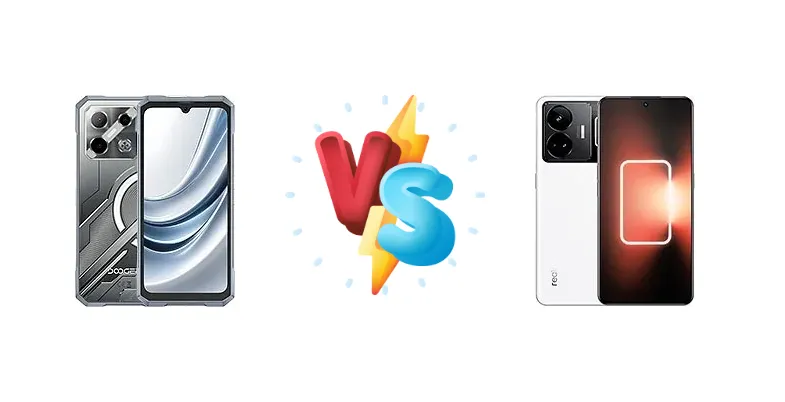
The smartphone landscape is increasingly segmented, with manufacturers focusing on distinct strengths. The Doogee Blade GT Pro carves a niche with its remarkable battery endurance, boasting a 35:55h rating and 1400 charge cycles. Conversely, the Realme GT3 aggressively targets charging speed, featuring a groundbreaking 240W wired charging capability. This comparison dissects these contrasting philosophies to determine which device delivers the best overall user experience.
🏆 Quick Verdict
For the average user prioritizing longevity and minimizing charging anxiety, the Doogee Blade GT Pro is the clear winner. Its exceptional battery life and robust charging cycle count outweigh the Realme GT3’s faster charging, especially considering the GT3’s significantly shorter endurance rating of just 117h.
| Network |
|---|
| 2G bands | GSM 850 / 900 / 1800 / 1900 | GSM 850 / 900 / 1800 / 1900 |
| 3G bands | HSDPA 850 / 900 / 1700(AWS) / 1900 / 2100 | HSDPA 850 / 900 / 1700(AWS) / 1900 / 2100 |
| 4G bands | 1, 2, 3, 4, 5, 7, 8, 12, 17, 18, 19, 20, 25, 26, 28, 34, 38, 39, 40, 41, 66 | LTE |
| 5G bands | 1, 3, 7, 28, 38, 41, 77, 78, 79 SA/NSA | SA/NSA |
| Speed | HSPA, LTE, 5G | HSPA, LTE, 5G |
| Technology | GSM / HSPA / LTE / 5G | GSM / HSPA / LTE / 5G |
| Launch |
|---|
| Announced | 2025, June | 2023, February 28 |
| Status | Available. Released 2025, June | Available. Released 2023, July 08 |
| Body |
|---|
| Build | - | Glass front, plastic frame, glass back |
| Dimensions | 178.5 x 83.5 x 10.5 mm (7.03 x 3.29 x 0.41 in) | 163.9 x 75.8 x 8.9 mm (6.45 x 2.98 x 0.35 in) |
| SIM | Nano-SIM + Nano-SIM | Nano-SIM + Nano-SIM |
| Weight | 265 g (9.35 oz) | 199 g (7.02 oz) |
| | - | Illuminated RGB (on the back) |
| Display |
|---|
| Protection | Mohs level 6 | - |
| Resolution | 1080 x 2400 pixels, 20:9 ratio (~392 ppi density) | 1240 x 2772 pixels, 20:9 ratio (~451 ppi density) |
| Size | 6.72 inches, 109.0 cm2 (~73.1% screen-to-body ratio) | 6.74 inches, 109.2 cm2 (~87.9% screen-to-body ratio) |
| Type | IPS LCD, 120Hz | AMOLED, 1B colors, 144Hz, HDR10+, 500 nits (typ), 1100 nits (HBM), 1400 nits (peak) |
| Platform |
|---|
| CPU | Octa-core (2x2.5 GHz Cortex-A78 & 6x2.0 GHz Cortex-A55) | Octa-core (1x3.0 GHz Cortex-X2 & 3x2.5 GHz Cortex-A710 & 4x1.80 GHz Cortex-A510) |
| Chipset | Mediatek Dimensity 7025 (6 nm) | Qualcomm SM8475 Snapdragon 8+ Gen 1 (4 nm) |
| GPU | IMG BXM-8-256 | Adreno 730 |
| OS | Android 14 | Android 13, upgradable to Android 14, Realme UI 5.0 |
| Memory |
|---|
| Card slot | microSDXC (uses shared SIM slot) | No |
| Internal | 512GB 12GB RAM | 128GB 8GB RAM, 256GB 12GB RAM, 256GB 16GB RAM, 512GB 16GB RAM, 1TB 16GB RAM |
| | - | UFS 3.1 |
| Main Camera |
|---|
| Features | Dual-LED flash, HDR, panorama | Dual-LED dual-tone flash, HDR, panorama |
| Single | - | 16 MP, f/2.5, 25mm (wide), 1/3.09", 1.0µm |
| Triple | 100 MP, f/1.8, (wide), PDAF
8 MP, f/2.2, 112˚ (ultrawide)
2 MP (macro) | 50 MP, f/1.9, 24mm (wide), 1/1.56", 1.0µm, PDAF, OIS
8 MP, f/2.2, 16mm, 112˚ (ultrawide), 1/4.0", 1.12µm
2 MP, f/3.3, 20mm (microscope) |
| Video | 1440p@30fps, 1080p@30fps | 4K@30/60fps, 1080p@30/60fps, gyro-EIS |
| Selfie camera |
|---|
| Features | - | HDR, panorama |
| Single | 32 MP, f/2.3, (wide), 1/2.8" | 16 MP, f/2.5, 25mm (wide), 1/3.09", 1.0µm |
| Video | 1080p@30fps | 1080p@30fps, gyro-EIS |
| Sound |
|---|
| 3.5mm jack | - | No |
| 35mm jack | No | No |
| Loudspeaker | Yes | Yes, with stereo speakers |
| | - | 24-bit/192kHz audio |
| Comms |
|---|
| Bluetooth | 5.2, A2DP, LE | 5.3, A2DP, LE, aptX HD |
| Infrared port | - | Yes |
| NFC | Yes | Yes (dual side) |
| Positioning | GPS, GLONASS, GALILEO, BDS | GPS (L1+L5), GLONASS, BDS, GALILEO, QZSS |
| Radio | FM radio | No |
| USB | USB Type-C 2.0 | USB Type-C 2.0 |
| WLAN | Wi-Fi 802.11 a/b/g/n/ac, dual-band | Wi-Fi 802.11 a/b/g/n/ac, dual-band |
| Features |
|---|
| Sensors | Fingerprint (side-mounted), accelerometer, proximity, compass | Fingerprint (under display, optical), accelerometer, gyro, proximity, compass |
| Battery |
|---|
| Charging | 18W wired | 240W wired, PD, 50% in 4 min, 100% in 10 min |
| Type | 5800 mAh | 4600 mAh |
| Misc |
|---|
| Colors | Black, Silver | Pulse White, Booster Black |
| Models | - | RMX3709 |
| Price | About 340 EUR | About 600 EUR |
| Tests |
|---|
| Battery life | - |
Endurance rating 117h
|
| Camera | - |
Photo / Video |
| Display | - |
Contrast ratio: Infinite (nominal) |
| Loudspeaker | - |
-26.9 LUFS (Good)
|
| Performance | - |
AnTuTu: 1074427 (v9)
GeekBench: 3898 (v5.1), 3980 (v6)
GFXBench: 59fps (ES 3.1 onscreen) |
| EU LABEL |
|---|
| Battery | 35:55h endurance, 1400 cycles | - |
| Energy | Class E | - |
| Free fall | Class A (270 falls) | - |
| Repairability | Class C | - |
Doogee Blade GT Pro
- Exceptional battery life (35:55h endurance)
- High battery cycle count (1400 cycles)
- Efficient Dimensity 7025 chipset
- Display brightness data unavailable
- Camera specifications unknown
Realme GT3
- Blazing-fast 240W charging (100% in 10 minutes)
- Bright 974 nit display
- Powerful Snapdragon 8+ Gen 1 chipset
- Poor battery endurance (117h)
- Potentially shorter battery lifespan due to fast charging
Display Comparison
The Realme GT3 boasts a significantly brighter display, peaking at 974 nits, offering superior visibility in direct sunlight compared to the Doogee Blade GT Pro (brightness data unavailable). While the Doogee’s display specs are absent, the Realme’s infinite contrast ratio suggests a typical AMOLED panel. The Realme GT3’s brightness advantage is crucial for outdoor users and media consumers. The lack of detailed display information for the Doogee hinders a complete assessment, but the Realme clearly leads in this category.
Camera Comparison
Both devices are listed as having Photo/Video capabilities, but detailed camera specifications are lacking for both. Without sensor size, aperture, or image processing details, a meaningful comparison is impossible. However, given the Realme GT3’s positioning as a flagship-level device, it’s reasonable to expect a more sophisticated camera system with features like Optical Image Stabilization (OIS) and advanced computational photography. The Doogee Blade GT Pro likely focuses on providing a functional camera experience rather than competing at the high end of the market.
Performance
The Realme GT3’s Qualcomm Snapdragon 8+ Gen 1 (4nm) represents a substantial performance leap over the Doogee Blade GT Pro’s MediaTek Dimensity 7025 (6nm). The Snapdragon 8+ Gen 1’s Cortex-X2 prime core, clocked at 3.0 GHz, and more efficient 4nm process deliver superior CPU and GPU performance, particularly in demanding tasks like gaming and video editing. The Dimensity 7025, while capable, is geared towards efficiency rather than raw power. The Realme GT3 will offer a smoother experience with graphically intensive applications and maintain higher frame rates during gaming. The 6nm process of the Dimensity 7025 will likely result in slightly higher temperatures under sustained load.
Battery Life
The Doogee Blade GT Pro’s 35:55h endurance rating is a standout feature, dwarfing the Realme GT3’s 117h rating. This translates to significantly longer usage between charges. While the Realme GT3 compensates with its 240W wired charging – achieving 50% charge in 4 minutes and 100% in 10 minutes – this speed is less valuable if the battery drains quickly. The Doogee also boasts an impressive 1400 charge cycles, indicating exceptional long-term battery health. The Realme GT3’s charging speed is undeniably impressive, but the Doogee’s endurance and longevity provide a more practical benefit for most users.
Buying Guide
Buy the Doogee Blade GT Pro if you need a phone that can reliably last through multiple days of moderate use, or if you frequently travel and have limited access to power outlets. Its focus on battery health with 1400 cycles also ensures long-term usability. Buy the Realme GT3 if you absolutely prioritize the fastest possible charging speeds and are willing to compromise on battery endurance. This phone is ideal for users who frequently find themselves needing a quick power boost and don't mind charging multiple times a day.
Frequently Asked Questions
❓ How will the 240W charging of the Realme GT3 affect long-term battery health?
While 240W charging is incredibly fast, it can generate more heat, potentially accelerating battery degradation over time. Realme likely employs sophisticated charging algorithms to mitigate this, but the Doogee Blade GT Pro’s slower charging and higher cycle count suggest better long-term battery health.
❓ Is the Dimensity 7025 in the Doogee Blade GT Pro powerful enough for demanding games like Genshin Impact?
The Dimensity 7025 is a capable mid-range chipset, but it won’t deliver the same level of performance as the Snapdragon 8+ Gen 1 in the Realme GT3. Genshin Impact will likely be playable on medium settings, but users may experience occasional frame drops or reduced graphical fidelity.
❓ What type of user would benefit most from the Doogee Blade GT Pro's extended battery life?
The Doogee Blade GT Pro is ideal for travelers, outdoor enthusiasts, or anyone who frequently finds themselves away from power outlets. Its long endurance eliminates the need for constant charging, providing peace of mind and uninterrupted usage.
❓ Does the Realme GT3 support wireless charging, given its focus on wired charging speed?
Based on available information, the Realme GT3 does *not* support wireless charging. The device's design prioritizes the 240W wired charging technology, omitting wireless charging capabilities to maximize charging speed and efficiency.