
Doogee Blade GT Pro vs OnePlus 11R: A Deep Dive into Battery Life and Performance
| Phones Images | |||||
|---|---|---|---|---|---|
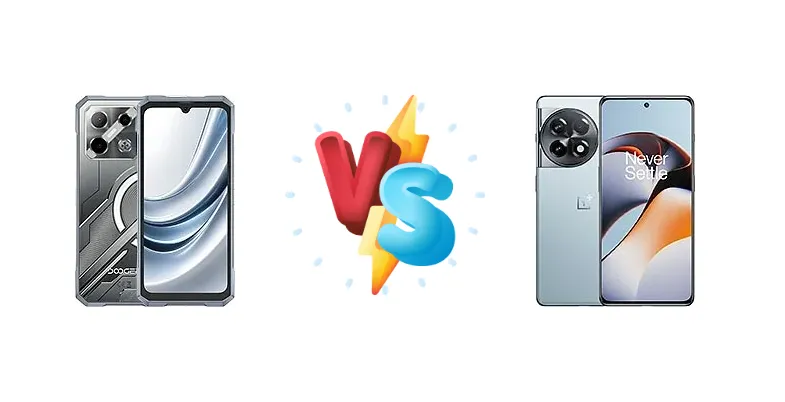
|
🏆 Quick Verdict
For the average user prioritizing longevity and consistent performance over peak speeds, the Doogee Blade GT Pro is the better choice. Its exceptional 35:55h battery endurance and 1400 charge cycles significantly outperform the OnePlus 11R, despite the latter's faster charging. However, gamers and power users will find the OnePlus 11R's Snapdragon 8+ Gen 1 more appealing.
| PHONES | ||
|---|---|---|
| Phone Names | Doogee Blade GT Pro | OnePlus 11R |
| Network | ||
|---|---|---|
| 2G bands | GSM 850 / 900 / 1800 / 1900 | GSM 850 / 900 / 1800 / 1900 |
| 3G bands | HSDPA 850 / 900 / 1700(AWS) / 1900 / 2100 | HSDPA 850 / 900 / 1700(AWS) / 2100 |
| 4G bands | 1, 2, 3, 4, 5, 7, 8, 12, 17, 18, 19, 20, 25, 26, 28, 34, 38, 39, 40, 41, 66 | 1, 3, 4, 5, 8, 28, 34, 38, 39, 40, 41 |
| 5G bands | 1, 3, 7, 28, 38, 41, 77, 78, 79 SA/NSA | 1, 3, 5, 8, 28, 40, 41, 77, 78 SA/NSA |
| Speed | HSPA, LTE, 5G | HSPA, LTE (3CA), 5G |
| Technology | GSM / HSPA / LTE / 5G | GSM / CDMA / HSPA / LTE / 5G |
| - | CDMA 800 | |
| Launch | ||
|---|---|---|
| Announced | 2025, June | 2023, February 07 |
| Status | Available. Released 2025, June | Available. Released 2023, February 21 |
| Body | ||
|---|---|---|
| Build | - | Glass front, glass back (Gorilla Glass 5), plastic frame |
| Dimensions | 178.5 x 83.5 x 10.5 mm (7.03 x 3.29 x 0.41 in) | 163.4 x 74.3 x 8.7 mm (6.43 x 2.93 x 0.34 in) |
| SIM | Nano-SIM + Nano-SIM | Nano-SIM + Nano-SIM |
| Weight | 265 g (9.35 oz) | 204 g (7.20 oz) |
| Display | ||
|---|---|---|
| Protection | Mohs level 6 | - |
| Resolution | 1080 x 2400 pixels, 20:9 ratio (~392 ppi density) | 1240 x 2772 pixels, 20:9 ratio (~451 ppi density) |
| Size | 6.72 inches, 109.0 cm2 (~73.1% screen-to-body ratio) | 6.74 inches, 109.2 cm2 (~90.0% screen-to-body ratio) |
| Type | IPS LCD, 120Hz | Fluid AMOLED, 1B colors, 120Hz, HDR10+, 1450 nits (peak) |
| Platform | ||
|---|---|---|
| CPU | Octa-core (2x2.5 GHz Cortex-A78 & 6x2.0 GHz Cortex-A55) | Octa-core (1x3.0 GHz Cortex-X2 & 3x2.5 GHz Cortex-A710 & 4x1.80 GHz Cortex-A510) |
| Chipset | Mediatek Dimensity 7025 (6 nm) | Qualcomm SM8475 Snapdragon 8+ Gen 1 (4 nm) |
| GPU | IMG BXM-8-256 | Adreno 730 |
| OS | Android 14 | Android 13, upgradable to Android 15, OxygenOS 15 |
| Memory | ||
|---|---|---|
| Card slot | microSDXC (uses shared SIM slot) | No |
| Internal | 512GB 12GB RAM | 128GB 8GB RAM, 256GB 16GB RAM, 512GB 18GB RAM |
| - | UFS 3.1 | |
| Main Camera | ||
|---|---|---|
| Features | Dual-LED flash, HDR, panorama | Color spectrum sensor, LED flash, HDR, panorama |
| Single | - | 16 MP, f/2.4, 24mm (wide), 1/3.09", 1.0µm |
| Triple | 100 MP, f/1.8, (wide), PDAF 8 MP, f/2.2, 112˚ (ultrawide) 2 MP (macro) | 50 MP, f/1.8, 24mm (wide), 1/1.56", 1.0µm, multi-directional PDAF, OIS 8 MP, f/2.2, 120˚ (ultrawide), 1/4.0", 1.12µm 2 MP (macro) |
| Video | 1440p@30fps, 1080p@30fps | 4K@30/60fps, 1080p@30/60/240fps, gyro-EIS |
| Selfie camera | ||
|---|---|---|
| Features | - | HDR |
| Single | 32 MP, f/2.3, (wide), 1/2.8" | 16 MP, f/2.4, 24mm (wide), 1/3.09", 1.0µm |
| Video | 1080p@30fps | 1080p@30fps |
| Sound | ||
|---|---|---|
| 3.5mm jack | - | No |
| 35mm jack | No | No |
| Loudspeaker | Yes | Yes, with stereo speakers |
| - | 24-bit/192kHz audio | |
| Comms | ||
|---|---|---|
| Bluetooth | 5.2, A2DP, LE | 5.3, A2DP, LE, aptX HD |
| Infrared port | - | Yes |
| NFC | Yes | Yes |
| Positioning | GPS, GLONASS, GALILEO, BDS | GPS (L1+L5), GLONASS (G1), BDS (B1I+B1c+B2a), GALILEO (E1+E5a), QZSS (L1+L5) |
| Radio | FM radio | No |
| USB | USB Type-C 2.0 | USB Type-C 2.0 |
| WLAN | Wi-Fi 802.11 a/b/g/n/ac, dual-band | Wi-Fi 802.11 a/b/g/n/ac/6, dual-band |
| Features | ||
|---|---|---|
| Sensors | Fingerprint (side-mounted), accelerometer, proximity, compass | Fingerprint (under display, optical), accelerometer, gyro, proximity, compass |
| Battery | ||
|---|---|---|
| Charging | 18W wired | 100W wired |
| Type | 5800 mAh | Li-Po 5000 mAh |
| Misc | ||
|---|---|---|
| Colors | Black, Silver | Galactic Silver, Sonic Black, Solar Red |
| Models | - | CPH2487 |
| Price | About 340 EUR | About 600 EUR |
| SAR | - | 1.16 W/kg (head) 0.61 W/kg (body) |
| EU LABEL | ||
|---|---|---|
| Battery | 35:55h endurance, 1400 cycles | - |
| Energy | Class E | - |
| Free fall | Class A (270 falls) | - |
| Repairability | Class C | - |
Doogee Blade GT Pro
- Exceptional battery life (35:55h endurance)
- Long battery lifespan (1400 charge cycles)
- Efficient Dimensity 7025 chipset
- Slow 18W charging
- Potentially less powerful camera system
- Limited display information
OnePlus 11R
- Flagship-level Snapdragon 8+ Gen 1 performance
- Ultra-fast 100W charging
- Likely superior camera capabilities
- Shorter battery life compared to Doogee
- Potentially more thermal throttling
- Lower battery cycle lifespan
Display Comparison
Neither device boasts a standout display. While specific display specs are missing for the Doogee Blade GT Pro, the OnePlus 11R is expected to feature a 120Hz AMOLED panel, common for its price bracket. The focus here isn't on display innovation, but rather on overall system efficiency. The Doogee's lower power chipset may contribute to better battery life even with a potentially less efficient display.
Camera Comparison
Without detailed camera specifications for the Doogee Blade GT Pro, a direct comparison is limited. However, the OnePlus 11R is likely to offer a more versatile camera system, typical of OnePlus flagships. The Snapdragon 8+ Gen 1’s ISP (Image Signal Processor) provides advanced image processing capabilities. While megapixel counts aren't everything, the OnePlus 11R likely benefits from superior image stabilization and low-light performance. We can assume the Doogee will offer a functional camera, but likely won't compete with the OnePlus in image quality.
Performance
The core difference lies in the chipsets. The OnePlus 11R’s Qualcomm Snapdragon 8+ Gen 1 (4nm) is a significant step up from the Doogee Blade GT Pro’s MediaTek Dimensity 7025 (6nm). The Snapdragon 8+ Gen 1 features a Cortex-X2 prime core clocked at 3.0 GHz, alongside Cortex-A710 and A510 cores, offering substantially higher peak performance. The Dimensity 7025, with its Cortex-A78 and A55 cores, is more focused on efficiency. This translates to smoother multitasking and gaming on the OnePlus 11R, but potentially shorter battery life. The 4nm process of the Snapdragon also contributes to better thermal efficiency, potentially mitigating throttling during sustained loads.
Battery Life
This is where the Doogee Blade GT Pro truly shines. Its 35:55h endurance is exceptional, indicating significantly longer usage between charges compared to the OnePlus 11R. While the OnePlus 11R boasts 100W wired charging – a massive advantage, allowing for a full charge in under 30 minutes – the Doogee’s 18W charging is comparatively slow. However, the Doogee compensates with a remarkable 1400 charge cycles, suggesting the battery will retain a higher capacity over the phone’s lifespan. The OnePlus 11R’s faster charging is convenient, but the Doogee’s longevity is a compelling long-term benefit.
Buying Guide
Buy the Doogee Blade GT Pro if you need a phone that can reliably last through two full days of moderate use, or if you frequently travel and have limited access to charging. Its focus on battery health with 1400 cycles also ensures long-term usability. Buy the OnePlus 11R if you prioritize demanding tasks like gaming, video editing, or running multiple apps simultaneously, and value the speed and responsiveness of a flagship-level processor, even at the cost of battery life.