
Doogee Blade GT Pro vs. Asus ROG Phone 7 Ultimate: A Deep Dive Comparison
| Phones Images | |||||
|---|---|---|---|---|---|
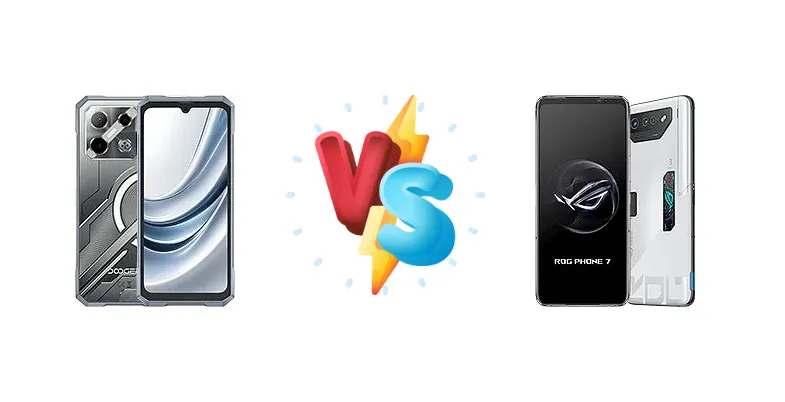
|
🏆 Quick Verdict
For the average user prioritizing longevity and value, the Doogee Blade GT Pro is the better choice, boasting an incredible 35:55h endurance. However, gamers and power users demanding the absolute best performance will find the Asus ROG Phone 7 Ultimate’s Snapdragon 8 Gen 2 and 65W charging to be worth the premium.
| PHONES | ||
|---|---|---|
| Phone Names | Doogee Blade GT Pro | Asus ROG Phone 7 Ultimate |
| Network | ||
|---|---|---|
| 2G bands | GSM 850 / 900 / 1800 / 1900 | GSM 850 / 900 / 1800 / 1900 |
| 3G bands | HSDPA 850 / 900 / 1700(AWS) / 1900 / 2100 | HSDPA 800 / 850 / 900 / 1700(AWS) / 1900 / 2100 |
| 4G bands | 1, 2, 3, 4, 5, 7, 8, 12, 17, 18, 19, 20, 25, 26, 28, 34, 38, 39, 40, 41, 66 | 1, 2, 3, 4, 5, 7, 8, 12, 17, 18, 19, 20, 25, 26, 28, 32, 34, 38, 39, 40, 41, 42, 43, 48, 66 - International |
| 5G bands | 1, 3, 7, 28, 38, 41, 77, 78, 79 SA/NSA | 1, 2, 3, 5, 7, 8, 12, 18, 20, 25, 26, 28, 38, 40, 41, 48, 66, 77, 78, 79 SA/NSA/Sub6 - International |
| Speed | HSPA, LTE, 5G | HSPA, LTE (Up to 7CA), 5G |
| Technology | GSM / HSPA / LTE / 5G | GSM / CDMA / HSPA / LTE / 5G |
| - | 1, 3, 5, 8, 28, 41, 77, 78, 79 SA/NSA/Sub6 - China | |
| Launch | ||
|---|---|---|
| Announced | 2025, June | 2023, April 13 |
| Status | Available. Released 2025, June | Available. Released 2023, May |
| Body | ||
|---|---|---|
| Build | - | Glass front (Gorilla Glass Victus), glass back (Gorilla Glass 3), aluminum frame |
| Dimensions | 178.5 x 83.5 x 10.5 mm (7.03 x 3.29 x 0.41 in) | 173 x 77 x 10.3 mm (6.81 x 3.03 x 0.41 in) |
| SIM | Nano-SIM + Nano-SIM | Nano-SIM + Nano-SIM |
| Weight | 265 g (9.35 oz) | 239 g (8.43 oz) |
| - | Built-in motorized cooling air vent (AeroActive Portal) IP54 water resistant 2" OLED display (on the back) Pressure sensitive zones (Gaming triggers) | |
| Display | ||
|---|---|---|
| Protection | Mohs level 6 | Corning Gorilla Glass Victus |
| Resolution | 1080 x 2400 pixels, 20:9 ratio (~392 ppi density) | 1080 x 2448 pixels (~395 ppi density) |
| Size | 6.72 inches, 109.0 cm2 (~73.1% screen-to-body ratio) | 6.78 inches, 109.5 cm2 (~82.2% screen-to-body ratio) |
| Type | IPS LCD, 120Hz | AMOLED, 1B colors, 165Hz, HDR10+, 1000 nits (HBM), 1500 nits (peak) |
| Platform | ||
|---|---|---|
| CPU | Octa-core (2x2.5 GHz Cortex-A78 & 6x2.0 GHz Cortex-A55) | Octa-core (1x3.2 GHz Cortex-X3 & 2x2.8 GHz Cortex-A715 & 2x2.8 GHz Cortex-A710 & 3x2.0 GHz Cortex-A510) |
| Chipset | Mediatek Dimensity 7025 (6 nm) | Qualcomm SM8550-AB Snapdragon 8 Gen 2 (4 nm) |
| GPU | IMG BXM-8-256 | Adreno 740 |
| OS | Android 14 | Android 13, up to 2 major Android upgrades |
| Memory | ||
|---|---|---|
| Card slot | microSDXC (uses shared SIM slot) | No |
| Internal | 512GB 12GB RAM | 512GB 16GB RAM |
| - | UFS 4.0 NTFS support for external storage | |
| Main Camera | ||
|---|---|---|
| Features | Dual-LED flash, HDR, panorama | LED flash, HDR, panorama |
| Triple | 100 MP, f/1.8, (wide), PDAF 8 MP, f/2.2, 112˚ (ultrawide) 2 MP (macro) | 50 MP, f/1.9, 24mm (wide), 1/1.56", 1.0µm, PDAF 13 MP, f/2.2, 13mm, 120˚ (ultrawide) 5 MP (macro) |
| Video | 1440p@30fps, 1080p@30fps | 8K@24fps, 4K@30/60fps, 1080p@30/60/120/240fps, 720p@480fps; gyro-EIS, HDR10+ |
| Selfie camera | ||
|---|---|---|
| Features | - | Panorama, HDR |
| Single | 32 MP, f/2.3, (wide), 1/2.8" | 32 MP, f/2.5, 29mm (wide), 1/3.2", 0.7µm |
| Video | 1080p@30fps | 1080p@30fps |
| Sound | ||
|---|---|---|
| 3.5mm jack | - | Yes |
| 35mm jack | No | Yes |
| Loudspeaker | Yes | Yes, with stereo speakers (2 amplifiers) |
| - | 32-bit/384kHz audio | |
| Comms | ||
|---|---|---|
| Bluetooth | 5.2, A2DP, LE | 5.3, A2DP, LE, aptX HD, aptX Adaptive, aptX Lossless |
| NFC | Yes | Yes |
| Positioning | GPS, GLONASS, GALILEO, BDS | GPS (L1+L5), GLONASS (L1), BDS (B1I+B1c+B2a), GALILEO (E1+E5a), QZSS (L1+L5), NavIC (L5) |
| Radio | FM radio | No |
| USB | USB Type-C 2.0 | USB Type-C 3.1 (side), DisplayPort 1.4; USB Type-C 2.0 (bottom), OTG, accessory connector |
| WLAN | Wi-Fi 802.11 a/b/g/n/ac, dual-band | Wi-Fi 802.11 a/b/g/n/ac/6e/7, tri-band, Wi-Fi Direct |
| Features | ||
|---|---|---|
| Sensors | Fingerprint (side-mounted), accelerometer, proximity, compass | Fingerprint (under display, optical), accelerometer, gyro, proximity, compass |
| Battery | ||
|---|---|---|
| Charging | 18W wired | 65W wired, PD3.0, QC5, 100% in 42 min 10W reverse wired |
| Type | 5800 mAh | Li-Po 6000 mAh |
| Misc | ||
|---|---|---|
| Colors | Black, Silver | Storm White |
| Price | About 340 EUR | About 780 EUR |
| Tests | ||
|---|---|---|
| Battery life | - | Endurance rating 131h |
| Camera | - | Photo / Video |
| Display | - | Contrast ratio: Infinite (nominal) |
| Loudspeaker | - | -25.5 LUFS (Very good) |
| Performance | - | AnTuTu: 1325105 (v9) GeekBench: 5139 (v5.5), 5567 (v6) GFXBench: 107fps (ES 3.1 onscreen) |
| EU LABEL | ||
|---|---|---|
| Battery | 35:55h endurance, 1400 cycles | - |
| Energy | Class E | - |
| Free fall | Class A (270 falls) | - |
| Repairability | Class C | - |
Doogee Blade GT Pro
- Exceptional battery life (35:55h endurance)
- Long battery lifespan (1400 charge cycles)
- More affordable price point
- Slower charging speed (18W)
- Less powerful processor than the ROG Phone
Asus ROG Phone 7 Ultimate
- Flagship Snapdragon 8 Gen 2 performance
- Ultra-fast 65W charging (42 min to 100%)
- Brighter, higher-quality display
- Significantly shorter battery life (131h endurance)
- Higher price tag
Display Comparison
The Asus ROG Phone 7 Ultimate boasts a significantly brighter display, reaching a measured 1095 nits, crucial for outdoor visibility. While the Doogee Blade GT Pro’s display specs are not provided, the ROG Phone’s infinite contrast ratio suggests a superior viewing experience, particularly for HDR content. The ROG Phone likely utilizes an LTPO panel for adaptive refresh rates, further enhancing efficiency and smoothness, a feature absent in the Doogee based on its market positioning.
Camera Comparison
Both devices offer photo and video capabilities, but detailed camera specifications are limited for the Doogee. The Asus ROG Phone 7 Ultimate likely features a more sophisticated camera system, potentially with larger sensors and advanced image processing algorithms. Without specific details on the Doogee’s sensor size and aperture, it’s difficult to assess its low-light performance. The ROG Phone’s image stabilization (OIS) is likely superior, resulting in sharper photos and smoother videos.
Performance
The core difference lies in the chipsets. The Asus ROG Phone 7 Ultimate’s Snapdragon 8 Gen 2 (4nm) is a flagship processor with a Cortex-X3 prime core clocked at 3.2 GHz, offering a substantial performance advantage over the Doogee’s Mediatek Dimensity 7025 (6nm). The Snapdragon 8 Gen 2’s architecture – Cortex-A715, A710, and A510 cores – is designed for sustained performance and efficiency. The Dimensity 7025, while capable, is geared towards a more balanced experience. The ROG Phone’s LPDDR5x RAM further contributes to faster data transfer speeds, crucial for demanding games. Thermal management will be a key differentiator; the ROG Phone’s advanced cooling system is designed to prevent throttling during extended gaming sessions, something the Doogee may struggle with.
Battery Life
The Doogee Blade GT Pro shines in battery endurance, achieving an impressive 35:55h rating. This is significantly longer than the Asus ROG Phone 7 Ultimate’s 131h. However, the ROG Phone compensates with much faster 65W wired charging (100% in 42 minutes) and reverse wired charging. The Doogee’s 18W charging is comparatively slow. The Doogee’s 1400 charge cycles also suggest a longer lifespan for the battery itself, mitigating degradation over time. The ROG Phone’s higher power draw from the Snapdragon 8 Gen 2 will inevitably impact battery life, despite its capacity.
Buying Guide
Buy the Doogee Blade GT Pro if you need a phone that will reliably last through two full days of moderate use, and value long-term battery health with its 1400 charge cycles. Buy the Asus ROG Phone 7 Ultimate if you prioritize peak gaming performance, rapid charging (fully charged in 42 minutes), and are willing to accept a shorter battery lifespan in exchange for uncompromising power.