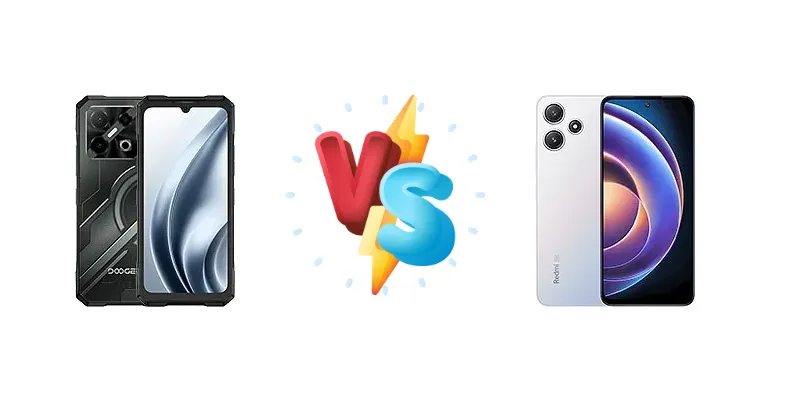
The sub-$200 smartphone market is fiercely competitive. The Doogee Blade GT Play and Xiaomi Redmi Note 12R both aim to deliver a compelling experience without breaking the bank, but they take different approaches. The Doogee prioritizes raw processing power with its Dimensity 7025, while the Redmi Note 12R focuses on efficiency with the Snapdragon 4 Gen 2. This comparison will dissect their strengths and weaknesses to determine which device offers the best value.
🏆 Quick Verdict
For users prioritizing sustained performance in demanding apps and games, the Doogee Blade GT Play is the better choice, thanks to its more powerful Dimensity 7025 chipset and impressive 35:55h battery endurance. However, the Redmi Note 12R offers a more efficient processor and PD charging, making it a solid option for everyday tasks.
| Network |
|---|
| 2G bands | GSM 850 / 900 / 1800 / 1900 | GSM 850 / 900 / 1800 / 1900 |
| 3G bands | HSDPA 850 / 900 / 1700(AWS) / 1900 / 2100 | HSDPA 850 / 900 / 2100 |
| 4G bands | 1, 2, 3, 4, 5, 7, 8, 12, 17, 18, 19, 20, 25, 26, 28, 34, 38, 39, 40, 41, 66 | 1, 3, 5, 8, 34, 38, 39, 40, 41 |
| 5G bands | 1, 3, 7, 28, 38, 41, 77, 78, 79 SA/NSA | 1, 5, 8, 28, 41, 78 SA/NSA |
| Speed | HSPA, LTE, 5G | HSPA, LTE, 5G |
| Technology | GSM / HSPA / LTE / 5G | GSM / CDMA / HSPA / EVDO / LTE / 5G |
| Launch |
|---|
| Announced | 2025, June | 2023, June 28 |
| Status | Available. Released 2025, June | Available. Released 2023, June 28 |
| Body |
|---|
| Build | - | Glass front, plastic frame, glass back |
| Dimensions | 178.5 x 83.5 x 10.5 mm (7.03 x 3.29 x 0.41 in) | 168.6 x 76.3 x 8.2 mm (6.64 x 3.00 x 0.32 in) |
| SIM | Nano-SIM + Nano-SIM | Nano-SIM + Nano-SIM |
| Weight | 265 g (9.35 oz) | 199 g (7.02 oz) |
| Display |
|---|
| Protection | Mohs level 6 | - |
| Resolution | 1080 x 2400 pixels, 20:9 ratio (~392 ppi density) | 1080 x 2460 pixels (~396 ppi density) |
| Size | 6.72 inches, 109.0 cm2 (~73.1% screen-to-body ratio) | 6.79 inches, 109.5 cm2 (~85.1% screen-to-body ratio) |
| Type | IPS LCD, 120Hz | IPS LCD, 90Hz, 550 nits |
| Platform |
|---|
| CPU | Octa-core (2x2.5 GHz Cortex-A78 & 6x2.0 GHz Cortex-A55) | Octa-core (2x2.2 GHz Cortex-A78 & 6x1.95 GHz Cortex-A55) |
| Chipset | Mediatek Dimensity 7025 (6 nm) | Qualcomm SM4450 Snapdragon 4 Gen 2 (4 nm) |
| GPU | IMG BXM-8-256 | Adreno 613 |
| OS | Android 14 | Android 13, MIUI 14 |
| Memory |
|---|
| Card slot | microSDXC (uses shared SIM slot) | microSDXC (uses shared SIM slot) |
| Internal | 256GB 8GB RAM | 128GB 4GB RAM, 128GB 6GB RAM, 128GB 8GB RAM, 256GB 8GB RAM |
| Main Camera |
|---|
| Dual | 50 MP, f/1.8, (wide), PDAF
2 MP (macro) | 50 MP, f/1.8, (wide), PDAF
2 MP (macro) |
| Features | Dual-LED flash, HDR, panorama | LED flash, HDR |
| Video | 1440p@30fps, 1080p@30fps | 1080p@30fps |
| Selfie camera |
|---|
| Features | - | HDR |
| Single | 16 MP, f/2.3, (wide) | 5 MP, f/2.2, (wide), 1/5.0", 1.12µm |
| Video | 1080p@30fps | 1080p@30fps |
| Sound |
|---|
| 35mm jack | No | Yes |
| Loudspeaker | Yes | Yes |
| Comms |
|---|
| Bluetooth | 5.2, A2DP, LE | 5.3, A2DP, LE |
| Infrared port | - | Yes |
| NFC | Yes | Yes (market/region dependent) |
| Positioning | GPS, GLONASS, GALILEO, BDS | GPS, GLONASS, GALILEO, BDS |
| Radio | FM radio | No |
| USB | USB Type-C 2.0 | USB Type-C |
| WLAN | Wi-Fi 802.11 a/b/g/n/ac, dual-band | Wi-Fi 802.11 a/b/g/n/ac, dual-band |
| Features |
|---|
| Sensors | Fingerprint (side-mounted), accelerometer, proximity, compass | Fingerprint (side-mounted), accelerometer, compass |
| Battery |
|---|
| Charging | 18W wired | 18W wired, PD |
| Type | 5800 mAh | Li-Po 5000 mAh |
| Misc |
|---|
| Colors | Black, Silver | Black, Blue, Silver |
| Models | - | 23076RA4BC |
| Price | About 320 EUR | About 150 EUR |
| EU LABEL |
|---|
| Battery | 35:55h endurance, 1400 cycles | - |
| Energy | Class E | - |
| Free fall | Class A (270 falls) | - |
| Repairability | Class C | - |
Doogee Blade GT Play
- More powerful Dimensity 7025 chipset for better performance
- Exceptional 35:55h battery endurance
- Advertised 1400 charge cycles for extended battery lifespan
- 6nm process may result in slightly higher heat output
- Charging limited to 18W without PD support
Xiaomi Redmi Note 12R
- More efficient Snapdragon 4 Gen 2 chipset
- Power Delivery (PD) charging support for faster charging with compatible chargers
- 4nm process for improved thermal management
- Less powerful chipset compared to the Dimensity 7025
- Shorter battery endurance compared to the Doogee
Display Comparison
Display specifications are absent from the provided data, but considering the price bracket, both devices likely feature LCD panels. The key differentiator will be resolution and refresh rate. However, the chipset's ability to drive a higher refresh rate smoothly will be more dependent on the Doogee's Dimensity 7025. Expect both to offer adequate viewing experiences for everyday use, but neither will likely compete with higher-end OLED displays.
Camera Comparison
Without detailed camera specifications, it’s difficult to make a definitive judgment. However, the chipset’s ISP (Image Signal Processor) plays a crucial role. The Dimensity 7025 generally offers more advanced image processing capabilities than the Snapdragon 4 Gen 2. This could translate to better dynamic range and low-light performance on the Doogee. The absence of information regarding sensor size and aperture makes a precise comparison impossible, but the Doogee’s more powerful chipset suggests a potential edge in image quality.
Performance
The core of the difference lies in the chipsets. The Doogee Blade GT Play’s Mediatek Dimensity 7025 (6nm) boasts a 2x2.5 GHz Cortex-A78 and 6x2.0 GHz Cortex-A55 configuration, offering a clear advantage in CPU-intensive tasks compared to the Xiaomi Redmi Note 12R’s Qualcomm SM4450 Snapdragon 4 Gen 2 (4nm) with its 2x2.2 GHz Cortex-A78 and 6x1.95 GHz Cortex-A55 setup. The 4nm process of the Snapdragon 4 Gen 2 should translate to better power efficiency, potentially leading to longer standby times. However, the Dimensity 7025’s higher clock speeds will likely result in superior performance in gaming and demanding applications. The Doogee's chipset is built on a 6nm process, while the Redmi Note 12R uses a more efficient 4nm process, suggesting the Redmi will run cooler under sustained load.
Battery Life
The Doogee Blade GT Play’s 35:55h endurance is a significant advantage. While both phones offer 18W wired charging, the Redmi Note 12R’s inclusion of Power Delivery (PD) allows for faster charging speeds with compatible chargers. However, the Doogee’s superior battery life means you’ll likely need to charge it less frequently. The 1400 charge cycles advertised for the Doogee suggest a focus on long-term battery health, potentially extending the device’s lifespan.
Buying Guide
Buy the Doogee Blade GT Play if you need a phone capable of handling graphically intensive games and multitasking without significant slowdown. Its Dimensity 7025 provides a noticeable performance edge. Buy the Xiaomi Redmi Note 12R if you prioritize all-day battery life with efficient power management and appreciate the convenience of Power Delivery (PD) charging for faster top-ups with compatible chargers.
Frequently Asked Questions
❓ Will the Doogee Blade GT Play overheat during extended gaming sessions?
While the Dimensity 7025 is a powerful chipset, the 6nm process may lead to higher temperatures under sustained load compared to the Redmi Note 12R's 4nm Snapdragon 4 Gen 2. However, the Doogee's larger battery capacity could help mitigate thermal throttling by distributing heat more effectively. Real-world testing would be needed to confirm the extent of any throttling.
❓ Does the Redmi Note 12R's Snapdragon 4 Gen 2 offer sufficient performance for popular social media apps and web browsing?
Absolutely. The Snapdragon 4 Gen 2 is more than capable of handling everyday tasks like social media, web browsing, and video streaming. Its efficiency will result in excellent battery life for these use cases, making it a great choice for users who prioritize simplicity and longevity over raw power.
❓ How long will it take to fully charge the Doogee Blade GT Play with the 18W charger?
Given the larger battery capacity and 18W charging, a full charge will likely take around 2.5 to 3 hours. While it lacks the faster charging speeds of PD-enabled devices, the Doogee's exceptional battery endurance means you won't need to charge it as frequently.