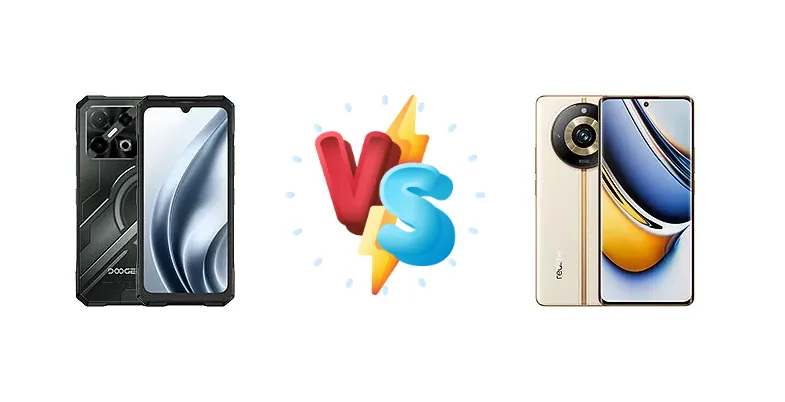
The Doogee Blade GT Play and Realme 11 Pro+ represent distinct approaches to the mid-range smartphone market. The Doogee prioritizes exceptional battery endurance, while the Realme 11 Pro+ focuses on rapid charging and a brighter display. This comparison dissects their key specifications to determine which device delivers the best overall experience.
🏆 Quick Verdict
For users prioritizing longevity and minimizing charging frequency, the Doogee Blade GT Play is the clear winner thanks to its remarkable 35:55h endurance. However, the Realme 11 Pro+ appeals to those who value a vibrant display and the convenience of 100W SuperVOOC charging.
| Network |
|---|
| 2G bands | GSM 850 / 900 / 1800 / 1900 | GSM 850 / 900 / 1800 / 1900 |
| 3G bands | HSDPA 850 / 900 / 1700(AWS) / 1900 / 2100 | HSDPA 850 / 900 / 2100 |
| 4G bands | 1, 2, 3, 4, 5, 7, 8, 12, 17, 18, 19, 20, 25, 26, 28, 34, 38, 39, 40, 41, 66 | 1, 3, 5, 8, 28, 38, 40, 41 - India |
| 5G bands | 1, 3, 7, 28, 38, 41, 77, 78, 79 SA/NSA | 1, 3, 5, 8, 28, 40, 41, 77, 78 SA/NSA - International |
| Speed | HSPA, LTE, 5G | HSPA, LTE, 5G |
| Technology | GSM / HSPA / LTE / 5G | GSM / CDMA / HSPA / CDMA2000 / LTE / 5G |
| | - | CDMA2000 1x |
| Launch |
|---|
| Announced | 2025, June | 2023, May 10 |
| Status | Available. Released 2025, June | Available. Released 2023, May 15 |
| Body |
|---|
| Build | - | Glass front, leather or plastic back, plastic frame |
| Dimensions | 178.5 x 83.5 x 10.5 mm (7.03 x 3.29 x 0.41 in) | 161.6 x 73.9 x 8.2 mm or 8.7 mm |
| SIM | Nano-SIM + Nano-SIM | Nano-SIM + Nano-SIM |
| Weight | 265 g (9.35 oz) | 183 g or 189 g (6.46 oz) |
| Display |
|---|
| Protection | Mohs level 6 | - |
| Resolution | 1080 x 2400 pixels, 20:9 ratio (~392 ppi density) | 1080 x 2412 pixels, 20:9 ratio (~394 ppi density) |
| Size | 6.72 inches, 109.0 cm2 (~73.1% screen-to-body ratio) | 6.7 inches, 108.0 cm2 (~90.5% screen-to-body ratio) |
| Type | IPS LCD, 120Hz | AMOLED, 1B colors, HDR10+, 120Hz, 950 nits (peak) |
| Platform |
|---|
| CPU | Octa-core (2x2.5 GHz Cortex-A78 & 6x2.0 GHz Cortex-A55) | Octa-core (2x2.6 GHz Cortex-A78 & 6x2.0 GHz Cortex-A55) |
| Chipset | Mediatek Dimensity 7025 (6 nm) | Mediatek Dimensity 7050 (6 nm) |
| GPU | IMG BXM-8-256 | Mali-G68 MC4 |
| OS | Android 14 | Android 13, up to 2 major Android upgrades, Realme UI 5.0 |
| Memory |
|---|
| Card slot | microSDXC (uses shared SIM slot) | No |
| Internal | 256GB 8GB RAM | 256GB 8GB RAM, 256GB 12GB RAM, 512GB 12GB RAM, 1TB 12GB RAM |
| Main Camera |
|---|
| Dual | 50 MP, f/1.8, (wide), PDAF
2 MP (macro) | - |
| Features | Dual-LED flash, HDR, panorama | LED flash, HDR, panorama |
| Triple | - | 200 MP, f/1.7, 23mm (wide), 1/1.4", 0.56µm, PDAF, OIS
8 MP, f/2.2, 16mm, 112˚ (ultrawide)
2 MP (macro) |
| Video | 1440p@30fps, 1080p@30fps | 4K@30fps, 1080p@30/60/120/480fps, 720p@960fps, gyro-EIS |
| Selfie camera |
|---|
| Features | - | Panorama |
| Single | 16 MP, f/2.3, (wide) | 32 MP, f/2.5, 22mm (wide) |
| Video | 1080p@30fps | 1080p@30fps |
| Sound |
|---|
| 3.5mm jack | - | No |
| 35mm jack | No | No |
| Loudspeaker | Yes | Yes, with stereo speakers |
| | - | 24-bit/192kHz audio |
| Comms |
|---|
| Bluetooth | 5.2, A2DP, LE | 5.2, A2DP, LE, aptX HD |
| NFC | Yes | Yes |
| Positioning | GPS, GLONASS, GALILEO, BDS | GPS, GLONASS, GALILEO, BDS, QZSS, NavIC |
| Radio | FM radio | No |
| USB | USB Type-C 2.0 | USB Type-C 2.0 |
| WLAN | Wi-Fi 802.11 a/b/g/n/ac, dual-band | Wi-Fi 802.11 a/b/g/n/ac/6, dual-band |
| Features |
|---|
| Sensors | Fingerprint (side-mounted), accelerometer, proximity, compass | Fingerprint (under display, optical), accelerometer, gyro, proximity, compass |
| Battery |
|---|
| Charging | 18W wired | 100W wired |
| Type | 5800 mAh | 5000 mAh |
| Misc |
|---|
| Colors | Black, Silver | Astral Black, Sunrise Beige, Oasis Green |
| Models | - | RMX3740, RMX3741 |
| Price | About 320 EUR | € 399.90 / ₹ 27,990 |
| EU LABEL |
|---|
| Battery | 35:55h endurance, 1400 cycles | - |
| Energy | Class E | - |
| Free fall | Class A (270 falls) | - |
| Repairability | Class C | - |
Doogee Blade GT Play
- Exceptional battery life (35:55h endurance)
- High battery cycle count (1400 cycles)
- Potentially lower price point
- Slow charging speed (18W)
- Limited display information
- Camera specifications unknown
Realme 11 Pro+
- Bright display (793 nits)
- Ultra-fast 100W charging
- Potentially better camera system
- Significantly lower battery endurance (112h)
- Faster battery degradation (likely)
- Higher price point (likely)
Display Comparison
The Realme 11 Pro+ boasts a significantly brighter display, peaking at 793 nits, which translates to superior visibility in direct sunlight. While the Doogee Blade GT Play’s display specifications are not provided, the Realme’s brightness advantage is substantial. This makes the Realme more suitable for outdoor photography and video consumption. The Realme likely utilizes an AMOLED panel, common in this price bracket, offering vibrant colors and deep blacks, while the Doogee’s panel type remains unknown. The lack of display specs for the Doogee makes a direct comparison difficult, but the Realme’s measured brightness is a clear advantage.
Camera Comparison
The Realme 11 Pro+ is positioned as a camera-focused device, though specific sensor details are missing. The Doogee Blade GT Play’s camera specifications are also absent. Without knowing sensor sizes, apertures, or image processing algorithms, a direct comparison is impossible. However, Realme typically emphasizes camera capabilities in its 'Pro+' series, suggesting a more sophisticated camera system than the Doogee. The absence of information on OIS (Optical Image Stabilization) for either device is a significant omission, impacting low-light photography and video stability. We can assume the Realme will offer more camera features and potentially better image quality, given its marketing focus.
Performance
Both devices utilize Mediatek Dimensity chips fabricated on a 6nm process, indicating similar efficiency. However, the Realme 11 Pro+ features the Dimensity 7050, with a slightly higher CPU clock speed (2.6 GHz vs 2.5 GHz on the Doogee’s Dimensity 7025). This marginal clock speed increase, coupled with potentially optimized GPU drivers, may result in slightly smoother performance in demanding games. Both CPUs share the same core configuration (2x Cortex-A78 & 6x Cortex-A55), suggesting similar multi-core performance. The Realme’s advantage will likely be most noticeable in sustained workloads where the slightly improved thermal headroom of the 7050 can be leveraged.
Battery Life
The Doogee Blade GT Play’s standout feature is its exceptional battery endurance, rated at 35:55 hours. This is dramatically higher than the Realme 11 Pro+'s reported 112 hours, though the Realme’s rating is likely based on a different testing methodology. The Realme compensates for its lower endurance with 100W SuperVOOC charging, allowing for a full charge in a fraction of the time compared to the Doogee’s 18W charging. The Doogee’s 1400 charge cycles suggest a longer lifespan for the battery itself, mitigating degradation over time. The Realme prioritizes convenience with ultra-fast charging, while the Doogee focuses on maximizing time between charges.
Buying Guide
Buy the Doogee Blade GT Play if you need a phone that can reliably last through two full days of moderate use, or if you frequently travel and have limited access to power outlets. Buy the Realme 11 Pro+ if you prefer a brighter, more visually engaging display and want the fastest possible charging speeds, even if it means charging more often.
Frequently Asked Questions
❓ How much faster is the 100W charging on the Realme 11 Pro+ compared to the 18W charging on the Doogee Blade GT Play?
The 100W charging on the Realme 11 Pro+ will drastically reduce charging times. While exact figures depend on battery level, it can likely charge from 0-100% in under 30 minutes, whereas the Doogee’s 18W charging will take several hours. This difference is significant for users who frequently need to top up their battery quickly.
❓ Does the Dimensity 7050 in the Realme 11 Pro+ offer a noticeable gaming performance improvement over the Dimensity 7025 in the Doogee Blade GT Play?
The performance difference will be subtle, but present. The slightly higher clock speed of the Dimensity 7050 (2.6 GHz vs 2.5 GHz) and potential GPU optimizations may result in a few extra frames per second in demanding games. However, both chips are capable of handling most mobile games at medium to high settings.
❓ Given the Doogee's exceptional battery life, will the battery health degrade significantly over time despite the 1400 charge cycles?
While 1400 charge cycles is a high number, battery degradation is inevitable. However, the Doogee's slower charging speed and lower overall usage (due to the long endurance) should contribute to a slower rate of degradation compared to the Realme 11 Pro+, which will be subjected to more frequent and faster charging cycles.