
Doogee Blade GT Play vs. Motorola Moto G Stylus 5G (2023): A Detailed Comparison
| Phones Images | |||||
|---|---|---|---|---|---|
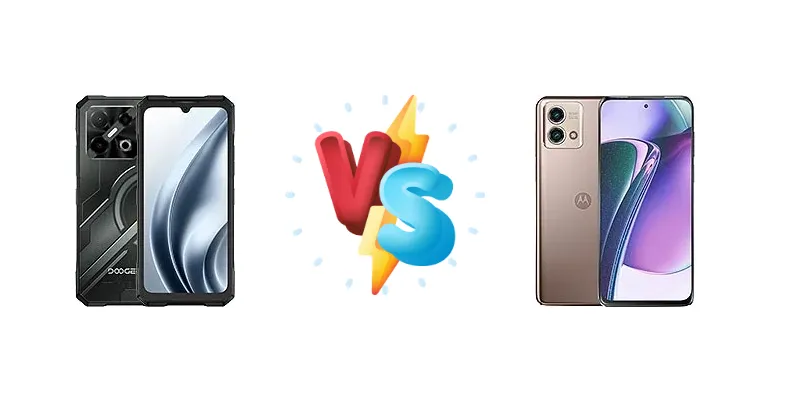
|
🏆 Quick Verdict
For users prioritizing sustained performance and exceptional battery life, the Doogee Blade GT Play emerges as the winner. Its Dimensity 7025 chipset and impressive 35:55h endurance outweigh the Moto G Stylus 5G's stylus and slightly faster charging, making it ideal for demanding users.
| PHONES | ||
|---|---|---|
| Phone Names | Doogee Blade GT Play | Motorola Moto G Stylus 5G (2023) |
| Network | ||
|---|---|---|
| 2G bands | GSM 850 / 900 / 1800 / 1900 | GSM 850 / 900 / 1800 / 1900 |
| 3G bands | HSDPA 850 / 900 / 1700(AWS) / 1900 / 2100 | HSDPA 850 / 900 / 1700(AWS) / 1900 / 2100 |
| 4G bands | 1, 2, 3, 4, 5, 7, 8, 12, 17, 18, 19, 20, 25, 26, 28, 34, 38, 39, 40, 41, 66 | 1, 2, 3, 4, 5, 7, 8, 12, 13, 14, 17, 18, 19, 20, 25, 26, 29, 30, 38, 39, 40, 41, 48, 66, 71 |
| 5G bands | 1, 3, 7, 28, 38, 41, 77, 78, 79 SA/NSA | 1, 2, 3, 5, 7, 12, 13, 14, 25, 26, 29, 30, 38, 41, 48, 66, 70, 71, 77, 78 SA/NSA |
| Speed | HSPA, LTE, 5G | HSPA, LTE, 5G |
| Technology | GSM / HSPA / LTE / 5G | GSM / HSPA / LTE / 5G |
| Launch | ||
|---|---|---|
| Announced | 2025, June | 2023, May 30 |
| Status | Available. Released 2025, June | Available. Released 2023, June 02 |
| Body | ||
|---|---|---|
| Build | - | Glass front, plastic frame, plastic back |
| Dimensions | 178.5 x 83.5 x 10.5 mm (7.03 x 3.29 x 0.41 in) | 162.8 x 73.8 x 9.2 mm (6.41 x 2.91 x 0.36 in) |
| SIM | Nano-SIM + Nano-SIM | Nano-SIM |
| Weight | 265 g (9.35 oz) | 202 g (7.13 oz) |
| Display | ||
|---|---|---|
| Protection | Mohs level 6 | - |
| Resolution | 1080 x 2400 pixels, 20:9 ratio (~392 ppi density) | 1080 x 2400 pixels, 20:9 ratio (~399 ppi density) |
| Size | 6.72 inches, 109.0 cm2 (~73.1% screen-to-body ratio) | 6.6 inches, 105.2 cm2 (~87.5% screen-to-body ratio) |
| Type | IPS LCD, 120Hz | IPS LCD, 120Hz |
| Platform | ||
|---|---|---|
| CPU | Octa-core (2x2.5 GHz Cortex-A78 & 6x2.0 GHz Cortex-A55) | Octa-core (4x2.2 GHz Cortex-A78 & 4x1.8 GHz Cortex-A55) |
| Chipset | Mediatek Dimensity 7025 (6 nm) | Qualcomm SM6450 Snapdragon 6 Gen 1 (4 nm) |
| GPU | IMG BXM-8-256 | Adreno 710 |
| OS | Android 14 | Android 13, planned upgrade to Android 14 |
| Memory | ||
|---|---|---|
| Card slot | microSDXC (uses shared SIM slot) | microSDXC (dedicated slot) |
| Internal | 256GB 8GB RAM | 64GB 4GB RAM, 128GB 4GB RAM, 128GB 6GB RAM, 256GB 6GB RAM |
| Main Camera | ||
|---|---|---|
| Dual | 50 MP, f/1.8, (wide), PDAF 2 MP (macro) | 50 MP, f/1.9, (wide), 1.0µm, PDAF 8 MP, f/2.2, (ultrawide), 1/4.0", 1.12µm, AF |
| Features | Dual-LED flash, HDR, panorama | LED flash, HDR, panorama |
| Video | 1440p@30fps, 1080p@30fps | 4K@30fps, 1080p@30/60fps |
| Selfie camera | ||
|---|---|---|
| Features | - | HDR |
| Single | 16 MP, f/2.3, (wide) | 16 MP, f/2.5, (wide), 1.0µm |
| Video | 1080p@30fps | 1080p@30fps |
| Sound | ||
|---|---|---|
| 35mm jack | No | Yes |
| Loudspeaker | Yes | Yes, with stereo speakers |
| Comms | ||
|---|---|---|
| Bluetooth | 5.2, A2DP, LE | 5.1, A2DP, LE |
| NFC | Yes | Yes |
| Positioning | GPS, GLONASS, GALILEO, BDS | GPS (L1+L5), GALILEO |
| Radio | FM radio | FM radio |
| USB | USB Type-C 2.0 | USB Type-C 2.0 |
| WLAN | Wi-Fi 802.11 a/b/g/n/ac, dual-band | Wi-Fi 802.11 a/b/g/n/ac, dual-band |
| Features | ||
|---|---|---|
| Sensors | Fingerprint (side-mounted), accelerometer, proximity, compass | Fingerprint (side-mounted), accelerometer, gyro, proximity, compass, barometer |
| Battery | ||
|---|---|---|
| Charging | 18W wired | 20W wired |
| Type | 5800 mAh | Li-Po 5000 mAh |
| Misc | ||
|---|---|---|
| Colors | Black, Silver | Cosmic Black, Rose Champagne |
| Models | - | XT2315-1, XT2315-4 |
| Price | About 320 EUR | $ 93.43 |
| EU LABEL | ||
|---|---|---|
| Battery | 35:55h endurance, 1400 cycles | - |
| Energy | Class E | - |
| Free fall | Class A (270 falls) | - |
| Repairability | Class C | - |
Doogee Blade GT Play
- Superior battery endurance (35:55h)
- Potentially higher peak CPU performance
- Longer battery lifespan (1400 cycles)
- Slower charging speed (18W)
- Less established brand reputation
Motorola Moto G Stylus 5G (2023)
- Integrated stylus for note-taking and creativity
- Faster charging (20W)
- Qualcomm’s software optimizations
- Shorter battery endurance
- Potentially lower peak CPU performance
Display Comparison
Display specifications are absent from the provided data, but considering the price points, both devices likely feature LCD panels. The key differentiator will be resolution and refresh rate. However, the chipset's ability to drive a higher refresh rate smoothly is where the Dimensity 7025 could have an advantage. The Motorola's software optimizations might prioritize stylus responsiveness, potentially impacting overall display performance.
Camera Comparison
Camera details are limited. Without sensor size or aperture information, it’s difficult to make a definitive judgment. However, the inclusion of a stylus with the Motorola suggests a potential focus on creative applications, which could translate to more robust image editing features. Both phones likely feature multi-camera setups, but the quality will heavily depend on the primary sensor and image processing algorithms. We can assume both will include standard wide, ultrawide, and potentially macro lenses, but the Doogee's processing power could allow for more complex computational photography.
Performance
The Doogee Blade GT Play’s Mediatek Dimensity 7025 (6nm) and its octa-core CPU (2x2.5 GHz Cortex-A78 & 6x2.0 GHz Cortex-A55) offer a theoretical performance edge over the Motorola’s Qualcomm SM6450 Snapdragon 6 Gen 1 (4nm) with its octa-core CPU (4x2.2 GHz Cortex-A78 & 4x1.8 GHz Cortex-A55). The 6nm process of the Dimensity 7025 is less efficient than the 4nm process of the Snapdragon, but the higher clock speeds of the A78 cores in the Doogee may compensate. The Snapdragon 6 Gen 1 benefits from Qualcomm’s established software optimizations, potentially leading to smoother day-to-day performance despite the slightly lower clock speeds. The Doogee's CPU configuration suggests a stronger focus on peak performance, while the Motorola aims for sustained efficiency.
Battery Life
The Doogee Blade GT Play boasts a remarkable 35:55h endurance and a 1400 cycle lifespan, indicating exceptional battery performance and longevity. While the Motorola Moto G Stylus 5G (2023) offers 20W wired charging, slightly faster than the Doogee’s 18W, the Doogee’s superior endurance likely means users will charge less frequently. The 1400 cycle lifespan suggests the Doogee’s battery will retain its capacity for a longer period, offering a better long-term investment.
Buying Guide
Buy the Doogee Blade GT Play if you need a phone capable of handling demanding tasks like gaming and video editing, and value long-lasting battery life above all else. Buy the Motorola Moto G Stylus 5G (2023) if you frequently take notes, sketch, or navigate with a stylus, and prefer a more mainstream brand with a focus on user-friendly software.