
Doogee Blade GT Play vs. Infinix Note 30 Pro: A Detailed Comparison
| Phones Images | |||||
|---|---|---|---|---|---|
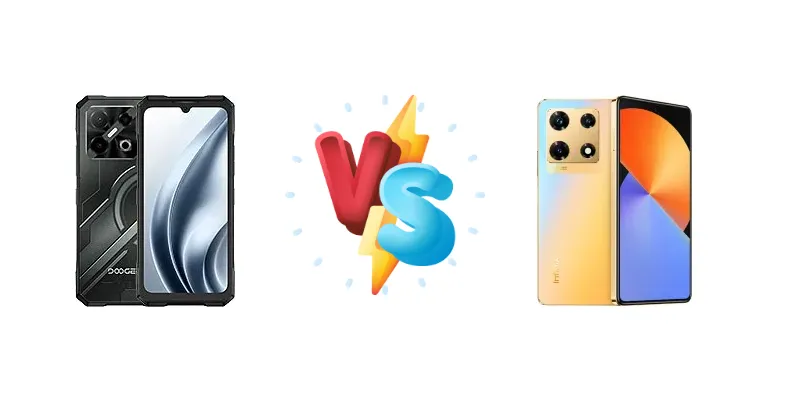
|
🏆 Quick Verdict
For the average user prioritizing convenience, the Infinix Note 30 Pro is the better choice. Its 68W charging, including wireless options, significantly reduces downtime. However, users demanding peak CPU performance for demanding tasks or gaming will find the Doogee Blade GT Play’s Dimensity 7025 a more suitable option.
| PHONES | ||
|---|---|---|
| Phone Names | Doogee Blade GT Play | Infinix Note 30 Pro |
| Network | ||
|---|---|---|
| 2G bands | GSM 850 / 900 / 1800 / 1900 | GSM 850 / 900 / 1800 / 1900 |
| 3G bands | HSDPA 850 / 900 / 1700(AWS) / 1900 / 2100 | HSDPA 850 / 900 / 1700(AWS) / 1900 / 2100 |
| 4G bands | 1, 2, 3, 4, 5, 7, 8, 12, 17, 18, 19, 20, 25, 26, 28, 34, 38, 39, 40, 41, 66 | 1, 2, 3, 4, 5, 7, 8, 12, 17, 20, 28, 38, 40, 41, 66 |
| 5G bands | 1, 3, 7, 28, 38, 41, 77, 78, 79 SA/NSA | - |
| Speed | HSPA, LTE, 5G | HSPA, LTE |
| Technology | GSM / HSPA / LTE / 5G | GSM / HSPA / LTE |
| Launch | ||
|---|---|---|
| Announced | 2025, June | 2023, May 22 |
| Status | Available. Released 2025, June | Available. Released 2023, May 22 |
| Body | ||
|---|---|---|
| Build | - | Glass front, plastic frame, glass back |
| Dimensions | 178.5 x 83.5 x 10.5 mm (7.03 x 3.29 x 0.41 in) | 162.7 x 76 x 8.2 mm (6.41 x 2.99 x 0.32 in) |
| SIM | Nano-SIM + Nano-SIM | Nano-SIM + Nano-SIM |
| Weight | 265 g (9.35 oz) | 203 g (7.16 oz) |
| - | IP53 | |
| Display | ||
|---|---|---|
| Protection | Mohs level 6 | - |
| Resolution | 1080 x 2400 pixels, 20:9 ratio (~392 ppi density) | 1080 x 2400 pixels, 20:9 ratio (~395 ppi density) |
| Size | 6.72 inches, 109.0 cm2 (~73.1% screen-to-body ratio) | 6.67 inches, 107.4 cm2 (~86.9% screen-to-body ratio) |
| Type | IPS LCD, 120Hz | AMOLED, 1B colors, 120Hz, 900 nits (peak) |
| - | * the display diagonal size and resolution is unconfirmed | |
| Platform | ||
|---|---|---|
| CPU | Octa-core (2x2.5 GHz Cortex-A78 & 6x2.0 GHz Cortex-A55) | Octa-core (2x2.2 GHz Cortex-A76 & 6x2.0 GHz Cortex-A55) |
| Chipset | Mediatek Dimensity 7025 (6 nm) | Mediatek Helio G99 (6 nm) |
| GPU | IMG BXM-8-256 | Mali-G57 MC2 |
| OS | Android 14 | Android 13, XOS 13 |
| Memory | ||
|---|---|---|
| Card slot | microSDXC (uses shared SIM slot) | microSDXC (dedicated slot) |
| Internal | 256GB 8GB RAM | 256GB 8GB RAM |
| Main Camera | ||
|---|---|---|
| Dual | 50 MP, f/1.8, (wide), PDAF 2 MP (macro) | - |
| Features | Dual-LED flash, HDR, panorama | Quad-LED flash, HDR, panorama |
| Triple | - | 108 MP, (wide), 1/1.67", PDAF 2 MP (macro) Auxiliary lens |
| Video | 1440p@30fps, 1080p@30fps | 1440p@30fps, 1080p@30fps |
| Selfie camera | ||
|---|---|---|
| Features | - | LED flash, HDR |
| Single | 16 MP, f/2.3, (wide) | 32 MP, f/2.0, (wide), 1/2.8" |
| Video | 1080p@30fps | 1080p@30fps |
| Sound | ||
|---|---|---|
| 3.5mm jack | - | Yes |
| 35mm jack | No | Yes |
| Loudspeaker | Yes | Yes, with dual speakers |
| - | Sound by JBL 24-bit/192kHz audio | |
| Comms | ||
|---|---|---|
| Bluetooth | 5.2, A2DP, LE | Yes |
| NFC | Yes | Yes (market/region dependent) |
| Positioning | GPS, GLONASS, GALILEO, BDS | GPS |
| Radio | FM radio | FM radio |
| USB | USB Type-C 2.0 | USB Type-C 2.0, OTG |
| WLAN | Wi-Fi 802.11 a/b/g/n/ac, dual-band | Wi-Fi 802.11 a/b/g/n/ac, dual-band, Wi-Fi Direct |
| Features | ||
|---|---|---|
| Sensors | Fingerprint (side-mounted), accelerometer, proximity, compass | Fingerprint (side-mounted), accelerometer, gyro, proximity, compass |
| Battery | ||
|---|---|---|
| Charging | 18W wired | 68W wired, PD3.0, 80% in 30 min 15W wireless Reverse wireless |
| Type | 5800 mAh | 5000 mAh |
| Misc | ||
|---|---|---|
| Colors | Black, Silver | Magic Black, Variable Gold |
| Models | - | X678B |
| Price | About 320 EUR | - |
| EU LABEL | ||
|---|---|---|
| Battery | 35:55h endurance, 1400 cycles | - |
| Energy | Class E | - |
| Free fall | Class A (270 falls) | - |
| Repairability | Class C | - |
Doogee Blade GT Play
- More powerful CPU for demanding tasks
- Longer battery lifespan (1400 cycles)
- Excellent battery endurance (35:55h)
- Slow 18W charging
- Lacks wireless charging
Infinix Note 30 Pro
- Ultra-fast 68W wired charging (80% in 30 min)
- Wireless charging and reverse wireless charging
- Convenient for on-the-go users
- Less powerful CPU compared to Doogee
- Battery cycle count likely lower than Doogee
Display Comparison
Display specifications are not provided, so a direct comparison is limited. However, given the price points, both likely utilize IPS LCD panels. The focus here shifts to processing power. The Doogee Blade GT Play’s Dimensity 7025, fabricated on a 6nm process, will likely offer better sustained performance than the Infinix Note 30 Pro’s Helio G99, also 6nm, due to its more advanced CPU core configuration.
Camera Comparison
Camera details are absent, making a detailed comparison impossible. However, considering the market segment, both phones likely feature a primary camera around the 50MP mark. Image processing will be a key differentiator, and brand reputation suggests Infinix may offer more aggressive post-processing for vibrant, social media-ready images. Without sensor size or aperture information, it’s difficult to assess low-light performance.
Performance
The core difference lies in the chipsets. The Doogee Blade GT Play’s Mediatek Dimensity 7025 features a dual-core setup with 2x2.5 GHz Cortex-A78 cores and 6x2.0 GHz Cortex-A55 cores. This contrasts with the Infinix Note 30 Pro’s Helio G99, which uses 2x2.2 GHz Cortex-A76 cores and 6x2.0 GHz Cortex-A55 cores. The Cortex-A78 cores in the Doogee represent a generational improvement over the A76, translating to faster single-core and multi-core performance. This will be noticeable in app launch times, multitasking, and graphically intensive games. While both use 6nm fabrication, the architectural advantage favors the Doogee.
Battery Life
The Doogee Blade GT Play boasts an impressive 35:55h endurance rating and a 1400 cycle battery lifespan, suggesting a focus on longevity. The Infinix Note 30 Pro, while lacking endurance data, compensates with significantly faster charging. Its 68W wired charging can reach 80% in just 30 minutes, a substantial advantage over the Doogee’s 18W charging. The inclusion of 15W wireless charging and reverse wireless charging further enhances the Infinix’s convenience factor. The Doogee’s longer cycle count suggests a more durable battery over the long term, but the Infinix mitigates this with its rapid recharge capability.
Buying Guide
Buy the Doogee Blade GT Play if you need a phone capable of handling demanding applications and sustained gaming sessions, and are willing to trade off ultra-fast charging. Its Dimensity 7025 chipset provides a noticeable performance edge. Buy the Infinix Note 30 Pro if you prioritize convenience and quick top-ups. The 68W charging and wireless charging capabilities are ideal for users who are always on the go and dislike being tethered to a wall.