
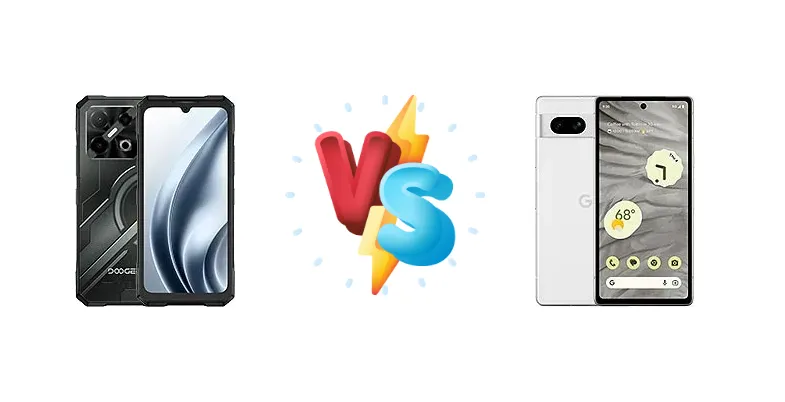
Doogee Blade GT Play vs. Google Pixel 7a: A Detailed Comparison
| Phones Images | |||||
|---|---|---|---|---|---|
|
🏆 Quick Verdict
For the average user prioritizing camera quality, software support, and a refined user experience, the Google Pixel 7a is the clear winner. However, the Doogee Blade GT Play offers compelling battery endurance and a potentially smoother gaming experience due to its CPU architecture, making it a strong contender for budget-conscious users.
| PHONES | ||
|---|---|---|
| Phone Names | Doogee Blade GT Play | Google Pixel 7a |
| Network | ||
|---|---|---|
| 2G bands | GSM 850 / 900 / 1800 / 1900 | GSM 850 / 900 / 1800 / 1900 |
| 3G bands | HSDPA 850 / 900 / 1700(AWS) / 1900 / 2100 | HSDPA 800 / 850 / 900 / 1700(AWS) / 1900 / 2100 |
| 4G bands | 1, 2, 3, 4, 5, 7, 8, 12, 17, 18, 19, 20, 25, 26, 28, 34, 38, 39, 40, 41, 66 | 1, 2, 3, 4, 5, 7, 8, 12, 13, 14, 17, 20, 25, 26, 28, 29, 30, 38, 40, 41, 48, 66, 71 - GWKK3, G0DZQ |
| 5G bands | 1, 3, 7, 28, 38, 41, 77, 78, 79 SA/NSA | 1, 2, 3, 5, 7, 8, 12, 14, 20, 25, 28, 30, 38, 41, 48, 66, 71, 77, 78 SA/NSA/Sub6 - GWKK3 |
| Speed | HSPA, LTE, 5G | HSPA, LTE, 5G |
| Technology | GSM / HSPA / LTE / 5G | GSM / HSPA / LTE / 5G |
| - | 1, 2, 3, 5, 7, 8, 12, 20, 25, 28, 38, 40, 41, 66, 75, 76, 77, 78, 79 SA/NSA/Sub6 - GHL1X, G82U8 | |
| Launch | ||
|---|---|---|
| Announced | 2025, June | 2023, May 10 |
| Status | Available. Released 2025, June | Available. Released 2023, May 10 |
| Body | ||
|---|---|---|
| Build | - | Glass front (Gorilla Glass 3), aluminum frame, plastic back |
| Dimensions | 178.5 x 83.5 x 10.5 mm (7.03 x 3.29 x 0.41 in) | 152 x 72.9 x 9 mm (5.98 x 2.87 x 0.35 in) |
| SIM | Nano-SIM + Nano-SIM | Nano-SIM + eSIM |
| Weight | 265 g (9.35 oz) | 193.5 g (6.84 oz) |
| - | IP67 dust/water resistant (up to 1m for 30 min) | |
| Display | ||
|---|---|---|
| Protection | Mohs level 6 | Corning Gorilla Glass 3 |
| Resolution | 1080 x 2400 pixels, 20:9 ratio (~392 ppi density) | 1080 x 2400 pixels, 20:9 ratio (~429 ppi density) |
| Size | 6.72 inches, 109.0 cm2 (~73.1% screen-to-body ratio) | 6.1 inches, 90.7 cm2 (~81.8% screen-to-body ratio) |
| Type | IPS LCD, 120Hz | OLED, HDR, 90Hz |
| - | Always-on display | |
| Platform | ||
|---|---|---|
| CPU | Octa-core (2x2.5 GHz Cortex-A78 & 6x2.0 GHz Cortex-A55) | Octa-core (2x2.85 GHz Cortex-X1 & 2x2.35 GHz Cortex-A78 & 4x1.80 GHz Cortex-A55) |
| Chipset | Mediatek Dimensity 7025 (6 nm) | Google Tensor G2 (5 nm) |
| GPU | IMG BXM-8-256 | Mali-G710 MP7 |
| OS | Android 14 | Android 13, upgradable to Android 15, up to 5 major Android upgrades |
| Memory | ||
|---|---|---|
| Card slot | microSDXC (uses shared SIM slot) | No |
| Internal | 256GB 8GB RAM | 128GB 8GB RAM |
| - | UFS 3.1 | |
| Main Camera | ||
|---|---|---|
| Dual | 50 MP, f/1.8, (wide), PDAF 2 MP (macro) | 64 MP, f/1.9, 26mm (wide), 1/1.73", 0.8µm, dual pixel PDAF, OIS 13 MP, f/2.2, 120˚ (ultrawide), 1.12µm |
| Features | Dual-LED flash, HDR, panorama | Dual-LED flash, Pixel Shift, Auto-HDR, panorama |
| Video | 1440p@30fps, 1080p@30fps | 4K@30/60fps, 1080p@30/60/120/240fps, OIS |
| Selfie camera | ||
|---|---|---|
| Features | - | HDR, panorama |
| Single | 16 MP, f/2.3, (wide) | 13 MP, f/2.2, 20mm (ultrawide), 1.12µm |
| Video | 1080p@30fps | 4K@30fps, 1080p@30fps |
| Sound | ||
|---|---|---|
| 3.5mm jack | - | No |
| 35mm jack | No | No |
| Loudspeaker | Yes | Yes, with stereo speakers |
| Comms | ||
|---|---|---|
| Bluetooth | 5.2, A2DP, LE | 5.3, A2DP, LE |
| NFC | Yes | Yes |
| Positioning | GPS, GLONASS, GALILEO, BDS | GPS, GLONASS, GALILEO, BDS, QZSS, NavIC |
| Radio | FM radio | No |
| USB | USB Type-C 2.0 | USB Type-C 3.2 |
| WLAN | Wi-Fi 802.11 a/b/g/n/ac, dual-band | Wi-Fi 802.11 a/b/g/n/ac/6e, tri-band |
| Features | ||
|---|---|---|
| Sensors | Fingerprint (side-mounted), accelerometer, proximity, compass | Fingerprint (under display, optical), accelerometer, gyro, proximity, compass, barometer |
| Battery | ||
|---|---|---|
| Charging | 18W wired | 18W wired, PD3.0 7.5W wireless |
| Type | 5800 mAh | Li-Po 4385 mAh |
| Misc | ||
|---|---|---|
| Colors | Black, Silver | Charcoal, Snow, Sea, Coral |
| Models | - | GWKK3, GHL1X, G0DZQ, G82U8 |
| Price | About 320 EUR | € 179.90 / $ 150.00 / £ 170.00 / ₹ 25,980 |
| EU LABEL | ||
|---|---|---|
| Battery | 35:55h endurance, 1400 cycles | - |
| Energy | Class E | - |
| Free fall | Class A (270 falls) | - |
| Repairability | Class C | - |
Doogee Blade GT Play
- Exceptional battery endurance (35:55h)
- High battery cycle count (1400)
- Potentially better thermal management due to 6nm process
- Camera likely inferior to Pixel 7a
- Software support and updates are uncertain
Google Pixel 7a
- Superior camera quality and image processing
- Guaranteed software updates and long-term support
- Brighter display for outdoor visibility
- Shorter battery endurance compared to Doogee
- Potential for thermal throttling under heavy load
Display Comparison
The Pixel 7a boasts a significantly brighter display, peaking at 1070 nits, which translates to excellent visibility outdoors. While the Doogee Blade GT Play’s display specs are not provided, the Pixel 7a’s brightness advantage is substantial. The Pixel 7a’s OLED panel likely offers superior color accuracy and contrast. The absence of LTPO technology on either device suggests neither offers adaptive refresh rates for power saving, but the Pixel 7a’s higher peak brightness is a key differentiator for outdoor use.
Camera Comparison
The Pixel 7a’s camera system is its standout feature, leveraging Google’s renowned computational photography. While specific sensor details aren’t provided for the Doogee Blade GT Play, the Pixel 7a’s image processing excels in dynamic range, detail, and low-light performance. The Pixel 7a’s video capabilities are also likely superior, benefiting from Google’s advanced stabilization and encoding algorithms. The absence of details regarding OIS or sensor size on the Doogee Blade GT Play suggests it won’t compete with the Pixel 7a in image quality.
Performance
The Google Tensor G2 (5nm) and Mediatek Dimensity 7025 (6nm) represent different approaches to mobile processing. The Tensor G2 utilizes a 2+2+4 core configuration with Cortex-X1 cores clocked at 2.85 GHz, prioritizing AI and machine learning tasks alongside raw performance. The Dimensity 7025 employs a 2+6 core setup with Cortex-A78 cores at 2.5 GHz, focusing on sustained performance and efficiency. The 6nm process of the Dimensity 7025 *should* offer better thermal efficiency than the 5nm Tensor G2, potentially leading to less throttling during extended gaming sessions. However, the Cortex-X1 cores in the Tensor G2 provide a performance peak that the Dimensity 7025 likely can’t match in burst workloads. The Pixel 7a benefits from Google’s software optimization, further enhancing its performance.
Battery Life
The Doogee Blade GT Play claims an impressive 35:55h endurance rating and 1400 charge cycles, indicating exceptional battery life and longevity. The Pixel 7a, with a reported 76h endurance, also offers solid battery performance, but the Doogee appears to have a significant edge in sustained usage. Both devices support 18W wired charging, but the Pixel 7a adds 7.5W wireless charging and PD3.0 support for faster wired charging with compatible adapters. The Doogee’s longer battery lifespan and cycle count are compelling for users who prioritize long-term reliability.
Buying Guide
Buy the Doogee Blade GT Play if you need exceptional battery life and prioritize raw CPU performance for gaming or demanding tasks, and are comfortable with a less polished software experience. Buy the Google Pixel 7a if you prefer a superior camera system, guaranteed software updates, and a seamless, intuitive user interface, even if it means sacrificing some battery endurance.