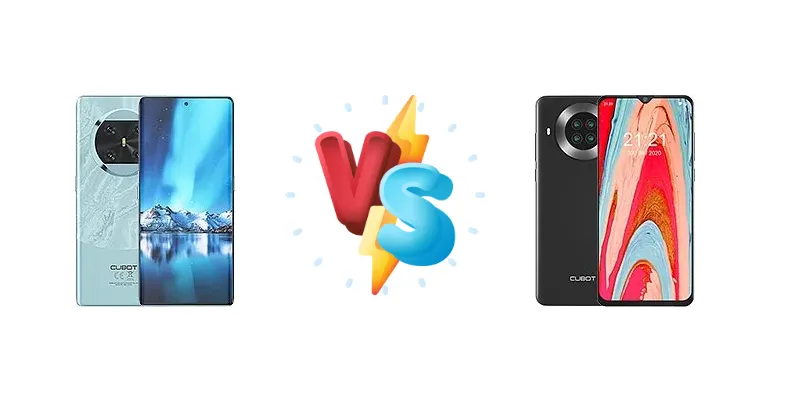
Cubot offers two compelling options in the budget smartphone space: the X90 and the Note 20 Pro. While both aim to deliver affordability, they diverge significantly in their core hardware. The X90 boasts the newer Mediatek Helio G99, while the Note 20 Pro relies on the older Helio P60. This comparison dissects these differences to determine which device offers the best experience for your needs.
🏆 Quick Verdict
For most users, the Cubot X90 is the superior choice. Its Helio G99 chipset provides a substantial performance uplift over the Note 20 Pro’s Helio P60, translating to smoother multitasking, better gaming, and improved overall responsiveness. The 33W charging is also a welcome addition, offsetting the likely similar battery capacities.
| Network |
|---|
| 2G bands | GSM 850 / 900 / 1800 / 1900 | GSM 850 / 900 / 1800 / 1900 |
| 3G bands | HSDPA 800 / 850 / 900 / 1700(AWS) / 1900 / 2100 | HSDPA 900 / 2100 |
| 4G bands | 1, 2, 3, 4, 5, 7, 8, 12, 13, 17, 18, 19, 20, 25, 26, 28, 38, 39, 40, 41, 66 | 1, 3, 7, 8, 19, 20 |
| Speed | HSPA, LTE | HSPA, LTE |
| Technology | GSM / HSPA / LTE | GSM / HSPA / LTE |
| Launch |
|---|
| Announced | 2024, May | 2020. Released 2020 |
| Status | Available. Released 2024, May | Discontinued |
| Body |
|---|
| Dimensions | 162.2 x 74 x 9.4 mm (6.39 x 2.91 x 0.37 in) | 162.8 x 75.4 x 9.1 mm (6.41 x 2.97 x 0.36 in) |
| SIM | Nano-SIM + Nano-SIM | Nano-SIM + Nano-SIM |
| Weight | 207 g (7.30 oz) | 200 g (7.05 oz) |
| Display |
|---|
| Resolution | 1080 x 2400 pixels, 20:9 ratio (~395 ppi density) | 720 x 1600 pixels, 20:9 ratio (~270 ppi density) |
| Size | 6.67 inches, 107.4 cm2 (~89.5% screen-to-body ratio) | 6.5 inches, 102.0 cm2 (~83.1% screen-to-body ratio) |
| Type | AMOLED, 1B colors, 120Hz, 1500 nits (peak) | IPS LCD |
| Platform |
|---|
| CPU | Octa-core (2x2.2 GHz Cortex-A76 & 6x2.0 GHz Cortex-A55) | Octa-core (4x2.0 GHz Cortex-A73 & 4x2.0 GHz Cortex-A53) |
| Chipset | Mediatek Helio G99 (6 nm) | Mediatek MT6771 Helio P60 (12 nm) |
| GPU | Mali-G57 MC2 | Mali-G72 MP3 |
| OS | Android 14 | Android 10 |
| Memory |
|---|
| Card slot | No | microSDXC (dedicated slot) |
| Internal | 256GB 16GB RAM | 128GB 8GB RAM |
| Main Camera |
|---|
| Features | LED flash, HDR, panorama | LED flash |
| Quad | - | 12 MP, (wide), 1/2.9", AF
20 MP, (depth), 1/2.78"
Auxiliary lenses |
| Triple | 100 MP, f/1.9, (wide), 1/1.8", PDAF
16 MP, 117˚ (ultrawide)
5 MP (macro) | - |
| Video | 1080p@30fps | Yes |
| Selfie camera |
|---|
| Single | 32 MP | 8 MP |
| Video | 1080p@30fps | Yes |
| Sound |
|---|
| 35mm jack | No | Yes |
| Loudspeaker | Yes | Yes |
| Comms |
|---|
| Bluetooth | 5.2, A2DP | 4.2, A2DP |
| NFC | Yes | Yes |
| Positioning | GPS, GALILEO, GLONASS, BDS | GPS |
| Radio | Unspecified | Unspecified |
| USB | USB Type-C, OTG | microUSB, OTG |
| WLAN | Wi-Fi 802.11 a/b/g/n/ac, dual-band | Wi-Fi 802.11 a/b/g/n |
| Features |
|---|
| Sensors | Fingerprint (under display, optical), accelerometer, gyro, proximity, compass | Accelerometer, gyro, proximity, compass |
| Battery |
|---|
| Charging | 33W wired | - |
| Type | 5100 mAh | 4200 mAh, removable |
| Misc |
|---|
| Colors | Green, Black | Black, Blue, Green |
| Price | About 290 EUR | - |
Cubot X90
- Significantly faster processor (Helio G99)
- More efficient 6nm process
- Faster 33W charging
- Potentially better image processing
- May be slightly more expensive
- Detailed display specs unknown
Cubot Note 20 Pro
- Lower price point (likely)
- Sufficient for basic tasks
- Acceptable for light usage
- Potentially longer standby time (due to less powerful processor)
- Outdated Helio P60 chipset
- Slower performance
- Less efficient 12nm process
- Likely slower charging
Display Comparison
Detailed display specifications are unavailable. However, given the price points, both devices likely utilize IPS LCD panels. The key difference will be in color calibration and brightness. Without specific data, it's reasonable to assume the X90, being a newer model, may benefit from slightly improved color accuracy. The absence of high refresh rates is expected in this segment.
Camera Comparison
Camera details are limited. Both phones likely feature a multi-camera setup, but the quality will heavily depend on the main sensor and image processing. Without sensor size information, it’s difficult to make a definitive statement. However, the X90’s more powerful chipset allows for more sophisticated image processing algorithms, potentially resulting in better dynamic range and low-light performance. The presence of a 2MP macro lens on either device is unlikely to significantly impact image quality.
Performance
The core differentiator lies in the chipsets. The Cubot X90’s Mediatek Helio G99 (6nm) is a significant upgrade over the Note 20 Pro’s Helio P60 (12nm). The G99’s newer Cortex-A76 cores, clocked at 2.2 GHz, offer substantially better single-core performance than the P60’s Cortex-A73 cores at 2.0 GHz. The 6nm process node also provides improved power efficiency, meaning the X90 will likely run cooler and offer better battery life under load. The G99’s GPU will also deliver a more fluid gaming experience. The Note 20 Pro’s P60, while capable for basic tasks, will struggle with modern, graphically intensive games.
Battery Life
Battery capacity data is missing for both devices. However, given the market segment, they likely fall within the 4000-5000 mAh range. The X90’s 33W wired charging is a clear advantage over the Note 20 Pro, which likely supports slower charging speeds. This translates to significantly faster top-up times, reducing downtime and improving usability. Even with a similar battery capacity, the G99’s improved power efficiency will likely result in longer real-world battery life for the X90.
Buying Guide
Buy the Cubot X90 if you prioritize performance for gaming, demanding apps, or future-proofing. Its newer chipset will handle more intensive tasks and provide a longer usable lifespan. Buy the Cubot Note 20 Pro if your needs are extremely basic – primarily calls, texts, and light social media – and you are on a very tight budget. The P60 is sufficient for these tasks, but it will struggle with anything more demanding.
Frequently Asked Questions
❓ Will the Cubot X90 handle demanding games like PUBG or Call of Duty Mobile?
The Helio G99 chipset in the Cubot X90 is capable of running PUBG and Call of Duty Mobile, but you'll likely need to use medium or low graphics settings for a consistently smooth experience. The P60 in the Note 20 Pro will struggle with these titles, even on the lowest settings.
❓ Is the difference in chipset performance noticeable for everyday tasks like browsing and social media?
Yes, the difference is noticeable. The X90’s G99 will provide snappier app launches, smoother scrolling, and faster multitasking compared to the Note 20 Pro’s P60. While the P60 is adequate for basic tasks, the X90 offers a more responsive and enjoyable user experience.
❓ How long will it take to fully charge the Cubot X90 with the 33W charger?
Assuming a 4500mAh battery (a common size in this segment), the Cubot X90 should fully charge from 0% to 100% in approximately 1 hour and 30 minutes to 2 hours. This is significantly faster than the Note 20 Pro, which likely supports slower charging speeds.
❓ Does the Cubot Note 20 Pro support VoLTE and Wi-Fi calling?
Support for VoLTE and Wi-Fi calling depends on your carrier and region. It's crucial to check with your mobile provider to confirm compatibility before purchasing either device, as the Helio P60's modem may have limited support for newer network technologies.