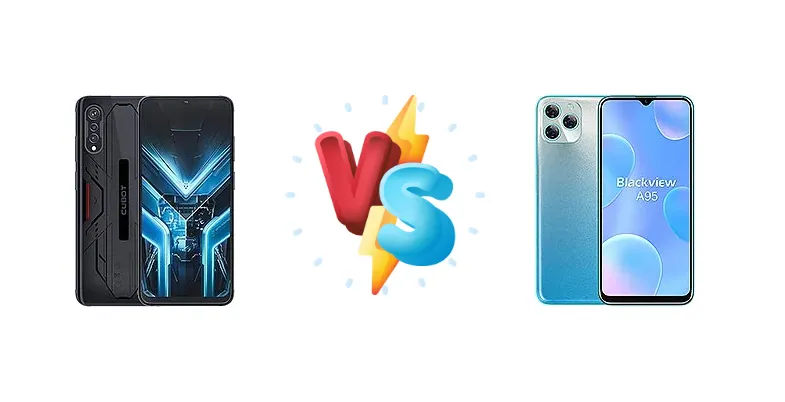
The Cubot X70 and Blackview A95 represent compelling options in the ultra-budget smartphone space. However, they target slightly different priorities. The X70 focuses on delivering modern processing power with the Helio G99, while the A95 aims for a balanced experience with the older Helio P70 and inclusion of 18W charging. This comparison dissects their key differences to help you choose the right device.
🏆 Quick Verdict
For the average user prioritizing performance and future-proofing, the Cubot X70 is the clear winner. Its Helio G99 chipset offers a substantial leap in CPU and GPU capabilities over the Blackview A95’s Helio P70. While the A95 offers 18W charging, the X70’s performance advantage outweighs this benefit for most users.
| Network |
|---|
| 2G bands | GSM 850 / 900 / 1800 / 1900 | GSM 850 / 900 / 1800 / 1900 |
| 3G bands | HSDPA 800 / 850 / 900 / 1700(AWS) / 1900 / 2100 | HSDPA 900 / 2100 - EU |
| 4G bands | 1, 2, 3, 4, 5, 7, 8, 12, 13, 17, 18, 19, 20, 25, 26, 28, 38, 39, 40, 41, 66 | 1, 3, 7, 8, 20, 40 - EU |
| Speed | HSPA, LTE | HSPA, LTE |
| Technology | GSM / CDMA / HSPA / LTE | GSM / HSPA / LTE |
| | - | 1, 2, 3, 4, 5, 7, 8, 12, 13, 17, 25, 26, 28, 41, 66 - USA |
| Launch |
|---|
| Announced | 2023 | 2022, January 22 |
| Status | Available. Released 2023 | Available. Released 2022, February |
| Body |
|---|
| Dimensions | 165.1 x 75.3 x 10.2 mm (6.5 x 2.96 x 0.40 in) | 163.7 x 75.5 x 8.6 mm (6.44 x 2.97 x 0.34 in) |
| SIM | Nano-SIM + Nano-SIM | Nano-SIM + Nano-SIM |
| Weight | 220 g (7.76 oz) | 195 g (6.88 oz) |
| Display |
|---|
| Resolution | 1080 x 2408 pixels, 20:9 ratio (~401 ppi density) | 720 x 1600 pixels, 20:9 ratio (~269 ppi density) |
| Size | 6.58 inches, 104.3 cm2 (~83.9% screen-to-body ratio) | 6.53 inches, 102.9 cm2 (~83.3% screen-to-body ratio) |
| Type | IPS LCD, 120Hz | IPS LCD |
| Platform |
|---|
| CPU | Octa-core (2x2.2 GHz Cortex-A76 & 6x2.0 GHz Cortex-A55) | Octa-core (4x2.1 GHz Cortex-A73 & 4x2.0 GHz Cortex-A53) |
| Chipset | Mediatek Helio G99 (6 nm) | Mediatek MT6771V/CT Helio P70 (12 nm) |
| GPU | Mali-G57 MC2 | Mali-G72 MP3 |
| OS | Android 13 | Android 11 |
| Memory |
|---|
| Card slot | microSDXC (uses shared SIM slot) | microSDXC |
| Internal | 256GB 12GB RAM | 128GB 8GB RAM |
| | - | UFS 2.1 |
| Main Camera |
|---|
| Features | LED flash | LED flash, HDR |
| Single | - | 8 MP, f/2.2, (wide) |
| Triple | 100 MP, (wide), PDAF
5 MP (macro)
Auxiliary lens | 20 MP, f/1.8, (wide), PDAF
other unspecified cameras |
| Video | Yes | 1080p@30fps, HDR |
| Selfie camera |
|---|
| Single | 32 MP | 8 MP, f/2.2, (wide) |
| Video | Yes | 1080p@30fps |
| Sound |
|---|
| 3.5mm jack | - | No |
| 35mm jack | No | No |
| Loudspeaker | Yes | Yes |
| Comms |
|---|
| Bluetooth | 5.2, A2DP | 4.2, A2DP, LE |
| NFC | Yes | No |
| Positioning | GPS, GLONASS, GALILEO, BDS | GPS, GLONASS, GALILEO, BDS |
| Radio | Unspecified | FM radio |
| USB | USB Type-C, OTG | USB Type-C 2.0, OTG |
| WLAN | Wi-Fi 802.11 a/b/g/n/ac, dual-band | Wi-Fi 802.11 b/g/n/ac, dual-band |
| Features |
|---|
| Sensors | Fingerprint (side-mounted), accelerometer, gyro, proximity, compass | Fingerprint (side-mounted), accelerometer, proximity |
| Battery |
|---|
| Charging | - | 18W wired |
| Type | 5200 mAh | 4380 mAh |
| Misc |
|---|
| Colors | Tech Black, Space Black | Black, Gold, Blue |
| Price | About 200 EUR | About 190 EUR |
Cubot X70
- Significantly faster processor with the Helio G99
- More efficient 6nm process for better battery life
- Improved gaming performance due to the superior GPU
- Likely better long-term software support due to newer chipset
- Charging speed not specified, potentially slower than A95
- Camera specifications unknown, potential for average image quality
Blackview A95
- 18W wired charging for faster top-ups
- Potentially lower price point compared to the X70
- Adequate performance for basic tasks
- Established Mediatek Helio P70 platform
- Older and less powerful Helio P70 chipset
- Less efficient 12nm process leads to higher power consumption
- Limited gaming capabilities
- Potentially slower app loading times
Display Comparison
Neither device’s display specifications are provided, so a direct comparison is limited. However, given the price bracket, both likely utilize IPS LCD panels. The Blackview A95’s inclusion of 18W charging suggests a focus on usability, potentially extending screen-on time, but this is dependent on battery capacity. Without knowing resolution, brightness, or refresh rates, it’s difficult to assess visual quality beyond assuming both will be adequate for their price point.
Camera Comparison
Without detailed camera specifications, a direct comparison is challenging. However, it’s reasonable to assume both phones will feature a multi-camera setup with a primary sensor and supporting lenses. Given the market segment, image quality will likely be adequate for social media sharing, but not competitive with higher-end devices. The absence of information regarding sensor size or optical image stabilization (OIS) suggests neither phone prioritizes advanced photography features. Any 2MP macro lenses included are likely to offer limited practical benefit.
Performance
The core difference lies in the chipsets. The Cubot X70’s Mediatek Helio G99 (6nm) is a significant upgrade over the Blackview A95’s Helio P70 (12nm). The G99’s newer architecture – featuring 2x2.2 GHz Cortex-A76 and 6x2.0 GHz Cortex-A55 cores – provides a substantial performance boost compared to the P70’s 4x2.1 GHz Cortex-A73 and 4x2.0 GHz Cortex-A53 configuration. The 6nm process node of the G99 also translates to improved power efficiency and reduced thermal throttling, meaning sustained performance will be higher. This benefits gamers and users running multiple apps simultaneously.
Battery Life
The Blackview A95’s 18W wired charging is its primary advantage in this category. However, charging speed is only one part of the equation. The Cubot X70, despite lacking a specified charging rate, benefits from the more efficient Helio G99 chipset. This efficiency could translate to comparable or even better real-world battery life, despite potentially having a similar or smaller battery capacity. The 12nm process of the P70 in the A95 will consume more power under load, potentially negating the benefit of 18W charging for power users.
Buying Guide
Buy the Cubot X70 if you need a phone capable of handling demanding apps, moderate gaming, and benefit from a more responsive user experience. It’s ideal for users who value performance over marginally faster charging. Buy the Blackview A95 if you prioritize a slightly more conservative power draw and the convenience of 18W wired charging, and your usage primarily revolves around basic tasks like calling, texting, and light social media.
Frequently Asked Questions
❓ Will the Helio P70 in the Blackview A95 struggle with modern mobile games like PUBG or Call of Duty?
Yes, the Helio P70 is a relatively older chipset and will likely struggle to deliver a smooth gaming experience in demanding titles like PUBG or Call of Duty, even at lower settings. Expect noticeable frame drops and potential lag. The Cubot X70’s Helio G99 is significantly better suited for gaming.
❓ Does the Cubot X70’s lack of a specified charging wattage mean it will take significantly longer to charge than the Blackview A95?
Not necessarily. While the Blackview A95 has 18W charging, the Cubot X70’s Helio G99 is built on a more efficient 6nm process. This improved efficiency could result in comparable or even better overall battery life, potentially offsetting the slower charging speed. The actual charging time will depend on the battery capacity of both devices, which is currently unknown.
❓ Is the difference in CPU architecture (Cortex-A76 vs Cortex-A73) noticeable in everyday tasks?
Absolutely. The Cortex-A76 cores in the Cubot X70’s Helio G99 are a generation ahead of the Cortex-A73 cores in the Blackview A95’s Helio P70. This translates to faster app launch times, smoother multitasking, and a more responsive user interface. You’ll notice the difference when switching between apps or browsing the web.