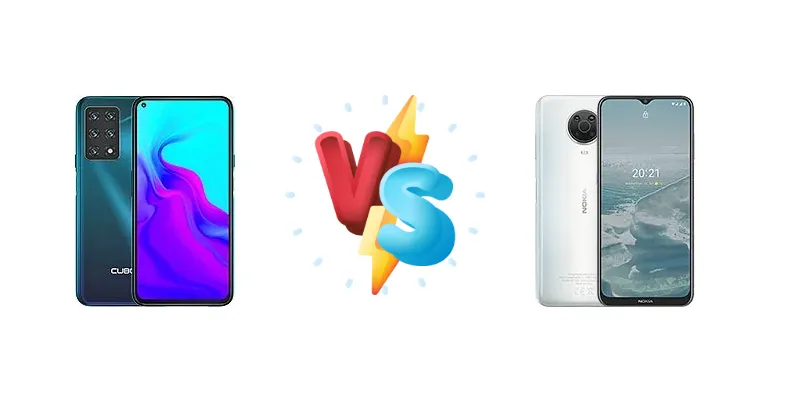
The sub-$200 smartphone market is fiercely competitive. The Cubot X30 and Nokia G20 both aim to deliver essential smartphone functionality at an accessible price point, but they take different approaches to achieving this. The X30 prioritizes processing power with its Helio P60, while the G20 focuses on a more conservative chipset paired with Nokia’s software experience and a larger battery. This comparison will dissect the key differences to determine which device offers the best value.
🏆 Quick Verdict
For users prioritizing application performance and responsiveness, the Cubot X30 emerges as the better choice thanks to its Helio P60 chipset. While the Nokia G20 offers a potentially smoother software experience and slightly longer battery life due to its lower power draw, the X30’s CPU architecture provides a noticeable performance advantage for everyday tasks and light gaming.
| Network |
|---|
| 2G bands | GSM 850 / 900 / 1800 / 1900 | GSM 850 / 900 / 1800 / 1900 |
| 3G bands | HSDPA 850 / 900 / 1700(AWS) / 1900 / 2100 | HSDPA 850 / 900 / 1900 / 2100 - International |
| 4G bands | 1, 2, 3, 4, 5, 7, 8, 12, 13, 17, 18, 19, 20, 25, 26, 28, 38, 40, 41, 66 | 1, 3, 5, 7, 8, 20, 28, 38, 40, 41 - International |
| Speed | HSPA, LTE | HSPA 42.2/5.76 Mbps, LTE Cat4 150/50 Mbps |
| Technology | GSM / HSPA / LTE | GSM / HSPA / LTE |
| | - | 1, 2, 3, 4, 5, 7, 8, 12, 17, 28, 66 - LATAM |
| Launch |
|---|
| Announced | 2020. Released 2020 | 2021, April 08 |
| Status | Discontinued | Available. Released 2021, May 17 |
| Body |
|---|
| Dimensions | 157.1 x 76.4 x 8.5 mm (6.19 x 3.01 x 0.33 in) | 164.9 x 76 x 9.2 mm (6.49 x 2.99 x 0.36 in) |
| SIM | Nano-SIM + Nano-SIM | · Nano-SIM· Nano-SIM + Nano-SIM |
| Weight | 193 g (6.81 oz) | 197 g (6.95 oz) |
| | - | Splash protection |
| Display |
|---|
| Resolution | 1080 x 2310 pixels (~398 ppi density) | 720 x 1600 pixels, 20:9 ratio (~269 ppi density) |
| Size | 6.4 inches, 101.4 cm2 (~84.5% screen-to-body ratio) | 6.52 inches, 102.6 cm2 (~81.9% screen-to-body ratio) |
| Type | IPS LCD | IPS LCD |
| Platform |
|---|
| CPU | Octa-core (4x2.0 GHz Cortex-A73 & 4x2.0 GHz Cortex-A53) | Octa-core (4x2.3 GHz Cortex-A53 & 4x1.8 GHz Cortex-A53) |
| Chipset | Mediatek MT6771 Helio P60 (12 nm) | Mediatek MT6765G Helio G35 (12 nm) |
| GPU | Mali-G72 MP3 | PowerVR GE8320 |
| OS | Android 10 | Android 11, upgradable to Android 13 |
| Memory |
|---|
| Card slot | microSDXC (uses shared SIM slot) | microSDXC (dedicated slot) |
| Internal | 128GB 8GB RAM, 256GB 8GB RAM | 64GB 4GB RAM, 128GB 4GB RAM |
| Main Camera |
|---|
| Features | LED flash | LED flash, HDR, panorama |
| Penta | 48 MP, (wide), 1/2.0", AF
16 MP, (ultrawide)
5 MP (macro)
Auxiliary lenses | - |
| Quad | - | 48 MP, f/1.8, (wide), PDAF
5 MP, (ultrawide)
2 MP (macro)
Auxiliary lens |
| Single | - | 8 MP, (wide) |
| Video | Yes | 1080p@30fps |
| Selfie camera |
|---|
| Single | 32 MP | 8 MP, (wide) |
| Video | Yes | 1080p@30fps |
| Sound |
|---|
| 3.5mm jack | - | Yes |
| 35mm jack | Unspecified | Yes |
| Loudspeaker | Yes | Yes |
| Comms |
|---|
| Bluetooth | 4.2, A2DP | 5.0, A2DP, LE |
| NFC | Yes | Yes (market/region dependent) |
| Positioning | GPS | GPS, GLONASS, BDS |
| Radio | Unspecified | FM radio |
| USB | USB Type-C, OTG | USB Type-C 2.0, OTG |
| WLAN | Wi-Fi 802.11 a/b/g/n | Wi-Fi 802.11 b/g/n |
| Features |
|---|
| Sensors | Fingerprint (side-mounted), accelerometer, gyro, proximity, compass | Fingerprint (side-mounted), accelerometer, gyro, proximity |
| Battery |
|---|
| Charging | - | 10W wired |
| Type | 4200 mAh | Li-Po 5050 mAh |
| Misc |
|---|
| Colors | Blue, Black, Gradient Green | Glacier, Night |
| Models | - | TA-1336, TA-1343, TA-1347, TA-1372, TA-1365 |
| Price | - | About 90 EUR |
| SAR | - | 1.01 W/kg (head) 1.02 W/kg (body) |
| SAR EU | - | 0.49 W/kg (head) 1.13 W/kg (body) |
Cubot X30
- More powerful Helio P60 chipset for better performance
- Superior CPU architecture with Cortex-A73 cores
- Potentially better gaming performance
- Likely shorter battery life compared to the Nokia G20
- Potentially less refined software experience
Nokia G20
- Clean Android experience with potential for software updates
- Potentially longer battery life due to lower power chipset
- Nokia’s brand reputation for reliability
- Significantly weaker Helio G35 chipset
- Slow 10W charging
- Limited performance for demanding tasks
Display Comparison
Neither device boasts a standout display. Both utilize 12nm chipsets, suggesting similar power constraints impacting display capabilities. Without specific display specs (resolution, brightness, panel type) beyond the chipsets, it’s difficult to definitively declare a winner. However, Nokia’s brand history suggests a focus on color accuracy, potentially giving it a slight edge in display quality, though this is speculative. The absence of high refresh rate support on either device indicates a focus on power efficiency over visual fluidity.
Camera Comparison
Without detailed camera specifications (sensor size, aperture, image processing algorithms), a direct comparison is limited. However, the market segment suggests both phones will feature modest camera systems. The Nokia G20’s brand reputation leans towards natural image processing, while Cubot often emphasizes software enhancements. It’s likely both phones will struggle in low-light conditions. The presence of a 2MP macro lens on either device is largely a marketing tactic, offering minimal practical benefit due to the small sensor size and lack of optical image stabilization (OIS).
Performance
The core difference lies in the chipsets. The Cubot X30’s Mediatek MT6771 Helio P60 features a more sophisticated CPU architecture – a combination of Cortex-A73 and Cortex-A53 cores clocked at 2.0 GHz. This contrasts with the Nokia G20’s Helio G35, which relies solely on Cortex-A53 cores, with a split configuration of 2.3 GHz and 1.8 GHz. The A73 cores in the P60 offer significantly higher single-core performance, translating to snappier app launches and smoother multitasking. While the G35’s higher clock speed on its A53 cores might offer a slight boost in certain benchmarks, the architectural advantage of the P60 will be more noticeable in real-world usage. The G35 is geared towards basic gaming, while the P60 can handle more demanding titles at lower settings.
Battery Life
The Nokia G20’s 10W charging is a significant drawback. While the battery capacity isn’t specified, the Helio G35’s lower power consumption suggests it will likely offer longer battery life than the Cubot X30. However, the X30’s more efficient use of power during tasks, thanks to the P60’s architecture, could partially offset this difference. The 10W charging on the G20 will result in significantly longer charge times, making it less convenient for users who need quick top-ups.
Buying Guide
Buy the Cubot X30 if you frequently multitask, use demanding apps, or need a phone that feels responsive even after prolonged use. Its Helio P60 chipset offers a significant performance boost over the G20. Buy the Nokia G20 if you prioritize a clean Android experience, extended battery life, and a brand known for software updates, even if it means sacrificing some processing power. It’s ideal for basic communication and light usage.
Frequently Asked Questions
❓ Will the Nokia G20 receive Android version updates beyond its initial release?
Nokia has a relatively good track record for providing software updates, even on their budget devices. While major Android version updates aren't guaranteed, the G20 is likely to receive at least one major update and several security patches, offering a longer software support lifespan than many competitors in this price range.
❓ Can the Cubot X30 handle popular games like PUBG Mobile or Call of Duty Mobile?
The Cubot X30’s Helio P60 chipset can run PUBG Mobile and Call of Duty Mobile, but you’ll need to lower the graphics settings to medium or low to achieve a playable frame rate. Expect some occasional stuttering during intense action sequences. The Nokia G20 would struggle significantly with these titles.
❓ How long will it take to fully charge the Nokia G20 with its 10W charger?
With its 10W charging, the Nokia G20 will take a considerable amount of time to fully charge – likely between 3 to 4 hours, depending on the battery capacity. This is a significant drawback compared to phones with faster charging capabilities.