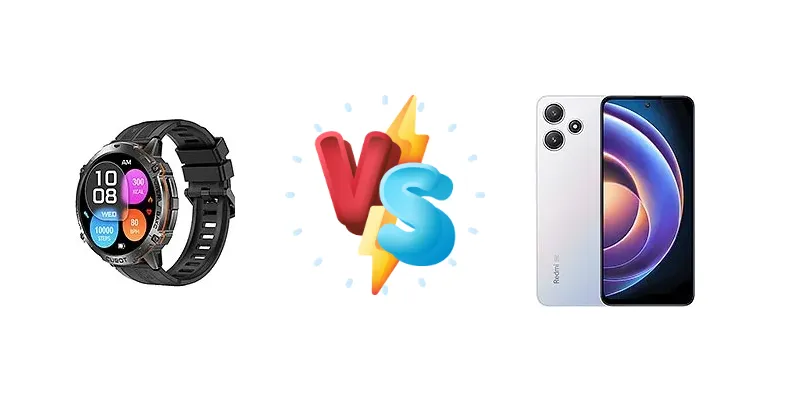
The budget smartphone market is fiercely competitive. The Xiaomi Redmi Note 12R enters the fray with Qualcomm's efficient Snapdragon 4 Gen 2, while the Cubot X3 aims to offer a compelling alternative. This comparison dissects their potential strengths and weaknesses, focusing on where the Redmi Note 12R's chipset advantage translates into real-world benefits.
🏆 Quick Verdict
For the average user prioritizing consistent performance and future-proofing, the Xiaomi Redmi Note 12R is the clear winner. Its Snapdragon 4 Gen 2 chipset, built on a 4nm process, offers a significant advantage in efficiency and processing power compared to the unknown internals of the Cubot X3, making it a more reliable daily driver.
| Network |
|---|
| 2G bands | N/A | GSM 850 / 900 / 1800 / 1900 |
| 3G bands | N/A | HSDPA 850 / 900 / 2100 |
| 4G bands | N/A | 1, 3, 5, 8, 34, 38, 39, 40, 41 |
| 5G bands | - | 1, 5, 8, 28, 41, 78 SA/NSA |
| EDGE | No | - |
| GPRS | No | - |
| Speed | No | HSPA, LTE, 5G |
| Technology | No cellular connectivity | GSM / CDMA / HSPA / EVDO / LTE / 5G |
| Launch |
|---|
| Announced | 2025, March | 2023, June 28 |
| Status | Available. Released 2025, March | Available. Released 2023, June 28 |
| Body |
|---|
| Build | Zinc alloy frame and rear | Glass front, plastic frame, glass back |
| Dimensions | 53.8 x 53.8 x 13.5 mm (2.12 x 2.12 x 0.53 in) | 168.6 x 76.3 x 8.2 mm (6.64 x 3.00 x 0.32 in) |
| SIM | No | Nano-SIM + Nano-SIM |
| Weight | 94.6 g (3.35 oz) | 199 g (7.02 oz) |
| Display |
|---|
| Resolution | 466 x 466 pixels (~381 ppi density) | 1080 x 2460 pixels (~396 ppi density) |
| Size | 1.73 inches | 6.79 inches, 109.5 cm2 (~85.1% screen-to-body ratio) |
| Type | TFT LCD | IPS LCD, 90Hz, 550 nits |
| Platform |
|---|
| CPU | - | Octa-core (2x2.2 GHz Cortex-A78 & 6x1.95 GHz Cortex-A55) |
| Chipset | - | Qualcomm SM4450 Snapdragon 4 Gen 2 (4 nm) |
| GPU | - | Adreno 613 |
| OS | Proprietary OS | Android 13, MIUI 14 |
| Memory |
|---|
| Card slot | No | microSDXC (uses shared SIM slot) |
| Internal | 16MB | 128GB 4GB RAM, 128GB 6GB RAM, 128GB 8GB RAM, 256GB 8GB RAM |
| Main Camera |
|---|
| Dual | - | 50 MP, f/1.8, (wide), PDAF
2 MP (macro) |
| Features | - | LED flash, HDR |
| Video | - | 1080p@30fps |
| Selfie camera |
|---|
| Features | - | HDR |
| Single | - | 5 MP, f/2.2, (wide), 1/5.0", 1.12µm |
| Video | - | 1080p@30fps |
| Sound |
|---|
| 35mm jack | No | Yes |
| Loudspeaker | Yes | Yes |
| Comms |
|---|
| Bluetooth | 5.3, A2DP | 5.3, A2DP, LE |
| Infrared port | - | Yes |
| NFC | No | Yes (market/region dependent) |
| Positioning | Unspecified | GPS, GLONASS, GALILEO, BDS |
| Radio | No | No |
| USB | No | USB Type-C |
| WLAN | No | Wi-Fi 802.11 a/b/g/n/ac, dual-band |
| Features |
|---|
| Sensors | Accelerometer, heart rate, SpO2, barometer, compass | Fingerprint (side-mounted), accelerometer, compass |
| Battery |
|---|
| Charging | - | 18W wired, PD |
| Type | 900 mAh | Li-Po 5000 mAh |
| Misc |
|---|
| Colors | Black | Black, Blue, Silver |
| Models | - | 23076RA4BC |
| Price | - | About 150 EUR |
Cubot X3
- Potentially lower price point
- May offer unique features not found on the Redmi Note 12R
- Could have a larger battery capacity (speculation)
- Unknown chipset performance
- Likely less efficient processor
- Potentially lower build quality
Xiaomi Redmi Note 12R
- Efficient Snapdragon 4 Gen 2 (4nm)
- Better performance and multitasking
- Reliable brand reputation
- PD fast charging support
- May be slightly more expensive
- Standard 18W charging isn't the fastest
- Display likely lacks advanced features like LTPO
Display Comparison
Without specific display details for the Cubot X3, a direct comparison is difficult. However, the Redmi Note 12R likely benefits from Xiaomi's display expertise, potentially offering better color accuracy and brightness. The absence of LTPO technology on the Redmi Note 12R suggests a standard 60Hz or 90Hz refresh rate, which is typical for this price segment. The Cubot X3's display quality is a significant unknown, potentially impacting viewing experience in direct sunlight or during media consumption.
Camera Comparison
Given the lack of camera specifications for the Cubot X3, it's difficult to assess its imaging capabilities. The Redmi Note 12R, while likely featuring a modest camera setup, benefits from Qualcomm's image signal processor (ISP) integrated within the Snapdragon 4 Gen 2. This ISP enhances image processing, resulting in better dynamic range and noise reduction. It's reasonable to assume the Redmi Note 12R will outperform the Cubot X3 in most lighting conditions, particularly in low-light scenarios. The prevalence of 2MP macro lenses on budget phones suggests the Cubot X3 may include one, offering limited practical value compared to a dedicated main sensor.
Performance
The Xiaomi Redmi Note 12R's Qualcomm SM4450 Snapdragon 4 Gen 2 (4nm) is the defining factor in this comparison. The 4nm fabrication process is crucial, offering significantly improved power efficiency compared to older, larger-node chipsets likely found in the Cubot X3. The CPU configuration – octa-core with 2x2.2 GHz Cortex-A78 and 6x1.95 GHz Cortex-A55 cores – provides a balance of performance and efficiency. The Cortex-A78 cores deliver a noticeable boost in single-core performance, beneficial for app launch times and responsiveness. The Cubot X3, lacking chipset details, likely relies on a less powerful and less efficient processor, resulting in slower performance and potential stuttering during multitasking. The Redmi Note 12R will handle demanding apps and light gaming with greater ease.
Battery Life
The Redmi Note 12R's 18W wired charging with PD support is a practical feature, allowing for a reasonable recharge time. While not the fastest charging available, PD ensures compatibility with a wider range of chargers. Without battery capacity or charging details for the Cubot X3, it's impossible to directly compare. However, the Snapdragon 4 Gen 2's 4nm efficiency in the Redmi Note 12R will contribute to longer battery life, even with a potentially similar battery capacity to the Cubot X3. The Redmi Note 12R's efficiency will translate to more hours of usage on a single charge.
Buying Guide
Buy the Cubot X3 if you need a phone primarily for basic communication and light tasks, and are heavily constrained by budget. Its appeal lies in potentially offering a lower price point. Buy the Xiaomi Redmi Note 12R if you prefer a smoother user experience, better multitasking capabilities, and the assurance of a modern, efficient chipset for gaming and demanding applications. The Redmi Note 12R is the better choice for users who want a phone that will last and perform well over time.
Frequently Asked Questions
❓ Will the Redmi Note 12R handle popular games like PUBG Mobile smoothly?
The Snapdragon 4 Gen 2 in the Redmi Note 12R is capable of running PUBG Mobile at medium settings with a stable frame rate. While it won't deliver the highest graphical fidelity, it provides a playable and enjoyable gaming experience. The 4nm process helps prevent excessive throttling during extended gaming sessions.
❓ Is the 18W charging on the Redmi Note 12R slow compared to other phones?
While 18W isn't the fastest charging available, it's a reasonable speed for a budget smartphone. Expect a full charge from 0-100% to take around 2-3 hours. The inclusion of PD (Power Delivery) ensures compatibility with a wider range of chargers, and the Snapdragon 4 Gen 2's efficiency means you won't be constantly needing to top up the battery.
❓ What kind of software updates can I expect on the Redmi Note 12R?
Xiaomi typically provides at least two major Android updates and several years of security patches for its Redmi Note series. While the exact update schedule for the Redmi Note 12R may vary, users can generally expect a reasonable level of software support, improving the phone's longevity and security.