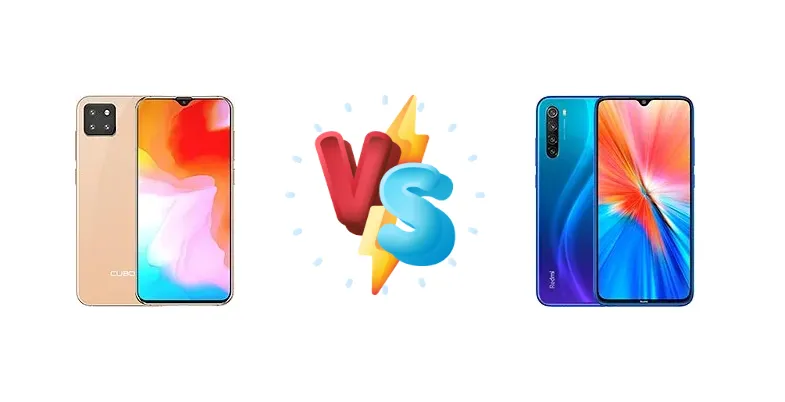
The sub-$200 smartphone market is fiercely competitive. Both the Cubot X20 and the Xiaomi Redmi Note 8 2021 aim to deliver essential smartphone functionality at an accessible price. However, they take different approaches to achieving this, with the Redmi Note 8 2021 representing a refresh of a popular model and the Cubot X20 offering a more basic, cost-optimized experience. This comparison will dissect their key differences to help you determine which device best suits your needs.
🏆 Quick Verdict
For the average user, the Xiaomi Redmi Note 8 2021 is the better choice. Its newer Mediatek Helio G85 chipset provides a significant performance uplift over the Cubot X20’s Helio P23, translating to smoother multitasking and a more responsive user experience. While both phones offer similar battery endurance, the Redmi Note 8 2021’s faster 18W charging is a welcome addition.
| Network |
|---|
| 2G bands | GSM 850 / 900 / 1800 / 1900 | GSM 850 / 900 / 1800 / 1900 |
| 3G bands | HSDPA 900 / 2100 | HSDPA 850 / 900 / 1700(AWS) / 1900 / 2100 |
| 4G bands | 1, 3, 7, 8, 19, 20 | 1, 2, 3, 4, 5, 7, 8, 20, 28, 38, 40 |
| Speed | HSPA, LTE | HSPA, LTE |
| Technology | GSM / HSPA / LTE | GSM / HSPA / LTE |
| Launch |
|---|
| Announced | 2020. Released 2020 | 2021, May 25 |
| Status | Discontinued | Available. Released 2021, May 27 |
| Body |
|---|
| Build | Glass front, plastic frame, glass back | Glass front (Gorilla Glass 5), glass back (Gorilla Glass 5), plastic frame |
| Dimensions | 157.1 x 74.6 x 8.1 mm (6.19 x 2.94 x 0.32 in) | 158.3 x 75.3 x 8.4 mm (6.23 x 2.96 x 0.33 in) |
| SIM | Nano-SIM + Nano-SIM | Nano-SIM + Nano-SIM |
| Weight | 240 g (8.47 oz) | 190 g (6.70 oz) |
| Display |
|---|
| Protection | - | Corning Gorilla Glass 5 |
| Resolution | 1080 x 2340 pixels, 19.5:9 ratio (~409 ppi density) | 1080 x 2340 pixels, 19.5:9 ratio (~409 ppi density) |
| Size | 6.3 inches, 97.4 cm2 (~83.1% screen-to-body ratio) | 6.3 inches, 97.4 cm2 (~81.7% screen-to-body ratio) |
| Type | IPS LCD | IPS LCD, 500 nits (typ) |
| Platform |
|---|
| CPU | Octa-core 2.5 GHz Cortex-A53 | Octa-core (2x2.0 GHz Cortex-A75 & 6x1.8 GHz Cortex-A55) |
| Chipset | Mediatek MT6763 Helio P23 (16 nm) | Mediatek MT6769Z Helio G85 (12 nm) |
| GPU | Mali-G71 MP2 | Mali-G52 MC2 |
| OS | Android 9.0 (Pie) | Android 11, MIUI 12.5 |
| Memory |
|---|
| Card slot | microSDXC (uses shared SIM slot) | microSDXC (dedicated slot) |
| Internal | 64GB 4GB RAM | 64GB 3GB RAM, 64GB 4GB RAM, 128GB 4GB RAM |
| | - | eMMC 5.1 |
| Main Camera |
|---|
| Features | LED flash | LED flash, HDR, panorama |
| Quad | - | 48 MP, f/1.8, 26mm (wide), 1/2.0", 0.8µm, PDAF
8 MP, f/2.2, 120˚ (ultrawide), 1/4.0", 1.12µm
2 MP (macro)
Auxiliary lens |
| Single | - | 13 MP, f/2.0, (wide), 1/3.1", 1.12µm |
| Triple | 12 MP, (wide), 1/2.9", AF
8 MP, 125˚ (ultrawide)
20 MP, (depth), 1/2.78" | - |
| Video | Yes | 1080p@30/120fps; gyro-EIS |
| Selfie camera |
|---|
| Features | - | HDR, panorama |
| Single | 13 MP, (wide), 1/3.06" | 13 MP, f/2.0, (wide), 1/3.1", 1.12µm |
| Video | Yes | 1080p@30fps |
| Sound |
|---|
| 3.5mm jack | - | Yes |
| 35mm jack | Unspecified | Yes |
| Loudspeaker | Yes | Yes |
| Comms |
|---|
| Bluetooth | 4.2, A2DP | 5.2, A2DP, LE |
| Infrared port | - | Yes |
| NFC | No | No |
| Positioning | GPS | GPS, GLONASS, GALILEO, BDS |
| Radio | Unspecified | FM radio |
| USB | USB Type-C, OTG | USB Type-C 2.0, OTG |
| WLAN | Wi-Fi 802.11 a/b/g/n | Wi-Fi 802.11 a/b/g/n/ac, dual-band, Wi-Fi Direct |
| Features |
|---|
| Sensors | Accelerometer, gyro, proximity, compass | Fingerprint (rear-mounted), accelerometer, gyro, proximity, compass |
| Battery |
|---|
| Charging | - | 18W wired |
| Type | 4000 mAh | Li-Po 4000 mAh |
| Misc |
|---|
| Colors | Blue, Gold, Black | Neptune Blue, Moonlight White, Space Black |
| Models | - | M1908C3JGG |
| Price | - | About 160 EUR |
| SAR | - | 0.97 W/kg (head) 0.75 W/kg (body) |
| SAR EU | - | 0.57 W/kg (head) 0.94 W/kg (body) |
| Tests |
|---|
| Battery life | - |
Endurance rating 102h
|
| Camera | - |
Photo / Video |
| Display | - |
Contrast ratio: 1487:1 (nominal) |
| Loudspeaker | - |
-28.6 LUFS (Average)
|
| Performance | - |
AnTuTu: 180195 (v8), 165779 (v9)
GeekBench: 5259 (v4.4), 1314 (v5.1)
GFXBench: 8.7fps (ES 3.1 onscreen) |
Cubot X20
- Lowest possible price point
- Acceptable battery life for basic use
- Functional for essential smartphone tasks
- Outdated Helio P23 chipset
- Likely limited camera capabilities
- Slower overall performance
Xiaomi Redmi Note 8 2021
- More powerful Helio G85 chipset
- Faster 18W charging
- Brighter display for outdoor visibility
- Slightly higher price
- Still a budget device with limitations
- May include bloatware (typical of Xiaomi)
Display Comparison
Both devices share a contrast ratio of 1487:1, suggesting similar image quality in terms of black levels. However, the Redmi Note 8 2021 boasts a measured peak brightness of 620 nits, which will provide significantly better visibility outdoors compared to the Cubot X20, whose brightness is not specified. While both likely utilize IPS LCD panels, the Redmi Note 8 2021’s higher brightness makes it the clear winner for outdoor usability.
Camera Comparison
Both phones are listed as having 'Photo / Video' capabilities, but lack specific details. Without sensor size or aperture information, a direct comparison is difficult. However, given the Redmi Note 8 2021’s positioning as a more feature-rich device, it’s reasonable to assume it has a more capable camera system. The inclusion of features like Night Mode or HDR, common in Xiaomi’s Redmi line, are likely absent on the Cubot X20. The presence of a dedicated macro camera on many Redmi Note 8 variants (though often 2MP and of limited utility) suggests a more comprehensive camera offering.
Performance
The core difference lies in the chipsets. The Xiaomi Redmi Note 8 2021’s Mediatek Helio G85 (12nm) is a substantial upgrade over the Cubot X20’s Helio P23 (16nm). The G85 features a combination of Cortex-A75 and A55 cores, offering a more efficient and powerful architecture than the P23’s all-Cortex-A53 setup. The G85’s 2x2.0 GHz Cortex-A75 cores provide a noticeable boost in single-core performance, while the 6x1.8 GHz Cortex-A55 cores improve multi-tasking. The 12nm process node of the G85 also contributes to better power efficiency. This translates to a smoother experience with demanding apps and games on the Redmi Note 8 2021.
Battery Life
Both devices achieve an endurance rating of 102 hours, indicating comparable battery life under similar usage conditions. However, the Redmi Note 8 2021 supports 18W wired charging, allowing for significantly faster top-ups compared to the Cubot X20, which lacks any specified charging speed. This faster charging capability is a practical advantage for users who need to quickly replenish their battery.
Buying Guide
Buy the Cubot X20 if you prioritize absolute affordability and are willing to compromise on performance for basic tasks like calls, texts, and light social media use. Buy the Xiaomi Redmi Note 8 2021 if you value a more fluid user experience, better gaming capabilities, and faster charging, even if it means spending slightly more. The Redmi Note 8 2021 is ideal for users who want a phone that can handle everyday tasks without feeling sluggish.
Frequently Asked Questions
❓ Is the Helio G85 in the Redmi Note 8 2021 capable of playing modern mobile games like PUBG or Call of Duty?
The Helio G85 is a gaming-focused chipset and can handle PUBG and Call of Duty Mobile at medium settings with reasonable frame rates. While it won't deliver a flagship gaming experience, it's a significant improvement over the Helio P23 in the Cubot X20, which would struggle with these titles.
❓ Does the Redmi Note 8 2021 have any software updates planned, or is it stuck on an older version of Android?
Xiaomi typically provides at least one major Android update for its Redmi Note series. However, the Redmi Note 8 2021 is nearing the end of its software support lifecycle. Check Xiaomi's official website or community forums for the latest update information.
❓ How does the charging speed of the Redmi Note 8 2021 compare to using a standard 5W charger?
The Redmi Note 8 2021's 18W charging is considerably faster than a standard 5W charger. While a full charge with the included 18W charger will take around 2-3 hours, a 5W charger could take upwards of 6-8 hours to fully replenish the battery.