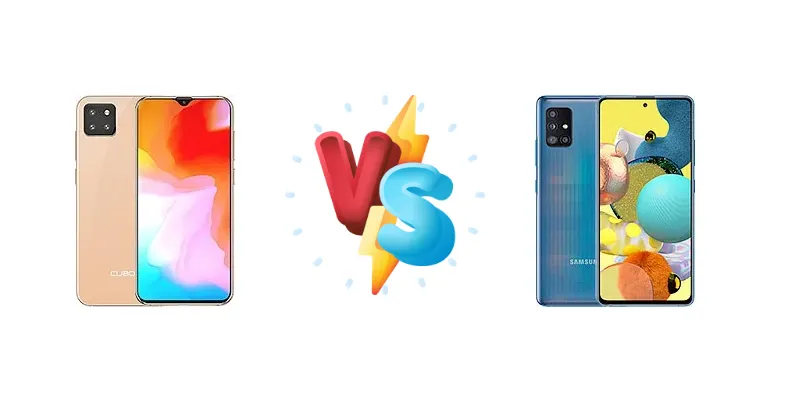
The smartphone landscape is crowded with options, particularly in the budget and mid-range segments. We're pitting the Cubot X20, a value-focused device, against the Samsung Galaxy A51 5G UW, a carrier-specific offering aiming to deliver 5G connectivity at a more accessible price point. This comparison focuses on the core differences in performance, battery life, and overall user experience stemming from their vastly different chipsets.
🏆 Quick Verdict
For the average user, the Samsung Galaxy A51 5G UW is the clear winner. While the Cubot X20 offers a lower entry price, the Snapdragon 765G provides a significantly more responsive and future-proof experience, especially when considering 5G capabilities and sustained performance. The A51 5G UW’s superior chipset justifies the price difference.
| Network |
|---|
| 2G bands | GSM 850 / 900 / 1800 / 1900 | GSM 850 / 900 / 1800 / 1900 |
| 3G bands | HSDPA 900 / 2100 | HSDPA 850 / 900 / 1900 / 2100 |
| 4G bands | 1, 3, 7, 8, 19, 20 | 2, 4, 5, 13, 66 |
| 5G bands | - | 260, 261 mmWave |
| Speed | HSPA, LTE | HSPA, LTE, 5G |
| Technology | GSM / HSPA / LTE | GSM / HSPA / LTE / 5G |
| Launch |
|---|
| Announced | 2020. Released 2020 | 2020, August 14 |
| Status | Discontinued | Available. Released 2020, August 14 |
| Body |
|---|
| Build | Glass front, plastic frame, glass back | Glass front (Gorilla Glass 3), plastic back, aluminum frame |
| Dimensions | 157.1 x 74.6 x 8.1 mm (6.19 x 2.94 x 0.32 in) | 158.8 x 73.4 x 8.6 mm (6.25 x 2.89 x 0.34 in) |
| SIM | Nano-SIM + Nano-SIM | Nano-SIM (pre-installed) |
| Weight | 240 g (8.47 oz) | 188.8 g (6.67 oz) |
| Display |
|---|
| Protection | - | Corning Gorilla Glass 3 |
| Resolution | 1080 x 2340 pixels, 19.5:9 ratio (~409 ppi density) | 1080 x 2400 pixels, 20:9 ratio (~405 ppi density) |
| Size | 6.3 inches, 97.4 cm2 (~83.1% screen-to-body ratio) | 6.5 inches, 102.0 cm2 (~87.5% screen-to-body ratio) |
| Type | IPS LCD | Super AMOLED |
| Platform |
|---|
| CPU | Octa-core 2.5 GHz Cortex-A53 | Octa-core (1x2.4 GHz Kryo 475 Prime & 1x2.2 GHz Kryo 475 Gold & 6x1.8 GHz Kryo 475 Silver) |
| Chipset | Mediatek MT6763 Helio P23 (16 nm) | Qualcomm SM7250 Snapdragon 765G 5G (7 nm) |
| GPU | Mali-G71 MP2 | Adreno 620 |
| OS | Android 9.0 (Pie) | Android 10, One UI 2 |
| Memory |
|---|
| Card slot | microSDXC (uses shared SIM slot) | microSDXC (uses shared SIM slot) |
| Internal | 64GB 4GB RAM | 128GB 6GB RAM |
| | - | UFS 2.1 |
| Main Camera |
|---|
| Features | LED flash | LED flash, panorama, HDR |
| Quad | - | 48 MP, f/2.0, 26mm (wide), 1/2.0", 0.8µm, PDAF
12 MP, f/2.2, 123˚ (ultrawide)
5 MP (macro)
Auxiliary lens |
| Single | - | 5 MP, AF |
| Triple | 12 MP, (wide), 1/2.9", AF
8 MP, 125˚ (ultrawide)
20 MP, (depth), 1/2.78" | - |
| Video | Yes | 4K@30fps, 1080p@30/120fps; gyro-EIS |
| Selfie camera |
|---|
| Features | - | HDR |
| Single | 13 MP, (wide), 1/3.06" | 32 MP, f/2.2, 26mm (wide), 1/2.8", 0.8µm |
| Video | Yes | 4K@30fps, 1080p@30fps |
| Sound |
|---|
| 3.5mm jack | - | Yes |
| 35mm jack | Unspecified | Yes |
| Loudspeaker | Yes | Yes |
| Comms |
|---|
| Bluetooth | 4.2, A2DP | 5.0, A2DP, LE |
| NFC | No | Yes |
| Positioning | GPS | GPS, GLONASS, GALILEO, BDS |
| Radio | Unspecified | FM radio, RDS, recording |
| USB | USB Type-C, OTG | USB Type-C 2.0, OTG |
| WLAN | Wi-Fi 802.11 a/b/g/n | Wi-Fi 802.11 a/b/g/n/ac, dual-band, Wi-Fi Direct |
| Features |
|---|
| Sensors | Accelerometer, gyro, proximity, compass | Fingerprint (under display, optical), accelerometer, gyro, proximity, compass |
| | - | ANT+ |
| Battery |
|---|
| Charging | - | 15W wired |
| Stand-by | - | Up to 672 h |
| Talk time | - | Up to 5 h |
| Type | 4000 mAh | Li-Po 4500 mAh |
| Misc |
|---|
| Colors | Blue, Gold, Black | Prism Bricks Blue |
| Models | - | SM-A516V |
| Price | - | About 470 EUR |
| SAR | - | 0.70 W/kg (head) 1.25 W/kg (body) |
| SAR EU | - | 0.59 W/kg (head) 1.32 W/kg (body) |
Cubot X20
- Lower price point makes it accessible.
- Potentially larger battery capacity (unconfirmed).
- Simple and straightforward user experience.
- Outdated Helio P23 chipset offers limited performance.
- Less efficient processor leads to potential battery drain.
- Likely slower software updates and shorter support lifespan.
Samsung Galaxy A51 5G UW
- Powerful Snapdragon 765G delivers smooth performance.
- 7nm process ensures excellent power efficiency.
- 5G connectivity for faster data speeds.
- Samsung’s software and camera optimizations.
- Higher price compared to the Cubot X20.
- 15W charging is relatively slow.
- Carrier-specific model may have bloatware.
Display Comparison
Neither device's display specifications are provided, so we must infer. Given the A51 5G UW's positioning, it likely features a higher-resolution panel, potentially AMOLED, offering superior color accuracy and contrast compared to the X20, which likely uses an IPS LCD. The A51 5G UW likely benefits from Samsung’s display expertise, resulting in better viewing angles and outdoor visibility. Bezels are also likely slimmer on the A51 5G UW, contributing to a more modern aesthetic.
Camera Comparison
Without detailed camera specs, a direct comparison is difficult. However, the Snapdragon 765G includes a more advanced Image Signal Processor (ISP) than the Helio P23. This means the A51 5G UW will likely exhibit superior image processing capabilities, including better noise reduction, dynamic range, and color accuracy. Samsung’s software optimizations further enhance the camera experience. While both phones may have similar megapixel counts, the A51 5G UW’s ISP will likely deliver more detailed and visually appealing photos, especially in challenging lighting conditions. We can assume the A51 5G UW will have better video recording capabilities as well.
Performance
The core difference lies in the chipsets. The Cubot X20’s MediaTek Helio P23 (16nm) is an older, entry-level processor. Its Cortex-A53 cores, while octa-core, operate at 2.5 GHz but are architecturally less efficient than the cores found in the Snapdragon 765G. The Samsung Galaxy A51 5G UW’s Snapdragon 765G (7nm) is built on a far more advanced process node, resulting in significantly improved power efficiency and thermal performance. The 765G’s Kryo CPU architecture – with its Prime, Gold, and Silver cores – dynamically allocates tasks for optimal performance and battery life. This translates to smoother multitasking, faster app loading times, and a more responsive user interface on the A51 5G UW. The 7nm process also allows for higher clock speeds without excessive heat generation, crucial for sustained performance.
Battery Life
Battery capacity isn't specified for either device. However, the Snapdragon 765G’s 7nm process contributes to significantly better power efficiency. While the Cubot X20 might have a larger battery, the A51 5G UW will likely achieve comparable or even better battery life due to its more efficient chipset. The A51 5G UW’s 15W wired charging is relatively slow by today’s standards, but the efficient chipset means it won’t need to be charged as frequently. The X20’s charging speed is unknown, but a slower chipset may require more frequent charging even with a larger battery.
Buying Guide
Buy the Cubot X20 if you prioritize absolute affordability and basic smartphone functionality, primarily for calls, texts, and light social media use. You're accepting compromises in performance and future-proofing. Buy the Samsung Galaxy A51 5G UW if you want a smoother, more capable experience with 5G connectivity, better multitasking, and the assurance of a more modern chipset that will handle software updates and demanding apps for longer.
Frequently Asked Questions
❓ Will the Cubot X20 struggle with demanding games like PUBG Mobile?
Yes, the Helio P23 is not designed for graphically intensive games. While you might be able to run PUBG Mobile at low settings, expect significant frame rate drops and stuttering, especially during intense action. The Snapdragon 765G in the A51 5G UW will provide a much smoother and more enjoyable gaming experience.
❓ How much faster is the 5G on the Samsung Galaxy A51 5G UW compared to 4G?
The 5G speeds on the A51 5G UW will vary depending on network coverage and carrier. However, in areas with good 5G coverage, you can expect download speeds several times faster than 4G – potentially exceeding 1 Gbps. This translates to faster downloads, smoother streaming, and lower latency for online gaming.
❓ Is the Snapdragon 765G in the A51 5G UW powerful enough for future Android updates?
Yes, the Snapdragon 765G is a capable chipset that should handle several future Android updates without significant performance issues. It's a much more future-proof choice than the Helio P23, which is already showing its age.
❓ Does the Samsung Galaxy A51 5G UW support carrier aggregation for improved 5G speeds?
Yes, the Snapdragon 765G supports carrier aggregation, allowing it to combine multiple 5G channels for faster and more reliable speeds. This is a key feature for maximizing 5G performance in real-world conditions.