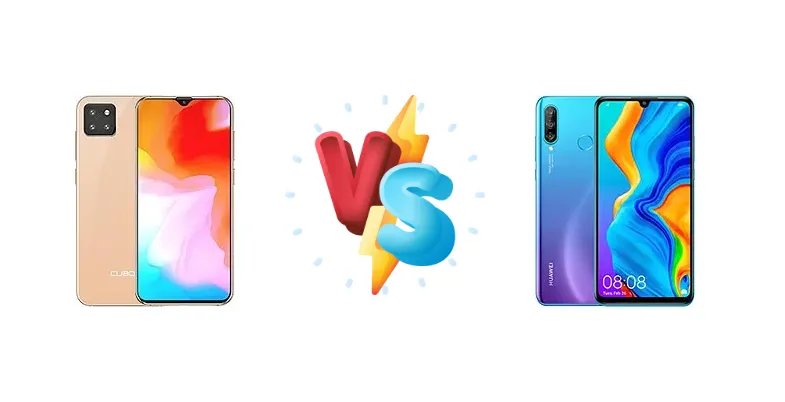
Both the Huawei P30 lite New Edition and the Cubot X20 occupy the competitive sub-$200 smartphone segment. The P30 lite, despite its age, benefits from Huawei’s Kirin chipset, while the Cubot X20 relies on Mediatek’s Helio P23. This comparison dives deep into the architectural differences and real-world implications of these choices, helping you determine which device delivers the best value.
🏆 Quick Verdict
For the average user prioritizing responsiveness and faster charging, the Huawei P30 lite New Edition is the better choice. Its Kirin 710 chipset, built on a smaller 12nm process, offers a noticeable performance advantage over the Cubot X20’s Helio P23, despite both utilizing Cortex-A53 cores. However, the X20 remains a viable option for basic tasks.
| Network |
|---|
| 2G bands | GSM 850 / 900 / 1800 / 1900 | GSM 850 / 900 / 1800 / 1900 |
| 3G bands | HSDPA 900 / 2100 | HSDPA 850 / 900 / 1700(AWS) / 1900 / 2100 |
| 4G bands | 1, 3, 7, 8, 19, 20 | 1, 3, 4, 7, 8, 20, 38 |
| Speed | HSPA, LTE | HSPA 42.2/5.76 Mbps, LTE (2CA) Cat6 400/50 Mbps |
| Technology | GSM / HSPA / LTE | GSM / HSPA / LTE |
| Launch |
|---|
| Announced | 2020. Released 2020 | 2020, January 14. Released 2020, January 14 |
| Status | Discontinued | Discontinued |
| Body |
|---|
| Build | Glass front, plastic frame, glass back | Glass front, glass back, plastic frame |
| Dimensions | 157.1 x 74.6 x 8.1 mm (6.19 x 2.94 x 0.32 in) | 152.9 x 72.7 x 7.4 mm (6.02 x 2.86 x 0.29 in) |
| SIM | Nano-SIM + Nano-SIM | Nano-SIM + Nano-SIM |
| Weight | 240 g (8.47 oz) | 152.9 g (5.40 oz) |
| Display |
|---|
| Resolution | 1080 x 2340 pixels, 19.5:9 ratio (~409 ppi density) | 1080 x 2312 pixels, 19.3:9 ratio (~415 ppi density) |
| Size | 6.3 inches, 97.4 cm2 (~83.1% screen-to-body ratio) | 6.15 inches, 93.6 cm2 (~84.2% screen-to-body ratio) |
| Type | IPS LCD | IPS LCD |
| Platform |
|---|
| CPU | Octa-core 2.5 GHz Cortex-A53 | Octa-core (4x2.2 GHz Cortex-A73 & 4x1.7 GHz Cortex-A53) |
| Chipset | Mediatek MT6763 Helio P23 (16 nm) | Kirin 710 (12 nm) |
| GPU | Mali-G71 MP2 | Mali-G51 MP4 |
| OS | Android 9.0 (Pie) | Android 9.0 (Pie), upgradable to Android 10, EMUI 10 |
| Memory |
|---|
| Card slot | microSDXC (uses shared SIM slot) | microSDXC (uses shared SIM slot) |
| Internal | 64GB 4GB RAM | 128GB 6GB RAM, 256GB 6GB RAM |
| | - | UFS 2.1 |
| Main Camera |
|---|
| Features | LED flash | LED flash, HDR, panorama |
| Triple | 12 MP, (wide), 1/2.9", AF
8 MP, 125˚ (ultrawide)
20 MP, (depth), 1/2.78" | 48 MP, f/1.8, 27mm (wide), 1/2.0", 0.8µm, PDAF
8 MP, 120˚, 17mm (ultrawide)
Auxiliary lens |
| Video | Yes | 1080p@30fps (gyro-EIS) |
| Selfie camera |
|---|
| Features | - | Panorama |
| Single | 13 MP, (wide), 1/3.06" | 32 MP, f/2.0, 26mm (wide), 1/2.8", 0.8µm |
| Video | Yes | 1080p@30fps |
| Sound |
|---|
| 3.5mm jack | - | Yes |
| 35mm jack | Unspecified | Yes |
| Loudspeaker | Yes | Yes |
| Comms |
|---|
| Bluetooth | 4.2, A2DP | 4.2, A2DP, LE |
| NFC | No | Yes |
| Positioning | GPS | GPS, GLONASS, BDS |
| Radio | Unspecified | FM radio |
| USB | USB Type-C, OTG | USB Type-C 2.0 |
| WLAN | Wi-Fi 802.11 a/b/g/n | Wi-Fi 802.11 a/b/g/n/ac, dual-band, Wi-Fi Direct |
| Features |
|---|
| Sensors | Accelerometer, gyro, proximity, compass | Fingerprint (rear-mounted), accelerometer, gyro, proximity, compass |
| Battery |
|---|
| Charging | - | 18W wired |
| Type | 4000 mAh | Li-Po 3340 mAh |
| Misc |
|---|
| Colors | Blue, Gold, Black | Peacock Blue, Midnight Black, Pearl White, Breathing Crystal |
| Models | - | Marie-L21BX, MAR-LX2B, HWV33 |
| Price | - | About 360 EUR |
Cubot X20
- Potentially lower price point
- Functional for basic smartphone tasks
- May offer larger storage options
- Inferior chipset performance
- Less efficient power consumption
- Slower charging speeds
Huawei P30 lite New Edition
- Faster and more responsive performance
- 18W fast charging support
- More efficient chipset (Kirin 710)
- Potentially higher price
- May have a smaller battery capacity
- Older device, potentially limited software updates
Display Comparison
Neither device boasts a standout display. Details regarding panel type (IPS, AMOLED) and resolution are missing for both, but given the price point, IPS LCDs are highly probable. The key difference lies in the chipset’s ability to drive the display efficiently. The Kirin 710’s more advanced image signal processor (ISP) *could* translate to slightly better color reproduction, but this is speculative without display-specific specs. Bezels are likely comparable, reflecting the design trends of their respective release periods.
Camera Comparison
Without detailed sensor information, a direct camera comparison is difficult. However, Huawei historically prioritizes camera performance, even in its budget offerings. The Kirin 710’s ISP likely provides superior image processing capabilities compared to the Helio P23’s ISP. While both phones likely feature a multi-camera setup, the image quality will likely be better on the P30 lite, particularly in low-light conditions. The presence of a dedicated Neural Processing Unit (NPU) in the Kirin 710 further enhances AI-powered camera features.
Performance
The Kirin 710 represents a significant architectural leap over the Helio P23. While both are octa-core CPUs, the Kirin 710 utilizes a big.LITTLE architecture with four high-performance Cortex-A73 cores clocked at 2.2 GHz, paired with four efficiency-focused Cortex-A53 cores at 1.7 GHz. The Helio P23, conversely, relies solely on eight Cortex-A53 cores clocked at 2.5 GHz. This means the Kirin 710 will excel in multi-tasking and demanding applications due to the A73 cores. The 12nm fabrication process of the Kirin 710 also contributes to better power efficiency and potentially less thermal throttling compared to the Helio P23’s 16nm process. Gamers will find the Kirin 710 a more capable performer.
Battery Life
Battery capacity is not specified for either device. However, the Huawei P30 lite New Edition’s 18W wired charging is a clear advantage. This significantly reduces charging times compared to the likely 10W or 15W charging on the Cubot X20. While a larger battery capacity on the X20 *could* offset the slower charging, the Kirin 710’s improved power efficiency means the P30 lite will likely deliver comparable, if not better, real-world battery life despite potentially having a smaller capacity.
Buying Guide
Buy the Cubot X20 if you need a functional smartphone for extremely basic tasks like calls, texts, and light social media, and are on a very tight budget. Buy the Huawei P30 lite New Edition if you prefer a smoother user experience, faster app loading times, and the convenience of 18W fast charging, even if it means spending slightly more.
Frequently Asked Questions
❓ Is the Kirin 710 still a capable chipset in 2024?
Despite being released in 2018, the Kirin 710 remains a surprisingly capable chipset for everyday tasks. Its big.LITTLE architecture and efficient 12nm process allow it to handle social media, web browsing, and even some light gaming without significant issues. It won't compete with flagship processors, but it's more than adequate for budget smartphone users.
❓ Will the Helio P23 struggle with modern app updates?
The Helio P23's older architecture and lower processing power may lead to slower app loading times and potential compatibility issues with future app updates. While most apps will still function, you might experience lag or reduced performance as apps become more demanding.
❓ Does the Huawei P30 lite New Edition support Google Mobile Services (GMS)?
This is a crucial point. Due to US sanctions, the Huawei P30 lite New Edition *likely* ships without full Google Mobile Services (GMS). It will instead use Huawei Mobile Services (HMS) and the Huawei AppGallery. This means no pre-installed Google apps like Gmail, YouTube, or the Play Store, requiring users to sideload apps or use Huawei's alternatives.