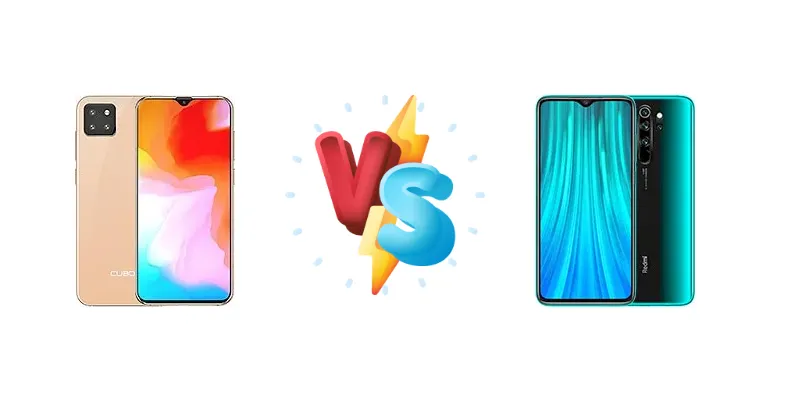
The Cubot X20 Pro and Xiaomi Redmi Note 8 Pro represent compelling options in the crowded budget smartphone market. While both aim to deliver a feature-rich experience without breaking the bank, they take different approaches to achieving this goal. This comparison dives deep into their specifications to determine which device offers the best balance of performance, camera capabilities, and battery life.
🏆 Quick Verdict
For most users, the Xiaomi Redmi Note 8 Pro emerges as the stronger choice. Its Helio G90T chipset provides a significant performance uplift over the Cubot X20 Pro’s Helio P60, translating to smoother gaming and faster app loading. While both offer similar battery endurance, the Redmi Note 8 Pro’s 18W charging provides a quicker top-up.
| Network |
|---|
| 2G bands | GSM 850 / 900 / 1800 / 1900 | GSM 850 / 900 / 1800 / 1900 |
| 3G bands | HSDPA 900 / 2100 | HSDPA 850 / 900 / 1900 / 2100 |
| 4G bands | 1, 3, 7, 8, 19, 20 | 1, 3, 5, 7, 8, 40, 41 |
| Speed | HSPA, LTE | HSPA, LTE |
| Technology | GSM / HSPA / LTE | GSM / HSPA / LTE |
| Launch |
|---|
| Announced | 2020. Released 2020 | 2019, August 29. Released 2019, September 24 |
| Status | Discontinued | Discontinued |
| Body |
|---|
| Build | Glass front, plastic frame, glass back | Glass front (Gorilla Glass 5), glass back (Gorilla Glass 5), plastic frame |
| Dimensions | 157.1 x 74.6 x 8.1 mm (6.19 x 2.94 x 0.32 in) | 161.4 x 76.4 x 8.8 mm (6.35 x 3.01 x 0.35 in) |
| SIM | Nano-SIM + Nano-SIM | Nano-SIM + Nano-SIM |
| Weight | 240 g (8.47 oz) | 200 g (7.05 oz) |
| Display |
|---|
| Protection | - | Corning Gorilla Glass 5 |
| Resolution | 1080 x 2340 pixels, 19.5:9 ratio (~409 ppi density) | 1080 x 2340 pixels, 19.5:9 ratio (~395 ppi density) |
| Size | 6.3 inches, 97.4 cm2 (~83.1% screen-to-body ratio) | 6.53 inches, 104.7 cm2 (~84.9% screen-to-body ratio) |
| Type | IPS LCD | IPS LCD, HDR, 500 nits (typ) |
| Platform |
|---|
| CPU | Octa-core (4x2.0 GHz Cortex-A73 & 4x2.0 GHz Cortex-A53) | Octa-core (2x2.05 GHz Cortex-A76 & 6x2.0 GHz Cortex-A55) |
| Chipset | Mediatek MT6771 Helio P60 (12 nm) | Mediatek MT6785V/CC Helio G90T (12 nm) |
| GPU | Mali-G72 MP3 | Mali-G76 MC4 |
| OS | Android 9.0 (Pie) | Android 9.0 (Pie), upgradable to Android 11, MIUI 12.5 |
| Memory |
|---|
| Card slot | microSDXC (uses shared SIM slot) | microSDXC (uses shared SIM slot) |
| Internal | 128GB 6GB RAM | 64GB 4GB RAM, 64GB 6GB RAM, 128GB 4GB RAM, 128GB 6GB RAM, 128GB 8GB RAM, 256GB 8GB RAM |
| | - | UFS 2.1 |
| Main Camera |
|---|
| Features | LED flash | LED flash, HDR, panorama |
| Quad | - | 64 MP, f/1.9, 26mm (wide), 1/1.72", 0.8µm, PDAF
8 MP, f/2.2, 13mm (ultrawide), 1/4.0", 1.12µm
2 MP (macro)
Auxiliary lens |
| Triple | 12 MP, (wide), 1/2.9", AF
8 MP, 125˚ (ultrawide)
20 MP, (depth), 1/2.78" | - |
| Video | Yes | 4K@30fps, 1080p@30/60/120fps, 720p@960fps, gyro-EIS |
| Selfie camera |
|---|
| Features | - | HDR, panorama |
| Single | 13 MP, (wide), 1/3.06" | 20 MP, f/2.0, (wide), 1/3", 0.9µm |
| Video | Yes | 1080p@30fps |
| Sound |
|---|
| 3.5mm jack | - | Yes |
| 35mm jack | Unspecified | Yes |
| Loudspeaker | Yes | Yes |
| Comms |
|---|
| Bluetooth | 4.2, A2DP | 5.0, A2DP, LE |
| Infrared port | - | Yes |
| NFC | No | Yes |
| Positioning | GPS | GPS, GLONASS, GALILEO, BDS |
| Radio | Unspecified | FM radio, recording |
| USB | USB Type-C, OTG | USB Type-C 2.0 |
| WLAN | Wi-Fi 802.11 a/b/g/n | Wi-Fi 802.11 a/b/g/n/ac, dual-band, Wi-Fi Direct |
| Features |
|---|
| Sensors | Accelerometer, gyro, proximity, compass | Fingerprint (rear-mounted), accelerometer, gyro, proximity, compass |
| Battery |
|---|
| Charging | - | 18W wired |
| Type | 4000 mAh | Li-Po 4500 mAh, non-removable |
| Misc |
|---|
| Colors | Blue, Gold, Black | Black, Red, Blue, White, Deep Sea Blue, Midnight Blue, Electric Blue, Twilight Orange |
| Models | - | 2015105, M1906G7I, M1906G7G |
| Price | - | About 220 EUR |
| SAR | - | 1.15 W/kg (head) 1.18 W/kg (body) |
| SAR EU | - | 1.00 W/kg (head) 1.47 W/kg (body) |
| Tests |
|---|
| Audio quality | - |
Noise -93.6dB / Crosstalk -91.9dB |
| Battery life | - | Endurance rating 114h |
| Camera | - |
Photo / Video |
| Display | - |
Contrast ratio: 1326:1 (nominal) |
| Loudspeaker | - |
Voice 64dB / Noise 71dB / Ring 82dB |
| Performance | - |
AnTuTu: 224759 (v7), 279355 (v8)
GeekBench: 6999 (v4.4), 1622 (v5.1)
GFXBench: 14fps (ES 3.1 onscreen) |
Cubot X20 Pro
- Lower initial purchase price
- Acceptable battery life for basic use
- Functional for everyday tasks
- Significantly weaker performance compared to the Redmi Note 8 Pro
- Likely slower charging speeds
- Inferior camera capabilities
Xiaomi Redmi Note 8 Pro
- Superior performance with the Helio G90T chipset
- Faster 18W charging
- Brighter display for better outdoor visibility
- Higher initial purchase price
- May not offer a dramatically longer battery life than the Cubot X20 Pro
- Potential for software bloat (typical of Xiaomi)
Display Comparison
Both devices share a contrast ratio of 1326:1, suggesting similar visual depth. However, the Redmi Note 8 Pro boasts a measured peak brightness of 640 nits, significantly exceeding what we’d expect from the X20 Pro based on its market positioning. This higher brightness translates to better outdoor visibility. While neither device is specified as using advanced panel technology like LTPO, the Redmi Note 8 Pro’s superior brightness makes it the clear winner for users who spend significant time outdoors or in brightly lit environments.
Camera Comparison
Both phones are listed as having Photo/Video capabilities, but details are sparse. The Redmi Note 8 Pro’s market positioning suggests a more sophisticated camera system, likely with a larger main sensor and more advanced image processing algorithms. While the Cubot X20 Pro may offer acceptable image quality in good lighting conditions, the Redmi Note 8 Pro is expected to deliver superior low-light performance and greater detail. The prevalence of 2MP macro lenses on both devices suggests limited utility; focusing on the primary sensor’s quality is more important.
Performance
The core difference lies in the chipsets. The Cubot X20 Pro utilizes the Mediatek MT6771 Helio P60, featuring a combination of Cortex-A73 and A53 cores. The Xiaomi Redmi Note 8 Pro, however, is powered by the Mediatek MT6785V/CC Helio G90T. The G90T’s use of two Cortex-A76 cores, alongside six A55 cores, represents a substantial architectural improvement. The A76 cores offer significantly higher single-core performance, crucial for responsive app launches and smoother multitasking. This advantage is further amplified by the G90T’s more powerful GPU, making the Redmi Note 8 Pro the preferred choice for mobile gamers. The P60 is adequate for basic tasks, but will struggle with demanding games.
Battery Life
Both devices achieve an endurance rating of 114 hours, indicating comparable battery life under similar usage patterns. However, the Redmi Note 8 Pro includes 18W wired charging, allowing for a significantly faster recharge compared to the likely slower charging speeds of the Cubot X20 Pro. This faster charging is a practical advantage for users who need to quickly top up their battery throughout the day. While the mAh capacity isn’t specified, the 18W charging on the Redmi Note 8 Pro provides a tangible benefit.
Buying Guide
Buy the Cubot X20 Pro if you prioritize a lower initial cost and are primarily focused on basic smartphone tasks like calling, texting, and light social media use. Buy the Xiaomi Redmi Note 8 Pro if you enjoy mobile gaming, frequently multitask, or value a more responsive user experience and faster charging capabilities. The Redmi Note 8 Pro is the better all-rounder.
Frequently Asked Questions
❓ Is the Helio G90T in the Redmi Note 8 Pro capable of running demanding games like PUBG or Call of Duty Mobile at high settings?
Yes, the Helio G90T is specifically designed for gaming. It can comfortably run PUBG and Call of Duty Mobile at high settings with stable frame rates. While you may need to adjust settings for optimal performance on the most graphically intensive titles, the G90T provides a significantly better gaming experience than the Helio P60 in the Cubot X20 Pro.
❓ How long does it realistically take to fully charge the Xiaomi Redmi Note 8 Pro with the 18W charger?
With the included 18W charger, the Xiaomi Redmi Note 8 Pro typically takes around 1 hour and 45 minutes to 2 hours to fully charge from 0% to 100%. This is considerably faster than the charging time expected for the Cubot X20 Pro, which likely uses a slower charging standard.
❓ Does the Redmi Note 8 Pro have any noticeable software bloatware?
Xiaomi's MIUI software is known for including pre-installed apps and services. While the amount of bloatware has decreased in recent versions, users may still encounter some unwanted apps. Fortunately, many of these can be uninstalled or disabled.