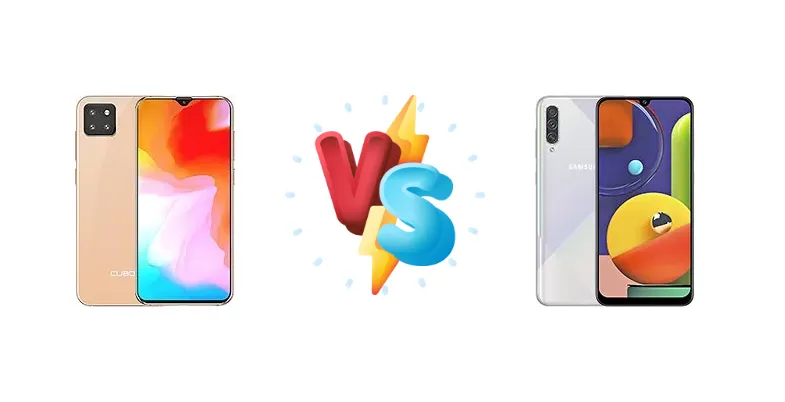
The Cubot X20 Pro and Samsung Galaxy A50s represent distinct approaches to the budget smartphone market. The X20 Pro aims to deliver competitive specs at an aggressive price point, while the A50s leverages Samsung’s brand recognition and refined software experience. This comparison dissects their core components to determine which device offers the best value for your money.
🏆 Quick Verdict
For the average user prioritizing efficiency and a smoother overall experience, the Samsung Galaxy A50s is the better choice. Its Exynos 9611, built on a 10nm process, offers superior power efficiency and sustained performance compared to the Cubot X20 Pro’s 12nm Helio P60, despite a slightly higher clock speed on some cores.
| Network |
|---|
| 2G bands | GSM 850 / 900 / 1800 / 1900 | GSM 850 / 900 / 1800 / 1900 |
| 3G bands | HSDPA 900 / 2100 | HSDPA 850 / 900 / 1900 / 2100 |
| 4G bands | 1, 3, 7, 8, 19, 20 | 1, 3, 5, 7, 8, 20, 28, 38, 40, 41 |
| Speed | HSPA, LTE | HSPA, LTE |
| Technology | GSM / HSPA / LTE | GSM / HSPA / LTE |
| Launch |
|---|
| Announced | 2020. Released 2020 | 2019, August 22. Released 2019, September |
| Status | Discontinued | Discontinued |
| Body |
|---|
| Build | Glass front, plastic frame, glass back | Glass front (Gorilla Glass 3), plastic back, plastic frame |
| Dimensions | 157.1 x 74.6 x 8.1 mm (6.19 x 2.94 x 0.32 in) | 158.5 x 74.5 x 7.7 mm (6.24 x 2.93 x 0.30 in) |
| SIM | Nano-SIM + Nano-SIM | · Nano-SIM· Nano-SIM + Nano-SIM |
| Weight | 240 g (8.47 oz) | 169 g (5.96 oz) |
| Display |
|---|
| Protection | - | Corning Gorilla Glass 3 |
| Resolution | 1080 x 2340 pixels, 19.5:9 ratio (~409 ppi density) | 1080 x 2340 pixels, 19.5:9 ratio (~403 ppi density) |
| Size | 6.3 inches, 97.4 cm2 (~83.1% screen-to-body ratio) | 6.4 inches, 100.5 cm2 (~85.1% screen-to-body ratio) |
| Type | IPS LCD | Super AMOLED |
| Platform |
|---|
| CPU | Octa-core (4x2.0 GHz Cortex-A73 & 4x2.0 GHz Cortex-A53) | Octa-core (4x2.3 GHz Cortex-A73 & 4x1.7 GHz Cortex-A53) |
| Chipset | Mediatek MT6771 Helio P60 (12 nm) | Exynos 9611 (10 nm) |
| GPU | Mali-G72 MP3 | Mali-G72 MP3 |
| OS | Android 9.0 (Pie) | Android 9.0 (Pie), upgradable to Android 11, One UI 3.1 |
| Memory |
|---|
| Card slot | microSDXC (uses shared SIM slot) | microSDXC (dedicated slot) |
| Internal | 128GB 6GB RAM | 64GB 4GB RAM, 128GB 4GB RAM, 128GB 6GB RAM |
| | - | UFS 2.1 |
| Main Camera |
|---|
| Features | LED flash | LED flash, panorama, HDR |
| Triple | 12 MP, (wide), 1/2.9", AF
8 MP, 125˚ (ultrawide)
20 MP, (depth), 1/2.78" | 48 MP, f/2.0, 26mm (wide), 1/2.0", 0.8µm, PDAF
8 MP, f/2.2, 13mm (ultrawide), 1/4.0", 1.12µm
Auxiliary lens |
| Video | Yes | 4K@30fps, 1080p@30fps |
| Selfie camera |
|---|
| Features | - | HDR |
| Single | 13 MP, (wide), 1/3.06" | 32 MP, f/2.0, 25mm (wide), 1/2.8", 0.8µm |
| Video | Yes | 4K@30fps, 1080p@30fps |
| Sound |
|---|
| 3.5mm jack | - | Yes |
| 35mm jack | Unspecified | Yes |
| Loudspeaker | Yes | Yes |
| Comms |
|---|
| Bluetooth | 4.2, A2DP | 5.0, A2DP, LE |
| NFC | No | Yes (market/region dependent) |
| Positioning | GPS | GPS, GLONASS, GALILEO, BDS |
| Radio | Unspecified | FM radio |
| USB | USB Type-C, OTG | USB Type-C 2.0, OTG |
| WLAN | Wi-Fi 802.11 a/b/g/n | Wi-Fi 802.11 a/b/g/n/ac, dual-band, Wi-Fi Direct |
| Features |
|---|
| Sensors | Accelerometer, gyro, proximity, compass | Fingerprint (under display, optical), accelerometer, gyro, proximity, compass |
| | - | ANT+ |
| Battery |
|---|
| Charging | - | 15W wired |
| Type | 4000 mAh | Li-Po 4000 mAh, non-removable |
| Misc |
|---|
| Colors | Blue, Gold, Black | Prism Crush Black, Prism Crush White, Prism Crush Green, Prism Crush Violet2 |
| Models | - | SM-A507F, SM-A507FN, SM-A5070 |
| Price | - | About 290 EUR |
| SAR EU | - | 0.43 W/kg (head) 1.55 W/kg (body) |
| Tests |
|---|
| Performance | - |
AnTuTu: 154761 (v7)
GeekBench: 5295 (v4.4)
GFXBench: 9.2fps (ES 3.1 onscreen) |
Cubot X20 Pro
- Potentially lower price point
- Aggressive specifications for the price
- May offer expandable storage
- Less efficient chipset (Helio P60)
- Likely inferior camera performance
- Potentially less refined software experience
Samsung Galaxy A50s
- More efficient chipset (Exynos 9611)
- Superior display quality (Super AMOLED)
- Refined software experience (Samsung One UI)
- Slightly higher price
- 15W charging is relatively slow
- May have limited storage options
Display Comparison
Neither device boasts a cutting-edge display. While specific display specs are unavailable for the Cubot X20 Pro, the Samsung Galaxy A50s features a Super AMOLED panel, known for its vibrant colors and deep blacks. The A50s’ panel likely has a higher contrast ratio than the X20 Pro’s, enhancing visual clarity. Bezels are expected to be comparable, typical of phones in this price bracket. Color accuracy is likely better on the A50s due to Samsung’s display calibration expertise.
Camera Comparison
Without detailed camera specs for the Cubot X20 Pro, a direct comparison is limited. However, Samsung typically excels in image processing. The A50s likely benefits from Samsung’s sophisticated algorithms for noise reduction and dynamic range optimization. While both phones likely include multiple rear cameras, the A50s’ image quality will likely be superior, particularly in challenging lighting conditions. The presence of Optical Image Stabilization (OIS) on the A50s, if equipped, would further enhance image clarity and reduce blur.
Performance
The core difference lies in the chipsets. The Samsung Galaxy A50s’ Exynos 9611 (10nm) has a clear architectural advantage over the Cubot X20 Pro’s Mediatek Helio P60 (12nm). The smaller 10nm node allows for greater transistor density and improved power efficiency. While both CPUs share the same Cortex-A73/A53 core configuration, the A50s’ cores run at 2.3 GHz versus 2.0 GHz on the X20 Pro. This, combined with the more efficient manufacturing process, translates to better sustained performance under load and less thermal throttling. The A50s will likely handle demanding games and multitasking more smoothly.
Battery Life
Battery capacity is not specified for the Cubot X20 Pro. The Samsung Galaxy A50s supports 15W wired charging. The Exynos 9611’s superior power efficiency will likely result in longer battery life for the A50s, even if the X20 Pro has a slightly larger battery capacity. The 15W charging on the A50s, while not exceptionally fast, is adequate for topping up the battery overnight.
Buying Guide
Buy the Cubot X20 Pro if you need a phone primarily for basic tasks like calling, texting, and light social media use, and are willing to accept potential performance limitations in demanding applications. Buy the Samsung Galaxy A50s if you prefer a more refined user experience, better sustained performance for gaming and multitasking, and the reliability of Samsung’s software ecosystem, even if it means paying a slight premium.
Frequently Asked Questions
❓ Does the Exynos 9611 in the Samsung Galaxy A50s tend to overheat during prolonged gaming sessions?
The Exynos 9611 is generally well-managed in terms of thermals. While it can get warm during extended gaming, the 10nm process helps prevent significant throttling, maintaining a relatively stable frame rate for longer periods compared to the Cubot X20 Pro’s Helio P60.
❓ Is the 2MP macro camera on either phone actually useful for taking detailed close-up photos?
Typically, 2MP macro cameras on phones in this price range offer limited detail and image quality. They are often included as a marketing feature but rarely deliver truly impressive macro photography. Expect soft images and limited dynamic range.
❓ Can the Samsung Galaxy A50s reliably run PUBG Mobile at 60fps?
The Samsung Galaxy A50s should be capable of running PUBG Mobile at 60fps on medium settings. However, sustained performance at higher settings may result in frame drops due to thermal limitations. The Exynos 9611 provides enough power for a playable experience, but don't expect flagship-level graphics.
❓ What kind of software updates can I expect on the Cubot X20 Pro?
Cubot's software update track record is less consistent than Samsung's. Expect fewer major Android version updates and potentially delayed security patches compared to the Samsung Galaxy A50s, which benefits from Samsung's more robust software support.