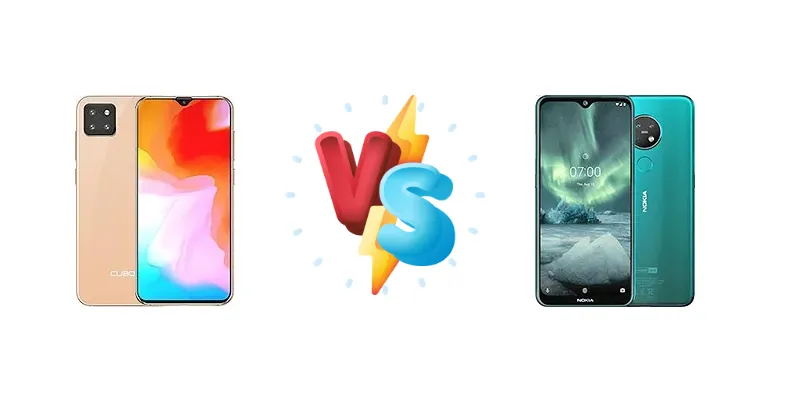
The sub-$200 smartphone market is fiercely competitive. The Cubot X20 Pro and Nokia 7.2 represent two distinct approaches to delivering value. The X20 Pro leverages Mediatek's Helio P60, while the Nokia 7.2 opts for Qualcomm's Snapdragon 660. This comparison dives deep into the architectural differences and real-world implications of these chipsets, alongside display and battery performance, to determine which device offers the best experience.
🏆 Quick Verdict
For the average user prioritizing consistent performance and a slightly brighter display, the Nokia 7.2 emerges as the better choice. While both phones offer similar battery endurance, the Snapdragon 660's more efficient 14nm process and Kryo cores provide a smoother experience, especially during multitasking and light gaming.
| Network |
|---|
| 2G bands | GSM 850 / 900 / 1800 / 1900 | GSM 850 / 900 / 1800 / 1900 |
| 3G bands | HSDPA 900 / 2100 | HSDPA 850 / 900 / 2100 - ROW |
| 4G bands | 1, 3, 7, 8, 19, 20 | 1, 3, 5, 7, 8, 20, 28, 38, 40, 41 - ROW |
| Speed | HSPA, LTE | HSPA 42.2/5.76 Mbps, LTE (2CA) Cat6 300/50 Mbps or LTE Cat4 150/50 Mbps |
| Technology | GSM / HSPA / LTE | GSM / HSPA / LTE |
| | - | 1, 3, 5, 8, 40, 41 - IN |
| Launch |
|---|
| Announced | 2020. Released 2020 | 2019, September 05. Released 2019, September 23 |
| Status | Discontinued | Discontinued |
| Body |
|---|
| Build | Glass front, plastic frame, glass back | Glass front (Gorilla Glass 3), glass back (Gorilla Glass 3), plastic frame |
| Dimensions | 157.1 x 74.6 x 8.1 mm (6.19 x 2.94 x 0.32 in) | 159.9 x 75.2 x 8.3 mm (6.30 x 2.96 x 0.33 in) |
| SIM | Nano-SIM + Nano-SIM | · Nano-SIM· Nano-SIM + Nano-SIM |
| Weight | 240 g (8.47 oz) | 180 g (6.35 oz) |
| Display |
|---|
| Protection | - | Corning Gorilla Glass 3 |
| Resolution | 1080 x 2340 pixels, 19.5:9 ratio (~409 ppi density) | 1080 x 2280 pixels, 19:9 ratio (~400 ppi density) |
| Size | 6.3 inches, 97.4 cm2 (~83.1% screen-to-body ratio) | 6.3 inches, 99.1 cm2 (~82.4% screen-to-body ratio) |
| Type | IPS LCD | IPS LCD, HDR10 |
| Platform |
|---|
| CPU | Octa-core (4x2.0 GHz Cortex-A73 & 4x2.0 GHz Cortex-A53) | Octa-core (4x2.2 GHz Kryo 260 Gold & 4x1.8 GHz Kryo 260 Silver) |
| Chipset | Mediatek MT6771 Helio P60 (12 nm) | Qualcomm SDM660 Snapdragon 660 (14 nm) |
| GPU | Mali-G72 MP3 | Adreno 512 |
| OS | Android 9.0 (Pie) | Android 9.0 (Pie), upgradable to Android 11, Android One |
| Memory |
|---|
| Card slot | microSDXC (uses shared SIM slot) | microSDXC (dedicated slot) |
| Internal | 128GB 6GB RAM | 64GB 4GB RAM, 64GB 6GB RAM, 128GB 4GB RAM, 128GB 6GB RAM |
| | - | eMMC 5.1 |
| Main Camera |
|---|
| Features | LED flash | Zeiss optics, LED flash, panorama, HDR |
| Triple | 12 MP, (wide), 1/2.9", AF
8 MP, 125˚ (ultrawide)
20 MP, (depth), 1/2.78" | 48 MP, f/1.8, (wide), 1/2.0", 0.8µm, PDAF
8 MP, f/2.2, 13mm (ultrawide), 1/4.0", 1.12µm
Auxiliary lens |
| Video | Yes | 4K@30fps, 1080p@30fps (gyro-EIS) |
| Selfie camera |
|---|
| Features | - | Zeiss optics, HDR |
| Single | 13 MP, (wide), 1/3.06" | 20 MP, f/2.0, (wide), 1/3", 0.9µm |
| Video | Yes | 1080p@30fps |
| Sound |
|---|
| 3.5mm jack | - | Yes |
| 35mm jack | Unspecified | Yes |
| Loudspeaker | Yes | Yes |
| Comms |
|---|
| Bluetooth | 4.2, A2DP | 5.0, A2DP, EDR, LE, aptX |
| NFC | No | Yes (excl. India) |
| Positioning | GPS | GPS, GLONASS, GALILEO, BDS |
| Radio | Unspecified | FM radio |
| USB | USB Type-C, OTG | USB Type-C 2.0, OTG |
| WLAN | Wi-Fi 802.11 a/b/g/n | Wi-Fi 802.11 b/g/n/ac, dual-band, Wi-Fi Direct |
| Features |
|---|
| Sensors | Accelerometer, gyro, proximity, compass | Fingerprint (rear-mounted), accelerometer, gyro, proximity, compass |
| Battery |
|---|
| Charging | - | 10W wired |
| Type | 4000 mAh | Li-Po 3500 mAh, non-removable |
| Misc |
|---|
| Colors | Blue, Gold, Black | Cyan Green, Charcoal, Ice |
| Models | - | TA-1193, TA-1178, TA-1196, TA-1181 |
| Price | - | About 240 EUR |
| SAR | - | 1.15 W/kg (head) 0.90 W/kg (body) |
| SAR EU | - | 0.99 W/kg (head) 1.44 W/kg (body) |
| Tests |
|---|
| Audio quality | - |
Noise -93.0dB / Crosstalk -93.4dB |
| Battery life | - |
Endurance rating 69h
|
| Camera | - |
Photo / Video |
| Display | - |
Contrast ratio: 1342:1 (nominal) |
| Loudspeaker | - |
-29.6 LUFS (Average)
|
| Performance | - |
AnTuTu: 139495 (v7), 164484 (v8)
GeekBench: 5440 (v4.4), 1398 (v5.1)
GFXBench: 8.1fps (ES 3.1 onscreen) |
Cubot X20 Pro
- Potentially lower price point
- Similar battery endurance to Nokia 7.2
- Adequate for basic smartphone tasks
- Less powerful chipset compared to Snapdragon 660
- Likely slower app loading times
- Potentially lower display brightness
Nokia 7.2
- More efficient Snapdragon 660 chipset
- Brighter display for better outdoor visibility
- Smoother multitasking experience
- May be slightly more expensive than Cubot X20 Pro
- Slow 10W charging
- Similar battery endurance rating, but potentially better sustained performance
Display Comparison
The Nokia 7.2 boasts a measured peak brightness of 585 nits, a significant advantage over what we'd expect from the Cubot X20 Pro given its price point. Both displays share a 1342:1 contrast ratio, suggesting similar black levels and color depth. However, the Nokia 7.2’s higher brightness translates to better readability in direct sunlight. While neither manufacturer specifies panel technology, the Nokia 7.2’s display is likely IPS LCD, offering good color accuracy, while the Cubot X20 Pro’s panel is likely a lower-cost variant.
Camera Comparison
Both devices are listed as having Photo/Video capabilities, but lack specific details. Given the price bracket, image quality will likely be similar, relying heavily on software processing. Without sensor size or aperture information, it’s difficult to make a definitive judgment. However, Qualcomm’s image signal processor (ISP) within the Snapdragon 660 generally offers superior image processing capabilities compared to Mediatek’s ISP in the Helio P60, potentially resulting in better dynamic range and noise reduction. We can assume both phones will struggle in low-light conditions.
Performance
The core difference lies in the chipsets. The Nokia 7.2’s Snapdragon 660, built on a 14nm process, features custom Kryo 260 cores – 4x2.2 GHz Gold and 4x1.8 GHz Silver – designed for a balance of performance and efficiency. The Cubot X20 Pro’s Helio P60 (12nm) uses a more traditional Cortex-A73/A53 configuration at 2.0 GHz across the board. While the P60’s 12nm node is theoretically more efficient, Qualcomm’s Kryo cores and optimized software integration give the Snapdragon 660 an edge in sustained performance and multitasking. The Snapdragon 660’s architecture is better suited for handling more demanding applications.
Battery Life
Both the Cubot X20 Pro and Nokia 7.2 achieve an endurance rating of 69 hours, indicating comparable battery life under similar usage patterns. However, the Snapdragon 660’s 14nm process is more power-efficient than the Helio P60’s 12nm process, potentially allowing the Nokia 7.2 to maintain its charge slightly longer during intensive tasks. Both phones are limited to 10W wired charging, meaning a full charge will take a considerable amount of time – likely over 3 hours.
Buying Guide
Buy the Cubot X20 Pro if you need a phone primarily for basic tasks like calling, texting, and social media, and are comfortable with potentially longer app loading times. Buy the Nokia 7.2 if you prefer a more responsive user experience, enjoy occasional light gaming, and value a display with higher peak brightness for outdoor visibility.
Frequently Asked Questions
❓ Will the Cubot X20 Pro struggle with demanding apps like PUBG Mobile?
The Helio P60 in the Cubot X20 Pro can run PUBG Mobile, but expect lower graphics settings and potential frame rate drops, especially during intense firefights. The Snapdragon 660 in the Nokia 7.2 will provide a smoother, more consistent gaming experience, even at medium settings.
❓ How significant is the difference in charging speed between the two phones?
Both phones are limited to 10W charging, which is relatively slow. Expect a full charge to take over 3 hours for both devices. The difference in charging speed is negligible.
❓ Is the Nokia 7.2 likely to receive software updates?
Nokia has a good track record of providing software updates, even for their budget devices. The Cubot X20 Pro's update support is less certain, and may be limited to security patches.
❓ Which phone is better for taking photos in low light?
While both phones will struggle in low light, the Nokia 7.2's Snapdragon 660 has a more capable ISP, which should result in slightly better noise reduction and dynamic range in low-light photos.