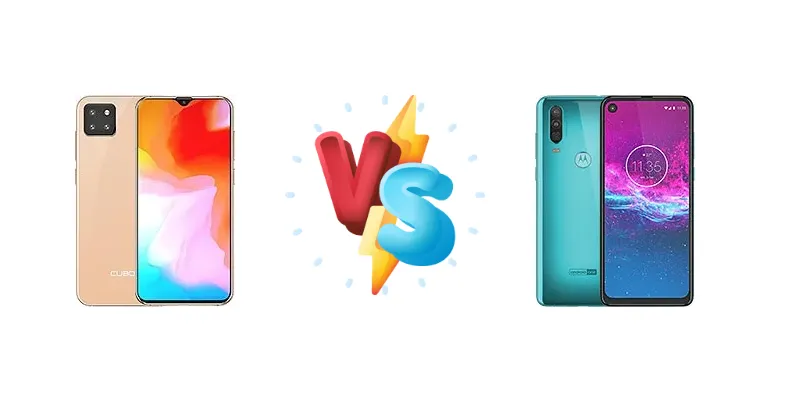
The Cubot X20 Pro and Motorola One Action represent distinct approaches to the budget-to-mid-range smartphone market. The Cubot focuses on delivering a modern chipset at a competitive price, while the Motorola One Action prioritizes a refined user experience and a respectable endurance rating. This comparison dissects their key differences to determine which device best suits your needs.
🏆 Quick Verdict
For the average user prioritizing consistent performance and a slightly brighter display, the Motorola One Action emerges as the better choice. Its Exynos 9609, built on a more efficient 10nm process, offers a performance edge over the Cubot X20 Pro’s Helio P60, despite both utilizing the same Cortex-A73 architecture.
| Network |
|---|
| 2G bands | GSM 850 / 900 / 1800 / 1900 | GSM 850 / 900 / 1800 / 1900 |
| 3G bands | HSDPA 900 / 2100 | HSDPA 850 / 900 / 1900 / 2100 |
| 4G bands | 1, 3, 7, 8, 19, 20 | 1, 3, 5, 7, 8, 20, 38, 40, 41 |
| Speed | HSPA, LTE | HSPA 42.2/5.76 Mbps, LTE (2CA) Cat6 300/50 Mbps |
| Technology | GSM / HSPA / LTE | GSM / CDMA / HSPA / EVDO / LTE |
| | - | 1, 2, 3, 4, 5, 7, 8, 12, 13, 17, 25, 26, 38, 41, 66 - USA |
| Launch |
|---|
| Announced | 2020. Released 2020 | 2019, August 16. Released 2019, October 31 |
| Status | Discontinued | Discontinued |
| Body |
|---|
| Build | Glass front, plastic frame, glass back | Glass front, plastic back, plastic frame |
| Dimensions | 157.1 x 74.6 x 8.1 mm (6.19 x 2.94 x 0.32 in) | 160.1 x 71.2 x 9.2 mm (6.30 x 2.80 x 0.36 in) |
| SIM | Nano-SIM + Nano-SIM | · Nano-SIM· Nano-SIM + Nano-SIM |
| Weight | 240 g (8.47 oz) | 176 g (6.21 oz) |
| | - | Water-repellent coating |
| Display |
|---|
| Resolution | 1080 x 2340 pixels, 19.5:9 ratio (~409 ppi density) | 1080 x 2520 pixels, 21:9 ratio (~432 ppi density) |
| Size | 6.3 inches, 97.4 cm2 (~83.1% screen-to-body ratio) | 6.3 inches, 94.0 cm2 (~82.5% screen-to-body ratio) |
| Type | IPS LCD | IPS LCD |
| Platform |
|---|
| CPU | Octa-core (4x2.0 GHz Cortex-A73 & 4x2.0 GHz Cortex-A53) | Octa-core (4x2.2 GHz Cortex-A73 & 4x1.6 GHz Cortex-A53) |
| Chipset | Mediatek MT6771 Helio P60 (12 nm) | Exynos 9609 (10 nm) |
| GPU | Mali-G72 MP3 | Mali-G72 MP3 |
| OS | Android 9.0 (Pie) | Android 9.0 (Pie), upgradable to Android 11, Android One |
| Memory |
|---|
| Card slot | microSDXC (uses shared SIM slot) | microSDXC (uses shared SIM slot) |
| Internal | 128GB 6GB RAM | 128GB 4GB RAM |
| | - | UFS 2.1 |
| Main Camera |
|---|
| Features | LED flash | Dual-LED dual-tone flash, HDR, panorama |
| Triple | 12 MP, (wide), 1/2.9", AF
8 MP, 125˚ (ultrawide)
20 MP, (depth), 1/2.78" | 12 MP, f/1.8, 26mm (wide), 1/2.8", 1.25µm, PDAF
16 MP, f/2.2, 14mm (ultrawide), dedicated video camera (1080p)
Auxiliary lens |
| Video | Yes | 4K@30fps, 1080p@30/60fps (gyro-EIS) |
| Selfie camera |
|---|
| Features | - | HDR |
| Single | 13 MP, (wide), 1/3.06" | 12 MP, f/2.0, 26mm (wide), 1/2.8", 1.25µm |
| Video | Yes | 1080p@30fps |
| Sound |
|---|
| 3.5mm jack | - | Yes |
| 35mm jack | Unspecified | Yes |
| Loudspeaker | Yes | Yes |
| Comms |
|---|
| Bluetooth | 4.2, A2DP | 5.0, A2DP, LE, EDR |
| NFC | No | Yes |
| Positioning | GPS | GPS, GLONASS, GALILEO, BDS |
| Radio | Unspecified | FM radio |
| USB | USB Type-C, OTG | USB Type-C 2.0, OTG |
| WLAN | Wi-Fi 802.11 a/b/g/n | Wi-Fi 802.11 a/b/g/n/ac, dual-band, Wi-Fi Direct |
| Features |
|---|
| Sensors | Accelerometer, gyro, proximity, compass | Fingerprint (rear-mounted), accelerometer, gyro, proximity, compass |
| Battery |
|---|
| Charging | - | 10W wired |
| Type | 4000 mAh | Li-Po 3500 mAh, non-removable |
| Misc |
|---|
| Colors | Blue, Gold, Black | Denim Blue, Pearl White, Aqua Teal |
| Models | - | XT2013-1, XT2013-2, XT2013-4 |
| Price | - | About 160 EUR |
| SAR | - | 1.16 W/kg (head) 1.43 W/kg (body) |
| Tests |
|---|
| Audio quality | - |
Noise -93.4dB / Crosstalk -93.7dB |
| Battery life | - |
Endurance rating 66h
|
| Camera | - |
Photo / Video |
| Display | - |
Contrast ratio: 1237:1 (nominal) |
| Loudspeaker | - |
Voice 67dB / Noise 71dB / Ring 84dB
|
| Performance | - |
AnTuTu: 148748 (v7)
GeekBench: 5271 (v4.4) |
Cubot X20 Pro
- Potentially lower price point
- Modern Helio P60 chipset
- Good endurance rating (66h)
- 12nm process may lead to more heat
- Display specifications unknown
- Charging speed not specified
Motorola One Action
- More efficient 10nm Exynos 9609
- Brighter display (459 nits)
- Guaranteed 66-hour endurance
- Slow 10W charging
- Camera details are limited
- May be slightly more expensive
Display Comparison
The Motorola One Action boasts a measured peak brightness of 459 nits and a 1237:1 contrast ratio, providing a more vibrant and visible experience, particularly outdoors. While the Cubot X20 Pro’s display specifications are not provided, the Motorola’s higher brightness is a tangible advantage. The contrast ratio, while similar, benefits from the brighter panel, resulting in deeper blacks and more impactful colors. Neither device is expected to feature high refresh rate panels, focusing instead on power efficiency.
Camera Comparison
Both devices are listed as having Photo/Video capabilities, but lack specific details. Without sensor size, aperture, or image processing details, a direct comparison is difficult. However, the Motorola One Action’s brand reputation suggests a more refined camera experience. The Cubot X20 Pro, being a budget-focused device, may rely more heavily on software processing to compensate for potentially lower-quality hardware. The absence of details regarding OIS or advanced features suggests both cameras are geared towards casual photography.
Performance
Both phones utilize an octa-core CPU configuration with 4x Cortex-A73 and 4x Cortex-A53 cores, but the Motorola One Action’s Exynos 9609, fabricated on a 10nm process, holds a performance advantage over the Cubot X20 Pro’s 12nm Helio P60. The 10nm process allows for greater transistor density and improved thermal efficiency, potentially leading to less throttling during sustained workloads. The Exynos 9609’s slightly higher clock speeds (2.2 GHz vs 2.0 GHz) further contribute to its performance edge, making it better suited for demanding applications and multitasking.
Battery Life
Both the Cubot X20 Pro and Motorola One Action share an endurance rating of 66 hours, indicating comparable battery life under similar usage conditions. However, the Motorola One Action’s 10W wired charging is significantly slower than what is becoming standard in the market. The Cubot X20 Pro’s charging speed is not specified, but a faster charging solution would be a significant advantage. The Exynos 9609’s 10nm process also contributes to better power efficiency, potentially offsetting any capacity differences.
Buying Guide
Buy the Cubot X20 Pro if you need a phone with a newer chipset and are comfortable potentially optimizing software for peak performance. It’s ideal for users who enjoy tinkering and maximizing value. Buy the Motorola One Action if you prefer a more polished, out-of-the-box experience with a guaranteed 66-hour endurance rating and a brighter, more visible display in outdoor conditions.
Frequently Asked Questions
❓ Does the Exynos 9609 in the Motorola One Action tend to overheat during prolonged gaming sessions?
The Exynos 9609, built on a 10nm process, is generally more thermally efficient than the Helio P60. While it can still get warm during extended gaming, it's less prone to significant throttling compared to the Cubot X20 Pro, which uses a less efficient 12nm process. Expect playable frame rates for most titles, but demanding games may require reduced graphics settings.
❓ How does the 66-hour endurance rating translate to real-world usage on the Motorola One Action?
The 66-hour endurance rating is based on a standardized test profile. In real-world usage, your mileage will vary depending on screen brightness, app usage, and network conditions. However, it suggests the Motorola One Action can comfortably last a full day of moderate use, and potentially two days with lighter usage. The 10W charging will require planning, as a full charge will take a considerable amount of time.
❓ Is the lack of detailed camera specifications on both phones a cause for concern?
Yes, it is. The absence of sensor size, aperture, and OIS details makes it difficult to assess the camera's capabilities. While both phones can take photos and videos, expect image quality to be average, particularly in low-light conditions. The Motorola One Action likely benefits from better software processing, but it's still a significant unknown.