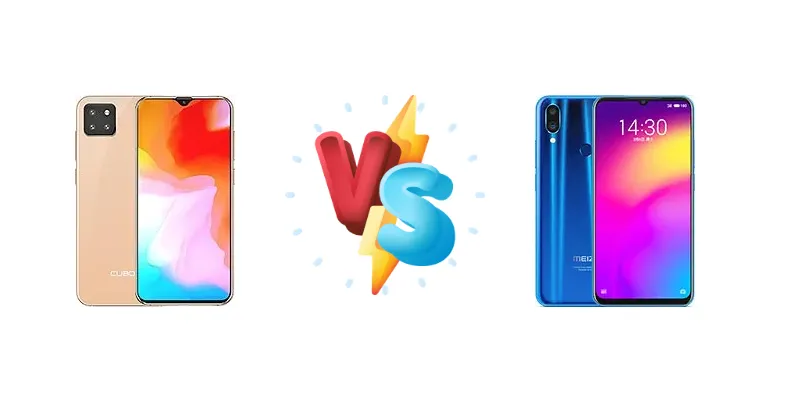
The sub-$200 smartphone market is fiercely competitive. The Cubot X20 Pro, powered by the Mediatek Helio P60, and the Meizu Note 9, featuring the Qualcomm Snapdragon 675, both aim to deliver a solid experience without breaking the bank. This comparison dives deep into their core components to determine which device offers the best value for budget-conscious consumers.
🏆 Quick Verdict
For most users, the Meizu Note 9 emerges as the stronger choice. Its Snapdragon 675, built on an 11nm process, provides a noticeable performance advantage over the Cubot X20 Pro’s Helio P60 (12nm), translating to smoother multitasking and gaming. The inclusion of 18W charging further sweetens the deal, making it a more practical daily driver.
| Network |
|---|
| 2G bands | GSM 850 / 900 / 1800 / 1900 | GSM 850 / 900 / 1800 / 1900 |
| 3G bands | HSDPA 900 / 2100 | HSDPA 850 / 900 / 2100 |
| 4G bands | 1, 3, 7, 8, 19, 20 | 1, 3, 5, 8, 34, 38, 39, 40, 41 |
| Speed | HSPA, LTE | HSPA, LTE |
| Technology | GSM / HSPA / LTE | GSM / CDMA / HSPA / LTE |
| | - | CDMA 800 & TD-SCDMA |
| Launch |
|---|
| Announced | 2020. Released 2020 | 2019, March. Released 2019, March |
| Status | Discontinued | Discontinued |
| Body |
|---|
| Build | Glass front, plastic frame, glass back | - |
| Dimensions | 157.1 x 74.6 x 8.1 mm (6.19 x 2.94 x 0.32 in) | 153.1 x 74.4 x 8.7 mm (6.03 x 2.93 x 0.34 in) |
| SIM | Nano-SIM + Nano-SIM | Nano-SIM + Nano-SIM |
| Weight | 240 g (8.47 oz) | 170 g (6.00 oz) |
| Display |
|---|
| Resolution | 1080 x 2340 pixels, 19.5:9 ratio (~409 ppi density) | 1080 x 2244 pixels, 18.7:9 ratio (~403 ppi density) |
| Size | 6.3 inches, 97.4 cm2 (~83.1% screen-to-body ratio) | 6.2 inches, 96.4 cm2 (~84.7% screen-to-body ratio) |
| Type | IPS LCD | IPS LCD |
| Platform |
|---|
| CPU | Octa-core (4x2.0 GHz Cortex-A73 & 4x2.0 GHz Cortex-A53) | Octa-core (2x2.0 GHz Kryo 460 Gold & 6x1.7 GHz Kryo 460 Silver) |
| Chipset | Mediatek MT6771 Helio P60 (12 nm) | Qualcomm SDM675 Snapdragon 675 (11 nm) |
| GPU | Mali-G72 MP3 | Adreno 612 |
| OS | Android 9.0 (Pie) | Android 9.0 (Pie), Flyme 7.2 |
| Memory |
|---|
| Card slot | microSDXC (uses shared SIM slot) | No |
| Internal | 128GB 6GB RAM | 64GB 4GB RAM, 64GB 6GB RAM, 128GB 6GB RAM |
| Main Camera |
|---|
| Dual | - | 48 MP, f/1.7, (wide), 1/2.0", 0.8µm, PDAF
Auxiliary lens |
| Features | LED flash | Dual-LED dual-tone flash, panorama |
| Triple | 12 MP, (wide), 1/2.9", AF
8 MP, 125˚ (ultrawide)
20 MP, (depth), 1/2.78" | - |
| Video | Yes | 1080p@30fps |
| Selfie camera |
|---|
| Single | 13 MP, (wide), 1/3.06" | 20 MP, f/2.0, (wide), 1/2.8", 1.0µm |
| Video | Yes | 1080p@30fps |
| Sound |
|---|
| 3.5mm jack | - | Yes |
| 35mm jack | Unspecified | Yes |
| Loudspeaker | Yes | Yes |
| Comms |
|---|
| Bluetooth | 4.2, A2DP | 5.0, A2DP, LE |
| NFC | No | No |
| Positioning | GPS | GPS, GLONASS, BDS |
| Radio | Unspecified | No |
| USB | USB Type-C, OTG | USB Type-C 2.0 |
| WLAN | Wi-Fi 802.11 a/b/g/n | Wi-Fi 802.11 a/b/g/n/ac, dual-band, Wi-Fi Direct |
| Features |
|---|
| Sensors | Accelerometer, gyro, proximity, compass | Fingerprint (rear-mounted), accelerometer, gyro, proximity, compass |
| Battery |
|---|
| Charging | - | 18W wired |
| Type | 4000 mAh | Li-Ion 4000 mAh, non-removable |
| Misc |
|---|
| Colors | Blue, Gold, Black | Black, White, Starlight Blue |
| Price | - | About 200 EUR |
Cubot X20 Pro
- Potentially lower price point
- Decent performance for basic tasks
- Likely large battery capacity (assumption based on market segment)
- Older and less efficient Helio P60 chipset
- Slower charging speeds (likely)
- Inferior ISP for image processing
Meizu Note 9
- More powerful Snapdragon 675 chipset
- Faster 18W wired charging
- Superior ISP for better image quality
- Potentially higher price
- May have a smaller battery capacity
- Software support may be limited (Meizu's history)
Display Comparison
Neither device boasts a standout display. Given the context data, we can assume both likely utilize IPS LCD panels, common in this price bracket. The key difference lies under the hood. The Snapdragon 675’s ISP supports better image signal processing, potentially leading to slightly improved photo quality even with similar camera sensors. Bezels are likely comparable, and color accuracy will depend on software calibration, a detail not provided.
Camera Comparison
Without detailed camera sensor information, a direct comparison is difficult. However, the Snapdragon 675’s image signal processor (ISP) is more capable than the Helio P60’s. This means the Meizu Note 9 can process images faster and with greater detail, even if both phones have similar megapixel counts. The ISP also supports features like better dynamic range and noise reduction. The absence of OIS information suggests neither phone will excel in low-light photography, but the superior ISP gives the Meizu Note 9 an edge.
Performance
The Qualcomm Snapdragon 675 (11nm) in the Meizu Note 9 holds a significant advantage over the Mediatek Helio P60 (12nm) in the Cubot X20 Pro. The 11nm process node allows for greater transistor density and improved power efficiency, resulting in better sustained performance and reduced thermal throttling. While both are octa-core CPUs, the Snapdragon 675’s Kryo 460 Gold cores (2x2.0 GHz) are architecturally more advanced than the Helio P60’s Cortex-A73 cores (4x2.0 GHz), offering superior single-core performance. The six Kryo 460 Silver cores (1.7 GHz) handle background tasks efficiently. This translates to a snappier user experience and better performance in demanding applications.
Battery Life
While the exact battery capacities are unknown, the Meizu Note 9’s 18W wired charging is a clear advantage. Faster charging significantly reduces downtime and makes the phone more convenient for users on the go. The Helio P60, while power-efficient, is offset by the Snapdragon 675’s superior process node. Even if the Cubot X20 Pro has a slightly larger battery, the Meizu Note 9’s faster charging will likely result in a more usable experience throughout the day.
Buying Guide
Buy the Cubot X20 Pro if you prioritize a potentially lower initial cost and are primarily focused on basic smartphone tasks like calling, texting, and light social media use. Buy the Meizu Note 9 if you value smoother performance, faster charging, and a more responsive user experience, even if it means spending slightly more upfront. The Note 9 is the better option for users who enjoy mobile gaming or frequently switch between applications.
Frequently Asked Questions
❓ Will the Snapdragon 675 in the Meizu Note 9 handle demanding games like PUBG Mobile smoothly?
Yes, the Snapdragon 675 is capable of running PUBG Mobile at medium to high settings with playable frame rates. While it won't deliver a flagship-level experience, it offers a significantly smoother gaming experience compared to the Helio P60, which may struggle with consistent frame rates in demanding titles.
❓ Is the 18W charging on the Meizu Note 9 a significant improvement over standard 10W charging?
Absolutely. 18W charging can reduce charging times by 40-50% compared to 10W charging. This means you can get a substantial charge in a shorter amount of time, making it much more convenient for users who are always on the go. A full charge from 0-100% will likely take around 90-120 minutes with 18W charging.
❓ Does the Cubot X20 Pro support software updates, and for how long?
Cubot's track record for software updates is inconsistent. While they typically provide initial Android version updates, long-term security patches are less frequent. Expect limited software support compared to more established brands like Meizu, though Meizu's support is also not known for being extensive.