
Cubot X100 vs. Oukitel WP210: A Deep Dive into Battery Life and Performance
| Phones Images | |||||
|---|---|---|---|---|---|
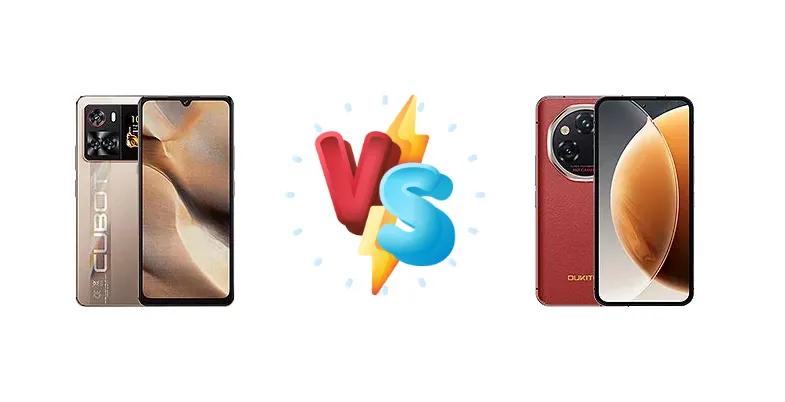
|
🏆 Quick Verdict
For the average user prioritizing longevity and minimizing charging frequency, the Oukitel WP210 is the clear winner. Its massive 86:17h battery endurance significantly outweighs the Cubot X100’s 31:15h, despite a slightly lower cycle count. However, gamers and power users will appreciate the X100’s more modern CPU architecture.
| PHONES | ||
|---|---|---|
| Phone Names | Cubot X100 | Oukitel WP210 |
| Network | ||
|---|---|---|
| 2G bands | GSM 850 / 900 / 1800 / 1900 | GSM 850 / 900 / 1800 / 1900 |
| 3G bands | HSDPA 800 / 850 / 900 / 1700(AWS) / 1900 / 2100 | HSDPA 800 / 850 / 900 / 1700(AWS) / 1900 / 2100 |
| 4G bands | 1, 2, 3, 4, 5, 7, 8, 12, 13, 17, 18, 19, 20, 25, 26, 28, 34, 38, 39, 40, 41, 66, 71 | 1, 2, 3, 4, 5, 7, 8, 12, 13, 17, 18, 19, 20, 25, 26, 28, 34, 38, 39, 40, 41, 66, 71 |
| 5G bands | 1, 2, 3, 5, 7, 8, 20, 25, 28, 38, 40, 41, 66, 77, 78 SA/NSA | 1, 2, 3, 5, 7, 8, 12, 20, 25, 28, 34, 38, 39, 40, 41, 48, 66, 71, 77, 78 SA/NSA |
| Speed | HSPA, LTE, 5G | HSPA, LTE, 5G |
| Technology | GSM / HSPA / LTE / 5G | GSM / HSPA / LTE / 5G |
| Launch | ||
|---|---|---|
| Announced | 2025, August | 2025, July |
| Status | Available. Released 2025, August | Available. Released 2025, July 15 |
| Body | ||
|---|---|---|
| Build | Glass front, plastic frame, plastic back | - |
| Dimensions | 171.9 x 78.1 x 8.9 mm (6.77 x 3.07 x 0.35 in) | 163.6 x 77.9 x 13.7 mm (6.44 x 3.07 x 0.54 in) |
| SIM | Nano-SIM + Nano-SIM | Nano-SIM + Nano-SIM |
| Weight | 207 g (7.30 oz) | 311 g (10.97 oz) |
| Display | ||
|---|---|---|
| Protection | Mohs level 6 | Corning Gorilla Glass 5, Mohs level 5 |
| Resolution | 720 x 1640 pixels (~260 ppi density) | 1080 x 2408 pixels, 20:9 ratio (~394 ppi density) |
| Size | 6.88 inches, 112.4 cm2 (~83.7% screen-to-body ratio) | 6.7 inches, 108.1 cm2 (~84.9% screen-to-body ratio) |
| Type | IPS LCD, 120Hz | IPS LCD, 120Hz, 500 nits |
| Platform | ||
|---|---|---|
| CPU | Octa-core (2x2.5 GHz Cortex-A78 & 6x2.0 GHz Cortex-A55) | Octa-core (1x3.1 GHz Cortex-A78 & 3x3.0 GHz Cortex-A78 & 4x2.0 GHz Cortex-A55) |
| Chipset | Mediatek Dimensity 7025 (6 nm) | Mediatek Dimensity 8200 (4 nm) |
| GPU | IMG BXM-8-256 | Mali-G610 MC6 |
| OS | Android 15 | Android 15 |
| Memory | ||
|---|---|---|
| Card slot | No | microSDXC (uses shared SIM slot) |
| Internal | 256GB 8GB RAM, 256GB 12GB RAM | 512GB 12GB RAM |
| Main Camera | ||
|---|---|---|
| Features | LED flash, HDR, panorama | LED flash, HDR, panorama |
| Triple | 64 MP, (wide), PDAF 5 MP, (ultrawide) 2 MP (macro) | 108 MP, f/1.9, (wide), 1/1.8", PDAF 2 MP (macro) Auxiliary lens |
| Video | 1080p@30fps | 4K@30fps |
| Selfie camera | ||
|---|---|---|
| Single | 16 MP | 32 MP, f/2.2, (wide), 1/2.74" |
| Video | 1080p@30fps | 1080p@30fps |
| Sound | ||
|---|---|---|
| 35mm jack | No | No |
| Loudspeaker | Yes, with stereo speakers | Yes |
| Comms | ||
|---|---|---|
| Bluetooth | 5.1, A2DP | 5.3, A2DP, LE |
| NFC | Yes | Yes |
| Positioning | GPS, GALILEO, GLONASS, BDS | GPS (L1+L5), GLONASS, GALILEO, BDS |
| Radio | Unspecified | FM radio |
| USB | USB Type-C, OTG | USB Type-C 2.0 |
| WLAN | Wi-Fi 802.11 a/b/g/n/ac, dual-band | Wi-Fi 802.11 a/b/g/n/ac/6, dual-band |
| Features | ||
|---|---|---|
| Sensors | Fingerprint (side-mounted), accelerometer, gyro, proximity, compass | Fingerprint (side-mounted), accelerometer, gyro, proximity, compass |
| Battery | ||
|---|---|---|
| Charging | 33W wired | 45W wired |
| Type | 5100 mAh | Li-Po 8800 mAh |
| Misc | ||
|---|---|---|
| Colors | Gray, Gold | Gray, Black, Red |
| Price | $ 213.21 / € 199.95 | - |
| EU LABEL | ||
|---|---|---|
| Battery | 31:15h endurance, 1400 cycles | 86:17h endurance, 1000 cycles |
| Energy | Class E | Class B |
| Free fall | Class A (270 falls) | Class A (270 falls) |
| Repairability | Class B | Class C |
Cubot X100
- More efficient CPU architecture (Dimensity 7025)
- Higher battery cycle count (1400 cycles)
- Potentially more refined camera software
- Significantly shorter battery life (31:15h)
- Less powerful processor (Dimensity 7025)
- Slower charging speed (33W)
Oukitel WP210
- Exceptional battery life (86:17h)
- More powerful processor (Dimensity 8200)
- Faster charging speed (45W)
- Lower battery cycle count (1000 cycles)
- Potentially less refined camera software
- Rugged design may not appeal to all users
Display Comparison
Display specifications are not provided, so a direct comparison is impossible. However, given the WP210’s focus on ruggedness, it likely features a more durable, though potentially less vibrant, panel. The X100, positioned as a more mainstream device, may prioritize color accuracy and brightness. We can infer that both devices will likely utilize IPS LCD or AMOLED panels common in this price bracket.
Camera Comparison
Camera details are absent, making a definitive comparison impossible. However, given the WP210’s rugged positioning, it may prioritize durability over cutting-edge camera technology. The X100, aiming for broader appeal, might offer a more refined camera experience. Without sensor size or aperture information, we can only speculate on low-light performance and image quality. It's likely both phones will include a standard array of lenses, but image processing algorithms will be a key differentiator.
Performance
The Oukitel WP210’s Dimensity 8200 (4nm) represents a significant leap in processing power over the Cubot X100’s Dimensity 7025 (6nm). The 8200 boasts a prime Cortex-A78 core clocked at 3.1 GHz, alongside three additional A78 cores at 3.0 GHz, compared to the X100’s 2x2.5 GHz A78 and 3x2.0 GHz A78 cores. This translates to faster application loading, smoother multitasking, and superior gaming performance. The 4nm process node of the 8200 also contributes to improved thermal efficiency, potentially mitigating throttling during sustained workloads. While the X100’s CPU is still capable, the WP210 offers a noticeable performance advantage.
Battery Life
The Oukitel WP210’s 86:17h battery endurance is the standout feature, dwarfing the Cubot X100’s 31:15h. This massive difference is likely due to a larger battery capacity in the WP210, combined with the Dimensity 8200’s efficient 4nm process. While the X100 supports 33W wired charging, the WP210’s 45W charging offers faster replenishment. Despite the WP210 having a lower battery cycle count (1000 vs 1400), the sheer longevity of a single charge makes it the superior choice for users prioritizing minimal charging.
Buying Guide
Buy the Cubot X100 if you need a phone that balances everyday tasks with occasional gaming and values a more recent CPU architecture. It’s ideal for users who don’t want to be tethered to a charger constantly, but aren’t demanding extreme battery life. Buy the Oukitel WP210 if you prioritize absolute battery endurance above all else – perfect for travelers, outdoor enthusiasts, or anyone who simply hates charging their phone daily. The WP210 is also a better choice for those who want a more powerful processor for demanding applications.