
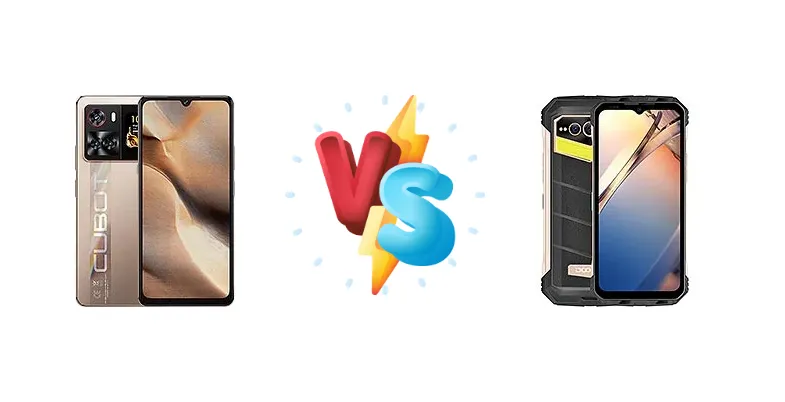
Cubot X100 vs Doogee S100 Pro: A Detailed Performance and Battery Life Showdown
| Phones Images | |||||
|---|---|---|---|---|---|
|
🏆 Quick Verdict
For users prioritizing raw processing power and sustained performance, the Cubot X100 is the clear winner. Its Dimensity 7025 chipset, featuring Cortex-A78 cores, offers a noticeable advantage over the Doogee S100 Pro’s Helio G99. However, the S100 Pro remains a viable option for everyday tasks and offers a competitive feature set.
| PHONES | ||
|---|---|---|
| Phone Names | Cubot X100 | Doogee S100 Pro |
| Network | ||
|---|---|---|
| 2G bands | GSM 850 / 900 / 1800 / 1900 | GSM 850 / 900 / 1800 / 1900 |
| 3G bands | HSDPA 800 / 850 / 900 / 1700(AWS) / 1900 / 2100 | HSDPA 800 / 850 / 900 / 1700(AWS) / 1900 / 2100 |
| 4G bands | 1, 2, 3, 4, 5, 7, 8, 12, 13, 17, 18, 19, 20, 25, 26, 28, 34, 38, 39, 40, 41, 66, 71 | 1, 2, 3, 4, 5, 7, 8, 12, 13, 17, 18, 19, 20, 25, 26, 28, 34, 38, 39, 40, 41, 66, 71 |
| 5G bands | 1, 2, 3, 5, 7, 8, 20, 25, 28, 38, 40, 41, 66, 77, 78 SA/NSA | - |
| Speed | HSPA, LTE, 5G | HSPA, LTE |
| Technology | GSM / HSPA / LTE / 5G | GSM / CDMA / HSPA / LTE |
| Launch | ||
|---|---|---|
| Announced | 2025, August | 2023, May 28 |
| Status | Available. Released 2025, August | Available. Released 2023, June 01 |
| Body | ||
|---|---|---|
| Build | Glass front, plastic frame, plastic back | - |
| Dimensions | 171.9 x 78.1 x 8.9 mm (6.77 x 3.07 x 0.35 in) | 178.5 x 83.1 x 27.3 mm (7.03 x 3.27 x 1.07 in) |
| SIM | Nano-SIM + Nano-SIM | Nano-SIM + Nano-SIM |
| Weight | 207 g (7.30 oz) | - |
| Display | ||
|---|---|---|
| Protection | Mohs level 6 | Corning Gorilla Glass 5 |
| Resolution | 720 x 1640 pixels (~260 ppi density) | 1080 x 2408 pixels, 20:9 ratio (~401 ppi density) |
| Size | 6.88 inches, 112.4 cm2 (~83.7% screen-to-body ratio) | 6.58 inches, 104.3 cm2 (~70.3% screen-to-body ratio) |
| Type | IPS LCD, 120Hz | IPS LCD |
| Platform | ||
|---|---|---|
| CPU | Octa-core (2x2.5 GHz Cortex-A78 & 6x2.0 GHz Cortex-A55) | Octa-core (2x2.2 GHz Cortex-A76 & 6x2.0 GHz Cortex-A55) |
| Chipset | Mediatek Dimensity 7025 (6 nm) | Mediatek Helio G99 (6 nm) |
| GPU | IMG BXM-8-256 | Mali-G57 MC2 |
| OS | Android 15 | Android 12 |
| Memory | ||
|---|---|---|
| Card slot | No | microSDXC (uses shared SIM slot) |
| Internal | 256GB 8GB RAM, 256GB 12GB RAM | 256GB 12GB RAM |
| Main Camera | ||
|---|---|---|
| Features | LED flash, HDR, panorama | Dual-LED flash, HDR, panorama |
| Triple | 64 MP, (wide), PDAF 5 MP, (ultrawide) 2 MP (macro) | 108 MP, f/1.8, (wide), 1/1.52", 0.7µm, PDAF 20 MP, f/1.8, (night vision), 2 infrared night vision lights 16 MP, f/2.2, 130˚ (ultrawide) |
| Video | 1080p@30fps | 1440p, 1080p |
| Selfie camera | ||
|---|---|---|
| Single | 16 MP | 32 MP, f/2.0, (wide), 1/2.8", 0.8µm |
| Video | 1080p@30fps | 1440p, 1080p |
| Sound | ||
|---|---|---|
| 35mm jack | No | No |
| Loudspeaker | Yes, with stereo speakers | Yes, with stereo speakers |
| Comms | ||
|---|---|---|
| Bluetooth | 5.1, A2DP | 5.0, A2DP, LE |
| NFC | Yes | Yes (market/region dependent) |
| Positioning | GPS, GALILEO, GLONASS, BDS | GPS (L1+L5), GLONASS, BDS, GALILEO |
| Radio | Unspecified | FM radio |
| USB | USB Type-C, OTG | USB Type-C 2.0, OTG |
| WLAN | Wi-Fi 802.11 a/b/g/n/ac, dual-band | Wi-Fi 802.11 a/b/g/n/ac, dual-band |
| Features | ||
|---|---|---|
| Sensors | Fingerprint (side-mounted), accelerometer, gyro, proximity, compass | Fingerprint (side-mounted), accelerometer, gyro, proximity, compass |
| Battery | ||
|---|---|---|
| Charging | 33W wired | 33W wired |
| Type | 5100 mAh | 22000 mAh |
| Misc | ||
|---|---|---|
| Colors | Gray, Gold | Black, Black/Silver, Black/Gold |
| Price | $ 213.21 / € 199.95 | About 300 EUR |
| EU LABEL | ||
|---|---|---|
| Battery | 31:15h endurance, 1400 cycles | - |
| Energy | Class E | - |
| Free fall | Class A (270 falls) | - |
| Repairability | Class B | - |
Cubot X100
- Superior CPU performance with Cortex-A78 cores
- Impressive 31:15h battery endurance
- Long-lasting battery health with 1400 charge cycles
- Display specifications unknown, potentially average
- Camera details lacking, image quality uncertain
Doogee S100 Pro
- Power-efficient Helio G99 chipset
- Competitive 33W fast charging
- Potentially lower price point
- Inferior CPU performance compared to the X100
- Likely less capable GPU for gaming
Display Comparison
Display specifications are absent from the provided data, making a direct comparison impossible. However, given the price points, both devices likely utilize IPS LCD panels. The absence of LTPO technology suggests neither phone will offer adaptive refresh rates for power saving. Bezels and color accuracy will likely be similar, with both aiming for acceptable, but not class-leading, visual experiences.
Camera Comparison
Camera details are unavailable. Assuming both phones target the budget segment, expect primary sensors in the 48MP-64MP range. The absence of information regarding Optical Image Stabilization (OIS) suggests neither phone will feature it. Lens apertures will likely be around f/1.8-f/2.0. Image processing will be a key differentiator, but without sample images, it’s impossible to assess. Any 2MP macro or depth sensors included should be considered marketing features rather than substantial photographic tools.
Performance
The core difference lies in the chipsets. The Cubot X100’s Mediatek Dimensity 7025 (6nm) boasts two high-performance Cortex-A78 cores clocked at 2.5 GHz, paired with six Cortex-A55 cores at 2.0 GHz. This configuration provides a significant uplift in CPU performance compared to the Doogee S100 Pro’s Helio G99 (6nm), which uses two Cortex-A76 cores at 2.2 GHz and six Cortex-A55 cores at 2.0 GHz. The A78 architecture is demonstrably more efficient and powerful than the A76, translating to faster app loading times and smoother multitasking on the X100. While both are 6nm chips, the architectural advantage of the Dimensity 7025 is key. The GPU performance difference is also likely substantial, favoring the X100 for gaming.
Battery Life
The Cubot X100 claims an impressive 31:15h endurance and 1400 charge cycles, suggesting a focus on long-term battery health. Both phones share a 33W wired charging capability, meaning 0-100% charge times will likely be comparable – around 60-75 minutes. While the S100 Pro’s Helio G99 is more power-efficient, the X100’s superior endurance rating suggests optimized software and potentially a larger battery capacity (though not specified). The 1400 cycle claim for the X100 is a significant advantage, promising longevity.
Buying Guide
Buy the Cubot X100 if you frequently engage in demanding tasks like mobile gaming, video editing, or multitasking, and require a phone that can handle them without significant slowdown. Buy the Doogee S100 Pro if you prioritize a balance of efficiency and affordability, primarily using your phone for communication, social media, and light content consumption, and value a potentially longer-lasting battery due to the less power-hungry chipset.