
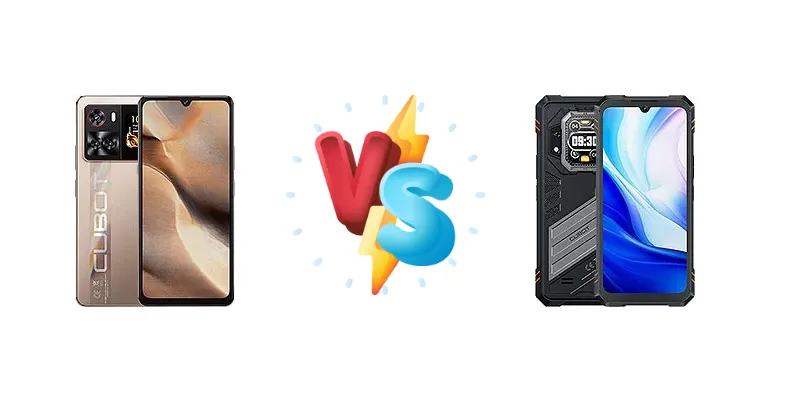
Cubot X100 vs KingKong Star 2: A Deep Dive into Performance and Endurance
| Phones Images | |||||
|---|---|---|---|---|---|
|
🏆 Quick Verdict
For the average user prioritizing all-day battery life and robust performance, the Cubot KingKong Star 2 emerges as the winner. Its Dimensity 8200 chipset and significantly larger battery capacity (43:41h endurance) outweigh the X100’s slightly faster Cortex-A78 cores.
| PHONES | ||
|---|---|---|
| Phone Names | Cubot X100 | Cubot KingKong Star 2 |
| Network | ||
|---|---|---|
| 2G bands | GSM 850 / 900 / 1800 / 1900 | GSM 850 / 900 / 1800 / 1900 |
| 3G bands | HSDPA 800 / 850 / 900 / 1700(AWS) / 1900 / 2100 | HSDPA 800 / 850 / 900 / 1700(AWS) / 1900 / 2100 |
| 4G bands | 1, 2, 3, 4, 5, 7, 8, 12, 13, 17, 18, 19, 20, 25, 26, 28, 34, 38, 39, 40, 41, 66, 71 | 1, 2, 3, 4, 5, 7, 8, 12, 13, 17, 18, 19, 20, 25, 26, 28, 34, 38, 39, 40, 41, 66, 71 |
| 5G bands | 1, 2, 3, 5, 7, 8, 20, 25, 28, 38, 40, 41, 66, 77, 78 SA/NSA | 1, 2, 3, 5, 7, 8, , 20, 25, 28, 38, 40, 41, 66, 77, 78 SA/NSA |
| Speed | HSPA, LTE, 5G | HSPA, LTE, 5G |
| Technology | GSM / HSPA / LTE / 5G | GSM / HSPA / LTE / 5G |
| Launch | ||
|---|---|---|
| Announced | 2025, August | 2024, September 30 |
| Status | Available. Released 2025, August | Available. Released 2024, October |
| Body | ||
|---|---|---|
| Build | Glass front, plastic frame, plastic back | - |
| Dimensions | 171.9 x 78.1 x 8.9 mm (6.77 x 3.07 x 0.35 in) | 177.7 x 81.8 x 13.5 mm (7.00 x 3.22 x 0.53 in) |
| SIM | Nano-SIM + Nano-SIM | Nano-SIM + Nano-SIM |
| Weight | 207 g (7.30 oz) | 305 g (10.76 oz) |
| Display | ||
|---|---|---|
| Protection | Mohs level 6 | Corning Gorilla Glass, Mohs level 6 |
| Resolution | 720 x 1640 pixels (~260 ppi density) | 1080 x 2400 pixels, 20:9 ratio (~392 ppi density) |
| Size | 6.88 inches, 112.4 cm2 (~83.7% screen-to-body ratio) | 6.72 inches, 109.0 cm2 (~75.0% screen-to-body ratio) |
| Type | IPS LCD, 120Hz | IPS LCD, 144Hz, 1500 nits (peak) |
| Platform | ||
|---|---|---|
| CPU | Octa-core (2x2.5 GHz Cortex-A78 & 6x2.0 GHz Cortex-A55) | Octa-core (1x3.1 GHz Cortex-A78 & 3x3.0 GHz Cortex-A78 & 4x2.0 GHz Cortex-A55) |
| Chipset | Mediatek Dimensity 7025 (6 nm) | Mediatek Dimensity 8200 (4 nm) |
| GPU | IMG BXM-8-256 | Mali-G610 MC6 |
| OS | Android 15 | Android 14 |
| Memory | ||
|---|---|---|
| Card slot | No | microSDXC (uses shared SIM slot) |
| Internal | 256GB 8GB RAM, 256GB 12GB RAM | 256GB 12GB RAM |
| Main Camera | ||
|---|---|---|
| Dual | - | 100 MP, (wide), PDAF 5 MP (macro), AF |
| Features | LED flash, HDR, panorama | LED flash |
| Triple | 64 MP, (wide), PDAF 5 MP, (ultrawide) 2 MP (macro) | - |
| Video | 1080p@30fps | Yes |
| Selfie camera | ||
|---|---|---|
| Single | 16 MP | 32 MP |
| Video | 1080p@30fps | Yes |
| Sound | ||
|---|---|---|
| 35mm jack | No | No |
| Loudspeaker | Yes, with stereo speakers | Yes |
| Comms | ||
|---|---|---|
| Bluetooth | 5.1, A2DP | 5.3, A2DP, LE |
| NFC | Yes | Yes |
| Positioning | GPS, GALILEO, GLONASS, BDS | GPS (L1+L5), GALILEO, GLONASS, BDS |
| Radio | Unspecified | Unspecified |
| USB | USB Type-C, OTG | USB Type-C, OTG |
| WLAN | Wi-Fi 802.11 a/b/g/n/ac, dual-band | Wi-Fi 802.11 a/b/g/n/ac/6, dual-band |
| Features | ||
|---|---|---|
| Sensors | Fingerprint (side-mounted), accelerometer, gyro, proximity, compass | Fingerprint (side-mounted), accelerometer, gyro, proximity, compass |
| Battery | ||
|---|---|---|
| Charging | 33W wired | 33W wired |
| Type | 5100 mAh | 5100 mAh |
| Misc | ||
|---|---|---|
| Colors | Gray, Gold | Black |
| Price | $ 213.21 / € 199.95 | About 250 EUR |
| EU LABEL | ||
|---|---|---|
| Battery | 31:15h endurance, 1400 cycles | 43:41h endurance, 900 cycles |
| Energy | Class E | Class C |
| Free fall | Class A (270 falls) | Class A (270 falls) |
| Repairability | Class B | Class C |
Cubot X100
- Potentially longer battery lifespan (1400 cycles)
- More affordable price point (likely)
- Slightly faster peak CPU clock speeds
- Significantly shorter battery endurance (31:15h)
- Less powerful chipset (Dimensity 7025)
- Potentially less future-proof
Cubot KingKong Star 2
- Superior chipset performance (Dimensity 8200)
- Exceptional battery endurance (43:41h)
- More efficient 4nm manufacturing process
- Fewer battery charge cycles (900)
- Potentially higher price
- May prioritize durability over display quality
Display Comparison
Display specifications are not provided, so a direct comparison is impossible. However, given the KingKong Star 2’s focus on durability, it likely features a more robust, potentially less color-accurate display than the X100. The X100, positioned as a more general-purpose device, may prioritize color accuracy and viewing angles. Both are likely to be LCD panels given the price bracket.
Camera Comparison
Camera details are absent, making a definitive comparison challenging. However, we can infer that the KingKong Star 2, being the higher-tier model, likely features a more capable primary sensor. The X100 may focus on software optimization to compensate for potentially less impressive hardware. Without sensor size or aperture information, it’s difficult to assess low-light performance or dynamic range capabilities. The inclusion of a 2MP macro lens on either device is likely a marketing feature with limited practical benefit.
Performance
The Cubot KingKong Star 2’s Mediatek Dimensity 8200 (4nm) represents a significant leap in performance over the X100’s Dimensity 7025 (6nm). The 8200 boasts a faster prime Cortex-A78 core (3.1 GHz vs 2.5 GHz) and a more efficient manufacturing process. This translates to better sustained performance under load and improved thermal management. While the X100’s octa-core CPU is capable, the Star 2’s chipset will deliver a noticeably smoother experience in demanding games and multitasking scenarios. The 4nm process also contributes to lower power consumption, complementing the larger battery.
Battery Life
Battery life is a clear win for the Cubot KingKong Star 2. Its 43:41h endurance significantly surpasses the X100’s 31:15h. This difference is attributable to both the larger battery capacity and the more efficient Dimensity 8200 chipset. While both devices support 33W wired charging, the Star 2’s larger battery will take longer to fully recharge. However, the extended runtime will likely offset this inconvenience for power users. The X100’s 1400 battery cycles suggest a focus on long-term battery health, while the Star 2’s 900 cycles indicate a trade-off for higher capacity.
Buying Guide
Buy the Cubot X100 if you need a solid all-rounder with a responsive processor for everyday tasks and moderate gaming, and value a slightly more streamlined software experience. Buy the Cubot KingKong Star 2 if you prioritize extended battery life for heavy usage, demanding gaming sessions, and require the extra processing power of the Dimensity 8200 for future-proofing and more intensive applications.