
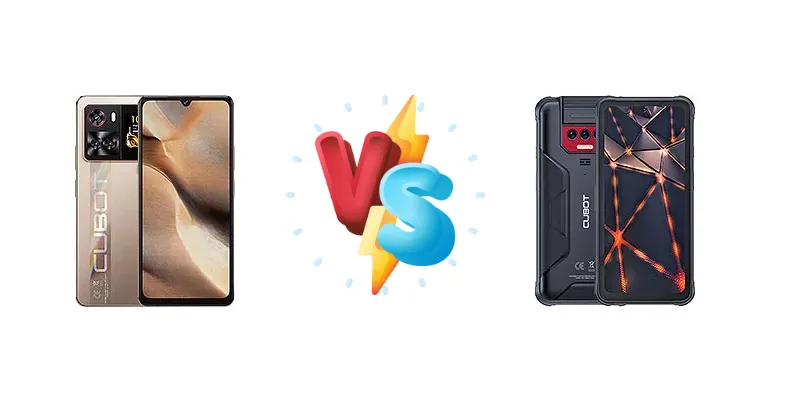
Cubot X100 vs KingKong 8: A Deep Dive into Performance and Durability
| Phones Images | |||||
|---|---|---|---|---|---|
|
🏆 Quick Verdict
For users prioritizing performance and extended battery life, the Cubot X100 is the clear winner. Its Dimensity 7025 chipset delivers significantly faster processing speeds and improved efficiency. However, those needing a durable, work-focused device will find the KingKong 8 a more suitable choice.
| PHONES | ||
|---|---|---|
| Phone Names | Cubot X100 | Cubot KingKong 8 |
| Network | ||
|---|---|---|
| 2G bands | GSM 850 / 900 / 1800 / 1900 | GSM 850 / 900 / 1800 / 1900 |
| 3G bands | HSDPA 800 / 850 / 900 / 1700(AWS) / 1900 / 2100 | HSDPA 850 / 900 / 1700(AWS) / 1900 / 2100 |
| 4G bands | 1, 2, 3, 4, 5, 7, 8, 12, 13, 17, 18, 19, 20, 25, 26, 28, 34, 38, 39, 40, 41, 66, 71 | 1, 2, 3, 4, 5, 7, 8, 12, 17, 20, 28, 41 |
| 5G bands | 1, 2, 3, 5, 7, 8, 20, 25, 28, 38, 40, 41, 66, 77, 78 SA/NSA | - |
| Speed | HSPA, LTE, 5G | HSPA, LTE |
| Technology | GSM / HSPA / LTE / 5G | GSM / HSPA / LTE |
| Launch | ||
|---|---|---|
| Announced | 2025, August | 2023, October 23 |
| Status | Available. Released 2025, August | Available. Released 2023, October 23 |
| Body | ||
|---|---|---|
| Build | Glass front, plastic frame, plastic back | - |
| Dimensions | 171.9 x 78.1 x 8.9 mm (6.77 x 3.07 x 0.35 in) | 169.9 x 80.2 x 20 mm (6.69 x 3.16 x 0.79 in) |
| SIM | Nano-SIM + Nano-SIM | Nano-SIM + Nano-SIM |
| Weight | 207 g (7.30 oz) | 382 g (13.47 oz) |
| Display | ||
|---|---|---|
| Protection | Mohs level 6 | - |
| Resolution | 720 x 1640 pixels (~260 ppi density) | 720 x 1612 pixels, 20:9 ratio (~270 ppi density) |
| Size | 6.88 inches, 112.4 cm2 (~83.7% screen-to-body ratio) | 6.53 inches, 102.4 cm2 (~75.2% screen-to-body ratio) |
| Type | IPS LCD, 120Hz | IPS LCD |
| Platform | ||
|---|---|---|
| CPU | Octa-core (2x2.5 GHz Cortex-A78 & 6x2.0 GHz Cortex-A55) | Octa-core (4x2.0 GHz Cortex-A73 & 4x2.0 GHz Cortex-A53) |
| Chipset | Mediatek Dimensity 7025 (6 nm) | Mediatek MT8788V/WA (12 nm) |
| GPU | IMG BXM-8-256 | - |
| OS | Android 15 | Android 13 |
| Memory | ||
|---|---|---|
| Card slot | No | microSDXC (uses shared SIM slot) |
| Internal | 256GB 8GB RAM, 256GB 12GB RAM | 256GB 12GB RAM |
| Main Camera | ||
|---|---|---|
| Features | LED flash, HDR, panorama | LED flash |
| Triple | 64 MP, (wide), PDAF 5 MP, (ultrawide) 2 MP (macro) | 48 MP, (wide), PDAF 2 MP (macro) 0.3 MP |
| Video | 1080p@30fps | Yes |
| Selfie camera | ||
|---|---|---|
| Single | 16 MP | 16 MP |
| Video | 1080p@30fps | Yes |
| Sound | ||
|---|---|---|
| 35mm jack | No | Unspecified |
| Loudspeaker | Yes, with stereo speakers | Yes |
| Comms | ||
|---|---|---|
| Bluetooth | 5.1, A2DP | 4.2, A2DP |
| NFC | Yes | Yes |
| Positioning | GPS, GALILEO, GLONASS, BDS | GPS, GLONASS, GALILEO |
| Radio | Unspecified | Unspecified |
| USB | USB Type-C, OTG | USB Type-C, OTG |
| WLAN | Wi-Fi 802.11 a/b/g/n/ac, dual-band | Wi-Fi 802.11 a/b/g/n/ac, dual-band |
| Features | ||
|---|---|---|
| Sensors | Fingerprint (side-mounted), accelerometer, gyro, proximity, compass | Fingerprint (side-mounted), accelerometer, gyro, proximity, compass |
| Battery | ||
|---|---|---|
| Charging | 33W wired | Wired Reverse wired |
| Type | 5100 mAh | 10600 mAh |
| Misc | ||
|---|---|---|
| Colors | Gray, Gold | Black, Red, Green |
| Price | $ 213.21 / € 199.95 | About 170 EUR |
| EU LABEL | ||
|---|---|---|
| Battery | 31:15h endurance, 1400 cycles | - |
| Energy | Class E | - |
| Free fall | Class A (270 falls) | - |
| Repairability | Class B | - |
Cubot X100
- Superior processing power with Dimensity 7025
- Exceptional battery endurance (31:15h)
- Faster charging (33W)
- Likely less durable than the KingKong 8
- May lack ruggedized features
Cubot KingKong 8
- Ruggedized design for enhanced durability
- Reverse wired charging for convenient power sharing
- Potentially more affordable
- Significantly slower processor (MT8788V)
- Lower battery endurance (estimated)
- Slower charging speeds (estimated)
Display Comparison
Display specifications are absent from the provided data, but given the market positioning, we can infer differences. The X100, targeting a broader audience, likely features a higher resolution and potentially a higher refresh rate panel. The KingKong 8, prioritizing durability, may utilize a more robust, though potentially lower-resolution, display covered with reinforced glass. Bezels on the KingKong 8 are likely thicker to accommodate the ruggedized design.
Camera Comparison
Camera details are limited. However, the chipset difference suggests the X100 will have a more capable image signal processor (ISP), leading to better image quality, especially in low-light conditions. While both phones likely feature multiple cameras, the X100’s processing power will allow for more sophisticated image processing algorithms. Without sensor size information, it’s difficult to make definitive claims, but the X100’s chipset provides a foundation for a superior camera experience.
Performance
The core difference lies in the chipsets. The Cubot X100’s Mediatek Dimensity 7025 (6nm) is a substantial upgrade over the KingKong 8’s MT8788V/WA (12nm). The 6nm process node allows for greater transistor density and improved power efficiency, translating to better performance and less heat generation. The Dimensity 7025’s Cortex-A78 cores (2x2.5 GHz) are significantly faster than the KingKong 8’s Cortex-A73 cores (4x2.0 GHz), resulting in a noticeable performance boost in CPU-intensive tasks. The A55 vs A53 comparison further reinforces the X100’s advantage in multi-core performance and efficiency. This means faster app loading, smoother multitasking, and a more responsive user experience for the X100.
Battery Life
The Cubot X100 boasts an impressive 31:15h endurance and 1400 charge cycles, indicating a focus on long-term battery health and usability. While the KingKong 8’s battery capacity is unknown, its lack of specific endurance data suggests it won’t match the X100’s longevity. The X100’s 33W wired charging is also faster than the KingKong 8’s unspecified wired charging, allowing for quicker top-ups. The KingKong 8’s reverse wired charging is a unique feature, enabling it to charge other devices, a benefit for users who frequently rely on portable power.
Buying Guide
Buy the Cubot X100 if you need a phone for demanding tasks like gaming, video editing, or heavy multitasking, and value exceptional battery life. Its modern chipset and optimized endurance make it ideal for power users. Buy the Cubot KingKong 8 if you work in challenging environments, require a phone that can withstand drops and exposure to the elements, and prioritize practical features like reverse wireless charging over raw processing speed.