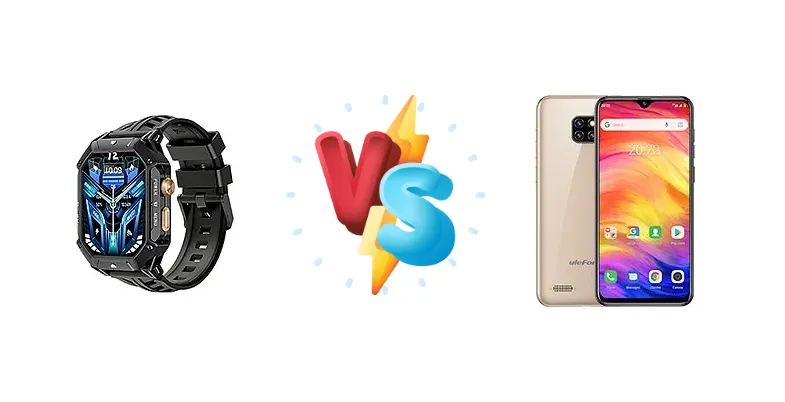
The sub-$100 smartphone market is fiercely competitive, demanding a careful balance of features and price. We pit the Cubot X1 against the Ulefone S11, two devices aiming to deliver essential smartphone functionality without breaking the bank. While the Cubot X1 remains largely a mystery in terms of detailed specifications, the Ulefone S11 offers a known quantity with its Mediatek MT6580 chipset, allowing for a focused comparison on real-world performance expectations.
🏆 Quick Verdict
For the average user prioritizing even basic responsiveness, the Ulefone S11 is the better choice. Its Mediatek MT6580 chipset, while dated, provides a demonstrable performance advantage over the unknown hardware within the Cubot X1. However, both phones represent compromises at this price point.
| Network |
|---|
| 2G bands | N/A | GSM 850 / 900 / 1800 / 1900 |
| 3G bands | N/A | HSDPA 850 / 900 / 1900 / 2100 |
| 4G bands | N/A | - |
| EDGE | No | - |
| GPRS | No | - |
| Speed | No | HSPA 21.1/5.76 Mbps |
| Technology | No cellular connectivity | GSM / HSPA |
| Launch |
|---|
| Announced | 2024, May | 2019, April. Released 2019, April |
| Status | Available. Released 2024, May | Discontinued |
| Body |
|---|
| Dimensions | 52.7 x 44.5 x 14.2 mm (2.07 x 1.75 x 0.56 in) | 156.1 x 73.7 x 9.7 mm (6.15 x 2.90 x 0.38 in) |
| SIM | No | Nano-SIM + Micro-SIM |
| Weight | - | 177.5 g (6.28 oz) |
| Display |
|---|
| Protection | Tempered glass | - |
| Resolution | 410 x 502 pixels (~304 ppi density) | 600 x 1280 pixels (~232 ppi density) |
| Size | 2.13 inches | 6.1 inches, 92.3 cm2 (~80.2% screen-to-body ratio) |
| Type | AMOLED | IPS LCD |
| Platform |
|---|
| CPU | - | Quad-core 1.3 GHz Cortex-A7 |
| Chipset | - | Mediatek MT6580 (28 nm) |
| GPU | - | Mali-400 |
| OS | Proprietary OS | Android 8.1 Oreo (Go edition) |
| Memory |
|---|
| Card slot | No | microSDXC (uses shared SIM slot) |
| Internal | Unspecified | 32GB 3GB RAM |
| | - | eMMC 5.1 |
| Main Camera |
|---|
| Features | - | LED flash, HDR |
| Triple | - | 8 MP, f/1.8, (wide), AF
2 MP
2 MP |
| Video | - | 720p@30fps |
| Selfie camera |
|---|
| Single | - | 5 MP |
| Video | - | 720p@30fps |
| Sound |
|---|
| 3.5mm jack | - | Yes |
| 35mm jack | No | Yes |
| Loudspeaker | Yes | Yes |
| Comms |
|---|
| Bluetooth | 5.2 | 4.0, A2DP |
| NFC | No | No |
| Positioning | No | GPS |
| Radio | No | Stereo FM radio, RDS, recording |
| USB | No | microUSB 2.0 |
| WLAN | No | Wi-Fi 802.11 b/g/n |
| Features |
|---|
| Sensors | Accelerometer, heart rate, SpO2, blood pressure, barometer, compass | Accelerometer, proximity |
| Battery |
|---|
| Type | 850 mAh | Li-Po 3500 mAh |
| Misc |
|---|
| Colors | Gray | Black, Gold, Twilight |
| Price | About 50 EUR | - |
Cubot X1
- Potentially lower price point (depending on retailer)
- May offer a slightly more compact form factor
- Basic smartphone functionality
- Unknown specifications make performance prediction difficult
- Likely inferior performance compared to Ulefone S11
- Potentially lower build quality
Ulefone S11
- Known Mediatek MT6580 chipset provides predictable performance
- Slightly better performance for basic tasks
- More readily available information and reviews
- Aging chipset with limited processing power
- Basic camera capabilities
- Slow charging speeds
Display Comparison
Without specific display details for the Cubot X1, a direct comparison is difficult. The Ulefone S11 likely utilizes a standard IPS LCD panel common in this price bracket. Expect moderate brightness levels, adequate viewing angles, but limited color accuracy. The absence of information regarding the Cubot X1’s panel technology suggests it likely employs a similar, budget-focused display, potentially with lower resolution or brightness than the Ulefone S11. Users prioritizing outdoor visibility will likely find both displays challenging.
Camera Comparison
Neither device is expected to excel in photography. The Ulefone S11 likely features a basic camera setup, potentially with a 5MP or 8MP main sensor. The Cubot X1’s camera specifications are unknown, but it’s unlikely to surpass the Ulefone S11 in image quality. Both phones will struggle in low-light conditions, and image processing will be minimal. The presence of a 2MP macro camera on the Ulefone S11 is largely a marketing gimmick, offering limited practical benefit due to its low resolution and lack of optical image stabilization.
Performance
The Ulefone S11’s Mediatek MT6580, built on a 28nm process, features a quad-core 1.3 GHz Cortex-A7 CPU. This chipset, while aging, offers a known baseline for performance. The Cubot X1’s processor remains unknown, making performance prediction impossible. However, given the price point, it’s reasonable to assume it’s either a similarly aged or even less powerful chipset. The MT6580’s Cortex-A7 cores are optimized for power efficiency, but lack the architectural advancements of newer cores, resulting in slower processing speeds. Users should expect basic multitasking and app loading times on the Ulefone S11, with the Cubot X1 potentially exhibiting even slower performance.
Battery Life
Battery capacity for both devices is unknown. However, given the budget nature of these phones, expect capacities in the 2000-3000 mAh range. The Ulefone S11’s Mediatek MT6580’s power efficiency may translate to slightly better battery life compared to a more powerful, but less optimized, chipset in the Cubot X1. Charging speeds are also likely to be slow, with both devices potentially lacking fast charging capabilities. Expect several hours to fully charge from 0-100%.
Buying Guide
Buy the Cubot X1 if you need a phone for absolutely minimal tasks – basic calling, texting, and perhaps light messaging – and are willing to accept potentially significant performance limitations. Buy the Ulefone S11 if you prefer a device capable of handling slightly more demanding tasks like web browsing, social media, and light app usage, benefiting from the known performance of the Mediatek MT6580.
Frequently Asked Questions
❓ Is the Mediatek MT6580 in the Ulefone S11 capable of running popular social media apps like Facebook and Instagram?
Yes, the Mediatek MT6580 is capable of running Facebook and Instagram, but expect slower loading times and occasional lag, especially with multiple apps open. The chipset is sufficient for basic social media usage, but it won't provide a fluid or responsive experience.
❓ What kind of gaming performance can I expect from the Ulefone S11?
Gaming on the Ulefone S11 is limited to very basic 2D games and older, less demanding 3D titles. The MT6580’s GPU is not powerful enough to handle modern, graphically intensive games at playable frame rates. Expect significant lag and stuttering in most modern games.
❓ Given the lack of information on the Cubot X1, is it a risky purchase?
Yes, purchasing the Cubot X1 is a higher risk due to the complete lack of detailed specifications. Without knowing the chipset, RAM, or storage, it's difficult to predict its performance or reliability. The Ulefone S11, with its known hardware, offers a more predictable and potentially more satisfying experience.