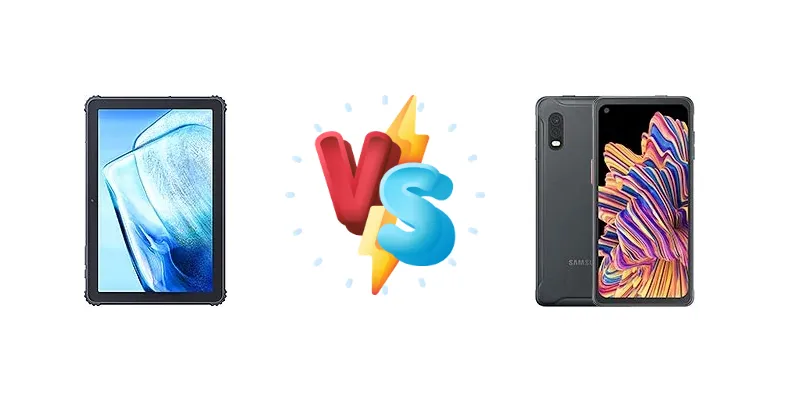
The demand for durable tablets capable of withstanding harsh environments is growing, catering to industries like construction, logistics, and field service. We pit the Cubot Tab KingKong, a budget-focused rugged tablet, against the Samsung Galaxy XCover Pro, a more established player in the ruggedized space, to determine which offers the best blend of performance, durability, and value.
🏆 Quick Verdict
For users prioritizing affordability and a larger screen, the Cubot Tab KingKong offers a compelling package. However, the Samsung Galaxy XCover Pro’s more efficient Exynos 9611 chipset and established brand reputation make it the better choice for professionals demanding consistent performance and long-term software support.
| Network |
|---|
| 2G bands | GSM 850 / 900 / 1800 / 1900 | GSM 850 / 900 / 1800 / 1900 |
| 3G bands | HSDPA 850 / 900 / 1700(AWS) / 1900 / 2100 | HSDPA 850 / 900 / 1900 / 2100 - International |
| 4G bands | 1, 2, 3, 4, 5, 7, 8, 17, 20, 28, 38, 39, 40, 41 | 1, 2, 3, 5, 7, 8, 20, 28, 38, 40, 41 - International |
| Speed | HSPA, LTE | HSPA 42.2/5.76 Mbps, LTE (3CA) Cat11 600/50 Mbps |
| Technology | GSM / HSPA / LTE | GSM / HSPA / LTE |
| | - | 1, 2, 3, 4, 5, 7, 12, 13, 14, 20, 29, 38, 40, 41, 66 - Canada |
| Launch |
|---|
| Announced | 2023, July 19 | 2020, January |
| Status | Available. Released 2023, August 07 | Available. Released 2020, January |
| Body |
|---|
| Dimensions | 251.2 x 170.2 x 15.6 mm (9.89 x 6.70 x 0.61 in) | 159.9 x 76.7 x 10 mm (6.30 x 3.02 x 0.39 in) |
| SIM | Nano-SIM + Nano-SIM | · Nano-SIM· Nano-SIM + Nano-SIM |
| Weight | 820 g (1.81 lb) | 218 g (7.69 oz) |
| | - | IP68 dust/water resistant (up to 1.5m for 35 min)
Drop-to-concrete resistance from up to 1.5m
MIL-STD-810G compliant*
*does not guarantee ruggedness or use in extreme conditions |
| Display |
|---|
| Protection | - | Corning Gorilla Glass 5 |
| Resolution | 1200 x 1920 pixels, 16:10 ratio (~224 ppi density) | 1080 x 2340 pixels, 19.5:9 ratio (~409 ppi density) |
| Size | 10.1 inches, 295.8 cm2 (~69.2% screen-to-body ratio) | 6.3 inches, 97.4 cm2 (~79.4% screen-to-body ratio) |
| Type | IPS LCD | IPS LCD |
| Platform |
|---|
| CPU | Octa-core (4x2.0 GHz Cortex-A73 & 4x2.0 GHz Cortex-A53) | Octa-core (4x2.3 GHz Cortex-A73 & 4x1.7 GHz Cortex-A53) |
| Chipset | Mediatek MT8788 (12 nm) | Exynos 9611 (10 nm) |
| GPU | Mali-G72 MP3 | Mali-G72 MP3 |
| OS | Android 13 | Android 10, upgradable to Android 13, One UI 5 |
| Memory |
|---|
| Card slot | microSDXC (uses shared SIM slot) | microSDXC (dedicated slot) |
| Internal | 256GB 8GB RAM | 64GB 4GB RAM |
| Main Camera |
|---|
| Dual | - | 25 MP, f/1.7, 26mm (wide), PDAF
8 MP, f/2.2, 123˚ (ultrawide), 1/4.0", 1.12µm |
| Features | LED flash | Dual-LED flash, HDR, panorama |
| Single | 16 MP, AF | - |
| Video | Yes | 1080p@30fps |
| Selfie camera |
|---|
| Features | - | HDR |
| Single | 8 MP | 13 MP, f/2.0, (wide), 1/3.1", 1.12µm |
| Video | Yes | 1080p@30fps |
| Sound |
|---|
| 3.5mm jack | - | Yes |
| 35mm jack | Unspecified | Yes |
| Loudspeaker | Yes | Yes |
| Comms |
|---|
| Bluetooth | 4.2 | 5.0, A2DP, LE |
| NFC | No | Yes |
| Positioning | GPS, GLONASS, GALILEO | GPS, GLONASS, GALILEO, BDS |
| Radio | Unspecified | FM radio (market/region dependent) |
| USB | USB Type-C, OTG | USB Type-C 2.0 |
| WLAN | Wi-Fi 802.11 a/b/g/n/ac, dual-band | Wi-Fi 802.11 a/b/g/n/ac/k/v/r, dual-band, Wi-Fi Direct |
| Features |
|---|
| Sensors | Accelerometer, gyro | Fingerprint (side-mounted), accelerometer, gyro, proximity, compass |
| | - | ANT+ |
| Battery |
|---|
| Charging | 18W wired | 15W wired |
| Type | 10600 mAh | Li-Po 4050 mAh, removable |
| Misc |
|---|
| Colors | Black | Black |
| Models | - | SM-G715FN/DS, SM-G715FN, SM-G715F, SM-G715W, SM-G715U, SM-G715U1 |
| Price | - | About 120 EUR |
| SAR EU | - | 0.47 W/kg (head) 1.23 W/kg (body) |
Cubot Tab KingKong
- More affordable price point
- Potentially larger screen size for enhanced productivity
- Faster 18W wired charging
- Less efficient Mediatek MT8788 chipset
- Likely lower build quality and software support
- Uncertain camera performance
Samsung Galaxy XCover Pro
- More efficient Exynos 9611 chipset (10nm)
- Established brand reputation and software support
- Potentially better build quality and durability
- Higher price point
- Slower 15W wired charging
- May have a smaller screen size
Display Comparison
While specific display specs are unavailable for the Cubot Tab KingKong, its larger tablet form factor suggests a focus on screen real estate. The Samsung Galaxy XCover Pro, though not specified, likely utilizes a standard LCD panel. The Mediatek MT8788 powering the Cubot Tab KingKong will need to drive a larger display, potentially impacting graphics performance. The Exynos 9611 in the XCover Pro, built on a 10nm process, is more efficient and better suited for sustained graphical tasks, even if both devices lack high refresh rate panels.
Camera Comparison
Given the target audience, camera quality isn't a primary focus for either device. However, the absence of detailed camera specifications for the Cubot Tab KingKong suggests a basic imaging setup. The Samsung Galaxy XCover Pro, while not a photography powerhouse, likely offers a more refined camera experience with better image processing. The focus for both will be on capturing documentation in the field, rather than high-resolution artistic shots.
Performance
The Samsung Galaxy XCover Pro’s Exynos 9611 (10nm) holds a clear advantage over the Cubot Tab KingKong’s Mediatek MT8788 (12nm). The 10nm fabrication process allows for greater transistor density and improved power efficiency, translating to better sustained performance and reduced thermal throttling. While both CPUs feature the same Cortex-A73/A53 core configuration, the XCover Pro’s A73 cores are clocked higher at 2.3 GHz versus 2.0 GHz on the KingKong, providing a noticeable boost in single-core performance. This difference will be most apparent in demanding applications and multitasking scenarios.
Battery Life
Battery capacity is not specified for either device. However, the Samsung Galaxy XCover Pro’s 15W charging, while slower than the Cubot Tab KingKong’s 18W, benefits from the Exynos 9611’s superior power efficiency. The 10nm process allows the XCover Pro to extract more usage from a given battery capacity. The larger screen of the Cubot Tab KingKong will likely necessitate a larger battery to achieve comparable battery life, and the 18W charging will help offset the increased capacity.
Buying Guide
Buy the Cubot Tab KingKong if you need a large-screen, affordable tablet for basic tasks and media consumption in demanding environments, and aren't heavily reliant on demanding applications. Buy the Samsung Galaxy XCover Pro if you prioritize a more refined user experience, better performance for multitasking and productivity apps, and the peace of mind that comes with Samsung’s software update commitment and established ecosystem.
Frequently Asked Questions
❓ Does the Mediatek MT8788 chipset in the Cubot Tab KingKong struggle with multitasking or demanding applications?
The Mediatek MT8788, while capable for basic tasks, is less powerful and efficient than the Exynos 9611. Users should expect some slowdowns when running multiple apps simultaneously or using resource-intensive applications like CAD software or video editing tools. It's best suited for lighter workloads.
❓ Is the Samsung Galaxy XCover Pro’s 15W charging significantly slower than the Cubot Tab KingKong’s 18W?
While 18W is technically faster, the Exynos 9611’s power efficiency means the XCover Pro will likely reach a usable charge level faster overall, despite the lower wattage. The difference in 0-100% charge time will likely be minimal in real-world usage.
❓ How does the build quality of the Cubot Tab KingKong compare to the Samsung Galaxy XCover Pro in terms of ruggedness?
Samsung has a proven track record of building durable devices, and the XCover Pro is designed to meet MIL-STD-810H standards. While the Cubot Tab KingKong is also marketed as rugged, its build quality is likely less refined and may not offer the same level of protection against drops, dust, and water.