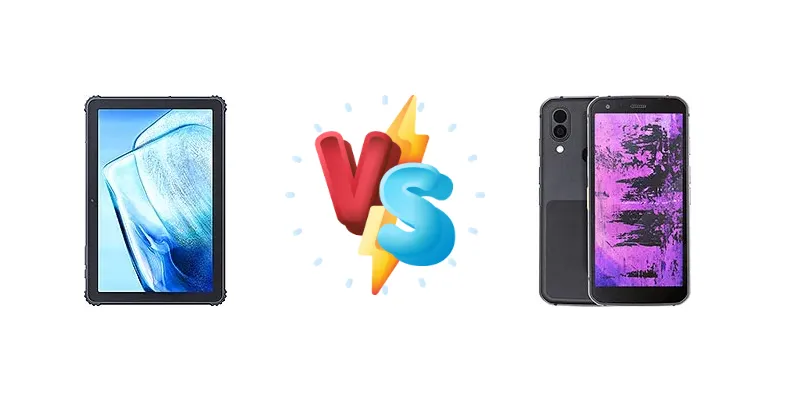
The rugged tablet market caters to a specific user base demanding durability and reliability. Both the Cubot Tab KingKong and the Cat S62 Pro aim to deliver on this promise, but they take different approaches to performance and features. This comparison dissects their core components to determine which tablet best suits demanding work environments or adventurous lifestyles.
🏆 Quick Verdict
For users prioritizing raw processing power and a more responsive experience, the Cat S62 Pro, with its Snapdragon 660, is the better choice. However, the Cubot Tab KingKong offers a compelling value proposition, potentially appealing to those on a tighter budget where absolute performance isn't critical.
| Network |
|---|
| 2G bands | GSM 850 / 900 / 1800 / 1900 | GSM 850 / 900 / 1800 / 1900 |
| 3G bands | HSDPA 850 / 900 / 1700(AWS) / 1900 / 2100 | HSDPA 850 / 900 / 1700(AWS) / 1900 / 2100 |
| 4G bands | 1, 2, 3, 4, 5, 7, 8, 17, 20, 28, 38, 39, 40, 41 | 1, 2, 3, 4, 5, 7, 8, 20, 28, 38, 40 |
| Speed | HSPA, LTE | HSPA 42.2/5.76 Mbps, LTE (2CA) Cat13 400/150 Mbps |
| Technology | GSM / HSPA / LTE | GSM / HSPA / LTE |
| Launch |
|---|
| Announced | 2023, July 19 | 2020, June 28. Released 2020, August 17 |
| Status | Available. Released 2023, August 07 | Discontinued |
| Body |
|---|
| Build | - | Glass front (Gorilla Glass 6), plastic back, aluminum frame |
| Dimensions | 251.2 x 170.2 x 15.6 mm (9.89 x 6.70 x 0.61 in) | 158.5 x 76.7 x 11.9 mm (6.24 x 3.02 x 0.47 in) |
| SIM | Nano-SIM + Nano-SIM | · Nano-SIM· Nano-SIM + Nano-SIM |
| Weight | 820 g (1.81 lb) | 248 g (8.75 oz) |
| | - | IP68/IP69 dust/water resistant (up to 1.5m for 35 mins)
Drop-to-concrete resistance from up to 1.8m
MIL-STD-810H compliant |
| Display |
|---|
| Protection | - | Corning Gorilla Glass 6 |
| Resolution | 1200 x 1920 pixels, 16:10 ratio (~224 ppi density) | 1080 x 2160 pixels, 18:9 ratio (~424 ppi density) |
| Size | 10.1 inches, 295.8 cm2 (~69.2% screen-to-body ratio) | 5.7 inches, 83.8 cm2 (~69.0% screen-to-body ratio) |
| Type | IPS LCD | IPS LCD |
| Platform |
|---|
| CPU | Octa-core (4x2.0 GHz Cortex-A73 & 4x2.0 GHz Cortex-A53) | Octa-core (4x2.2 GHz Kryo 260 Gold & 4x1.8 GHz Kryo 260 Silver) |
| Chipset | Mediatek MT8788 (12 nm) | Qualcomm SDM660 Snapdragon 660 (14 nm) |
| GPU | Mali-G72 MP3 | Adreno 512 |
| OS | Android 13 | Android 10 |
| Memory |
|---|
| Card slot | microSDXC (uses shared SIM slot) | microSDXC (dedicated slot) |
| Internal | 256GB 8GB RAM | 128GB 6GB RAM |
| Main Camera |
|---|
| Dual | - | 12 MP, f/1.8, (wide), 1/2.55", 1.4µm, dual pixel PDAF
FLIR thermal camera (Lepton 3.5 module) |
| Features | LED flash | Thermal imaging, heat palettes, temp. spot meter, LED flash |
| Single | 16 MP, AF | - |
| Video | Yes | 1080p@30fps, gyro-EIS |
| Selfie camera |
|---|
| Single | 8 MP | 8 MP |
| Video | Yes | 1080p@30fps |
| Sound |
|---|
| 3.5mm jack | - | No |
| 35mm jack | Unspecified | No |
| Loudspeaker | Yes | Yes |
| Comms |
|---|
| Bluetooth | 4.2 | 5.0, A2DP, LE |
| NFC | No | Yes |
| Positioning | GPS, GLONASS, GALILEO | GPS, GLONASS, GALILEO, BDS |
| Radio | Unspecified | FM radio |
| USB | USB Type-C, OTG | USB Type-C 2.0, OTG |
| WLAN | Wi-Fi 802.11 a/b/g/n/ac, dual-band | Wi-Fi 802.11 a/b/g/n/ac, dual-band, Wi-Fi Direct |
| Features |
|---|
| Sensors | Accelerometer, gyro | Fingerprint (rear-mounted), accelerometer, gyro, proximity, compass |
| Battery |
|---|
| Charging | 18W wired | - |
| Type | 10600 mAh | Li-Ion 4000 mAh |
| Misc |
|---|
| Colors | Black | Black |
| Price | - | About 530 EUR |
Cubot Tab KingKong
- Potentially lower price point
- Larger screen size for enhanced productivity
- Rugged design for durability
- Less powerful chipset (MT8788)
- Potentially lower camera quality
- Unknown battery capacity and charging speed
Cat S62 Pro
- More powerful chipset (Snapdragon 660)
- Optimized performance for multitasking
- Likely better camera image quality
- Higher price point
- Potentially smaller screen size
- Unknown battery capacity
Display Comparison
Neither device's display specifications are provided, so a direct comparison is limited. However, given the Cat S62 Pro's positioning as a more premium device, it likely features a higher quality panel with better color accuracy and viewing angles. Rugged tablets often prioritize durability over display fidelity, so expect both to have robust glass protection. The larger screen size of the Tab KingKong will be beneficial for multitasking and media consumption, but may impact portability.
Camera Comparison
Without specific camera details, it's difficult to make a definitive judgment. However, Cat devices generally prioritize functional camera performance over high megapixel counts. The Snapdragon 660’s image signal processor (ISP) is known for its good dynamic range and noise reduction capabilities. The Cubot Tab KingKong’s camera performance will likely be adequate for basic documentation and casual photography, but it’s unlikely to match the image quality of the Cat S62 Pro, especially in challenging lighting conditions. We anticipate the Cat S62 Pro will have better video recording capabilities.
Performance
The core difference lies in the chipsets. The Cat S62 Pro’s Qualcomm Snapdragon 660 (14nm) utilizes Kryo 260 cores, offering a more efficient architecture than the Cubot Tab KingKong’s Mediatek MT8788 (12nm). While the MT8788 boasts a slightly higher clock speed on its Cortex-A73 cores (2.0 GHz vs 2.2 GHz on the S62 Pro), the Snapdragon 660’s superior instruction set architecture and optimized GPU will translate to smoother multitasking, faster app launches, and better sustained performance. The 14nm process node of the Snapdragon 660, while older, is well-established and offers a good balance of performance and power efficiency. Users who frequently use demanding applications or engage in moderate gaming will see a noticeable advantage with the Cat S62 Pro.
Battery Life
The Cubot Tab KingKong’s battery capacity is unknown, but tablets generally have larger batteries than smartphones. The Cat S62 Pro’s battery capacity is also unknown. However, the Snapdragon 660’s power efficiency, combined with potential software optimizations, could result in comparable or even better real-world battery life despite a potentially smaller battery capacity. The Cubot Tab KingKong supports 18W wired charging, which is a standard rate. The Cat S62 Pro’s charging speed is unknown, but a faster charging rate would be a significant advantage.
Buying Guide
Buy the Cubot Tab KingKong if you need a large-screen, durable tablet for basic productivity tasks, media consumption, and light field work where cost is a primary concern. Buy the Cat S62 Pro if you prefer a more refined user experience, faster application loading times, and a chipset known for sustained performance under moderate workloads, even if it comes at a higher price point.
Frequently Asked Questions
❓ Will the Mediatek MT8788 in the Cubot Tab KingKong struggle with demanding applications like CAD software or video editing?
The Mediatek MT8788 is a capable chipset for everyday tasks, but it will likely exhibit performance limitations when running resource-intensive applications like CAD software or video editing. The Snapdragon 660 in the Cat S62 Pro is better suited for these workloads due to its more efficient architecture and optimized GPU.
❓ How does the ruggedization of the Cat S62 Pro compare to the Cubot Tab KingKong in terms of drop resistance and water/dust ingress protection?
While both tablets are marketed as rugged, Cat devices are known for adhering to stringent MIL-STD-810H standards for shock and vibration resistance, as well as boasting high IP ratings for water and dust ingress protection. The Cubot Tab KingKong likely meets some level of ruggedization, but the Cat S62 Pro is expected to offer a more robust and certified level of protection.
❓ Is the Snapdragon 660 in the Cat S62 Pro still a relevant chipset in 2024, or is it showing its age?
While not the newest chipset, the Snapdragon 660 remains a capable performer for moderate workloads in 2024. It provides a smooth user experience for everyday tasks and offers good power efficiency. It won't compete with flagship chipsets, but it's still a solid choice for a rugged tablet focused on reliability rather than cutting-edge performance.