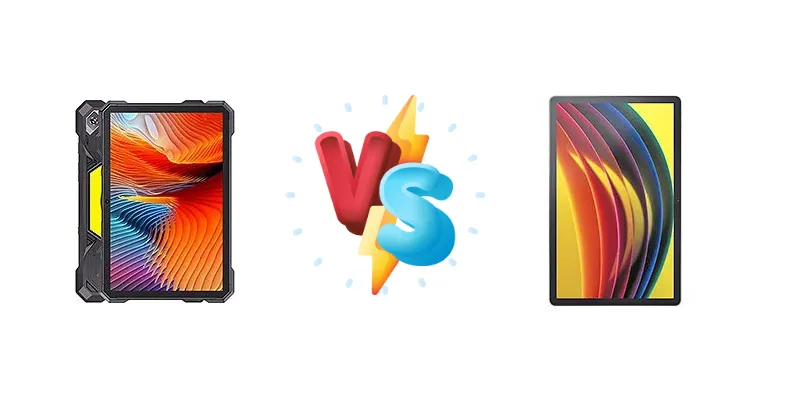
The tablet market offers a wide range of options, but finding the right balance between performance and battery life can be challenging. The Cubot Tab KingKong S and Lenovo Tab P11 Plus represent compelling choices in the budget to mid-range segment, each prioritizing different aspects of the user experience. This comparison dissects their core components to determine which tablet best suits your needs.
🏆 Quick Verdict
For users prioritizing all-day battery life and long-term reliability, the Cubot Tab KingKong S emerges as the winner. Its exceptional 36:59h endurance and 1400 charge cycles significantly outweigh the Lenovo Tab P11 Plus’s slightly faster processing power. However, the P11 Plus is a strong contender for those who value a bit more raw performance.
| Network |
|---|
| 2G bands | GSM 850 / 900 / 1800 / 1900 | GSM 850 / 900 / 1800 / 1900 |
| 3G bands | HSDPA 850 / 900 / 1700(AWS) / 1900 / 2100 | HSDPA 850 / 900 / 1900 / 2100 |
| 4G bands | 1, 2, 3, 4, 5, 7, 8, 12, 17, 20, 26, 28, 38, 40, 41, 66 | 1, 2, 3, 4, 5, 7, 8, 20, 28, 38, 40, 41 |
| Speed | HSPA, LTE | HSPA, LTE - cellular model only |
| Technology | GSM / HSPA / LTE | GSM / HSPA / LTE |
| Launch |
|---|
| Announced | 2025, September | 2021, June 28 |
| Status | Available. Released 2025, October | Available. Released 2021, July 29 |
| Body |
|---|
| Dimensions | 246.4 x 164.4 x 15.6 mm (9.70 x 6.47 x 0.61 in) | 258.4 x 163 x 7.5 mm (10.17 x 6.42 x 0.30 in) |
| SIM | Nano-SIM + Nano-SIM | Nano-SIM (cellular model only) |
| Weight | 912 g (2.01 lb) | 490 g (1.08 lb) |
| | - | Stylus support |
| Display |
|---|
| Protection | Mohs level 6 | - |
| Resolution | 800 x 1280 pixels, 16:10 ratio (~149 ppi density) | 1200 x 2000 pixels, 5:3 ratio (~212 ppi density) |
| Size | 10.1 inches, 295.8 cm2 (~73.0% screen-to-body ratio) | 11.0 inches, 344.4 cm2 (~81.8% screen-to-body ratio) |
| Type | IPS LCD, 90Hz | IPS LCD, 400 nits (typ) |
| Platform |
|---|
| CPU | Octa-core (2x2.0 GHz Cortex-A75 & 6x1.8 GHz Cortex-A55) | Octa-core (2x2.05 GHz Cortex-A76 & 6x2.0 GHz Cortex-A55) |
| Chipset | Unisoc Tiger T616 (12 nm) | Mediatek MT6785 Helio G90T (12 nm) |
| GPU | Mali-G57 MP1 | Mali-G76 MC4 |
| OS | Android 15 | Android 11 |
| Memory |
|---|
| Card slot | microSDXC (uses shared SIM slot) | microSDXC (dedicated slot) |
| Internal | 256GB 6GB RAM | 64GB 4GB RAM, 128GB 4GB RAM, 128GB 6GB RAM |
| Main Camera |
|---|
| Features | LED flash | LED flash |
| Single | 48 MP, PDAF | 13 MP, (wide), AF |
| Video | 1080p@30fps | 1080p@30fps |
| Selfie camera |
|---|
| Single | 16 MP | 8 MP, (wide) |
| Video | Yes | 1080p@30fps |
| Sound |
|---|
| 3.5mm jack | - | No |
| 35mm jack | Yes | No |
| Loudspeaker | Yes, with stereo speakers | Yes, with stereo speakers (4 speakers) |
| Comms |
|---|
| Bluetooth | 5.0, A2DP, LE | 5.1, A2DP, LE |
| NFC | No | No |
| Positioning | GPS, GALILEO, GLONASS, BDS | GPS, GLONASS, BDS - cellular model only |
| Radio | No | FM radio |
| USB | USB Type-C, OTG | USB Type-C 2.0 |
| WLAN | Wi-Fi 802.11 a/b/g/n/ac, dual-band | Wi-Fi 802.11 a/b/g/n/ac, dual-band, Wi-Fi Direct |
| Features |
|---|
| Sensors | Accelerometer | Accelerometer, gyro, proximity |
| Battery |
|---|
| Charging | 33W wired | 20W wired |
| Type | 15300 mAh | Li-Po 7700 mAh |
| Misc |
|---|
| Colors | Black | Slate Grey, Platinum Grey, Modernist teal |
| Models | - | ZA940124SE |
| Price | - | About 300 EUR |
| EU LABEL |
|---|
| Battery | 36:59h endurance, 1400 cycles | - |
| Energy | Class G | - |
| Free fall | Class A (208 falls) | - |
| Repairability | Class C | - |
Cubot Tab KingKong S
- Exceptional battery life (36:59h endurance)
- Impressive 1400 charge cycles for long-term reliability
- Potentially more efficient chipset (Unisoc T616)
- Slightly less powerful processor than the Lenovo Tab P11 Plus
- Limited information available on display quality
Lenovo Tab P11 Plus
- More powerful processor (Helio G90T) for smoother performance
- Faster 20W charging
- Potentially better color calibration
- Likely shorter battery life compared to the Cubot Tab KingKong S
- Fewer charge cycles, potentially impacting long-term battery health
Display Comparison
Neither device’s display specifications are provided, so a direct comparison is limited. However, given the price points, both likely utilize IPS LCD panels. The Lenovo Tab P11 Plus, being a slightly more established model, may benefit from better color calibration out of the box. Bezels are likely comparable, and without knowing resolution or refresh rates, it’s difficult to assess visual clarity differences. The absence of LTPO technology on either device suggests standard refresh rate operation.
Camera Comparison
Camera details are absent for both devices, making a meaningful comparison impossible. Given the market segment, it’s reasonable to assume both tablets feature modest camera setups primarily intended for video calls and casual snapshots. Without knowing sensor sizes, apertures, or image processing capabilities, any assessment would be speculative. The inclusion of a 2MP macro camera on either device would likely offer limited practical benefit due to its low resolution.
Performance
The Lenovo Tab P11 Plus boasts the MediaTek Helio G90T, featuring two Cortex-A76 cores clocked at 2.05 GHz, alongside six Cortex-A55 cores at 2.0 GHz. This architecture provides a performance edge over the Cubot Tab KingKong S’s Unisoc Tiger T616, which utilizes two Cortex-A75 cores at 2.0 GHz and six Cortex-A55 cores at 1.8 GHz. While both chipsets are built on a 12nm process, the Cortex-A76 cores in the G90T offer superior single-core performance, translating to snappier app launches and smoother multitasking. However, the T616’s efficiency may contribute to the KingKong S’s impressive battery life. The G90T’s Mali-G76 MC4 GPU will also provide a better gaming experience than the T616’s Mali-G52 MC2.
Battery Life
The Cubot Tab KingKong S truly shines in battery endurance, achieving a remarkable 36:59 hours of usage. This is significantly bolstered by its impressive 1400 charge cycles, indicating long-term battery health. The Lenovo Tab P11 Plus lacks this detailed endurance data, but its 20W charging, while faster than the KingKong S’s 33W, may not fully compensate for the potential difference in overall runtime. The 33W charging on the KingKong S, despite the lower wattage, could still offer a reasonable charge time given the likely battery capacity, and the longevity benefit of 1400 cycles is substantial.
Buying Guide
Buy the Cubot Tab KingKong S if you need a tablet that can reliably last through extended travel, workdays, or media marathons without frequent charging. It’s ideal for students, field workers, or anyone who values peace of mind regarding battery longevity. Buy the Lenovo Tab P11 Plus if you prefer a tablet with a more powerful chipset for smoother multitasking and slightly better gaming performance, and are willing to compromise on ultimate battery endurance.
Frequently Asked Questions
❓ How will the Unisoc Tiger T616 handle demanding games compared to the MediaTek Helio G90T?
The MediaTek Helio G90T, with its Cortex-A76 cores and Mali-G76 MC4 GPU, offers a noticeable performance advantage in gaming. While the Unisoc T616 can handle casual games, the G90T will provide smoother frame rates and better graphics settings in more demanding titles. Expect some compromises in graphical fidelity on the Cubot Tab KingKong S.
❓ Is the 33W charging on the Cubot Tab KingKong S significantly faster than the 20W charging on the Lenovo Tab P11 Plus, considering the battery capacity is unknown?
While 33W is numerically higher, the actual charging speed difference depends on the battery capacity of each tablet. However, the Cubot Tab KingKong S’s superior battery endurance and 1400 charge cycles suggest a focus on long-term battery health, potentially utilizing charging algorithms that prioritize longevity over absolute speed. The Lenovo’s 20W charging will likely provide a quicker initial boost, but the KingKong S’s battery will likely last much longer between charges.
❓ Given the lack of detailed camera specs, should I assume the camera quality is similar on both tablets?
Yes, it's reasonable to assume similar camera quality given their price points and the absence of specific details. Both tablets likely feature modest camera setups suitable for basic video calls and casual photos. Don't expect flagship-level image quality or advanced features from either device.