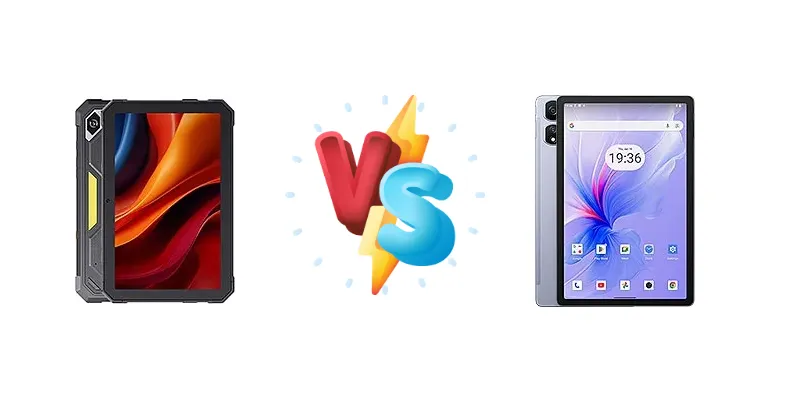
The budget Android tablet space is heating up, with both Cubot and Blackview offering compelling options. We're pitting the Cubot Tab KingKong Mini, focused on extreme battery life, against the Blackview Tab 16 Pro, which aims for a balance of performance and features. This comparison will dissect their core specs to determine which tablet best suits your needs.
🏆 Quick Verdict
For the average user prioritizing longevity, the Cubot Tab KingKong Mini is the clear winner. Its exceptional 154:50h battery endurance significantly outpaces the Blackview Tab 16 Pro’s 97:36h, making it ideal for travelers, students, or anyone away from a power outlet for extended periods.
| Network |
|---|
| 2G bands | GSM 850 / 900 / 1800 / 1900 | GSM 850 / 900 / 1800 / 1900 |
| 3G bands | HSDPA 850 / 900 / 1700(AWS) / 1900 / 2100 | HSDPA 900 / 2100 |
| 4G bands | 1, 2, 3, 4, 5, 7, 8, 12, 17, 20, 26, 28, 38, 40, 41, 66 | 1, 3, 7, 8, 19, 20, 40, 41 |
| Speed | HSPA, LTE | HSPA, LTE |
| Technology | GSM / HSPA / LTE | GSM / HSPA / LTE |
| Launch |
|---|
| Announced | 2025, September | 2024, May |
| Status | Available. Released 2025, October | Available. Released 2024, May |
| Body |
|---|
| Dimensions | 217.4 x 142.4 x 14.6 mm (8.56 x 5.61 x 0.57 in) | 256.8 x 167 x 7.5 mm (10.11 x 6.57 x 0.30 in) |
| SIM | Nano-SIM + Nano-SIM | Nano-SIM + Nano-SIM |
| Weight | 642 g (1.42 lb) | 503 g (1.11 lb) |
| Display |
|---|
| Protection | Mohs level 5 | Mohs level 5 |
| Resolution | 800 x 1340 pixels, 5:3 ratio (~180 ppi density) | 1200 x 1920 pixels, 16:10 ratio (~206 ppi density) |
| Size | 8.68 inches, 213.9 cm2 (~69.1% screen-to-body ratio) | 11.0 inches, 350.9 cm2 (~81.8% screen-to-body ratio) |
| Type | IPS LCD, 90Hz | IPS LCD |
| Platform |
|---|
| CPU | Octa-core (2x1.8 GHz Cortex-A75 & 6x1.6 GHz Cortex-A55) | Octa-core (2x2.0 GHz Cortex-A75 & 6x1.8 GHz Cortex-A55) |
| Chipset | Unisoc T615 (12 nm) | Unisoc Tiger T616 (12 nm) |
| GPU | Mali-G57 MP1 | Mali-G57 MP1 |
| OS | Android 15 | Android 14 |
| Memory |
|---|
| Card slot | microSDXC (uses shared SIM slot) | microSDXC (uses shared SIM slot) |
| Internal | 128GB 6GB RAM | 256GB 8GB RAM |
| Main Camera |
|---|
| Dual | - | 13 MP
2 MP |
| Features | LED flash | LED flash |
| Single | 48 MP, PDAF | - |
| Video | 1080p@30fps | 1080p@30fps |
| Selfie camera |
|---|
| Single | 16 MP | 8 MP |
| Video | Yes | Yes |
| Sound |
|---|
| 35mm jack | Yes | No |
| Loudspeaker | Yes | Yes, with stereo speakers |
| Comms |
|---|
| Bluetooth | 5.0, A2DP, LE | 5.0, A2DP |
| NFC | No | No |
| Positioning | GPS, GALILEO, GLONASS, BDS | GPS, GLONASS, GALILEO, BDS |
| Radio | No | Unspecified |
| USB | USB Type-C, OTG | USB Type-C, OTG |
| WLAN | Wi-Fi 802.11 a/b/g/n/ac, dual-band | Wi-Fi 802.11 a/b/g/n/ac, dual-band |
| Features |
|---|
| Sensors | Accelerometer | Accelerometer |
| Battery |
|---|
| Charging | 33W wired | 18W wired |
| Type | 10200 mAh | 7700 mAh |
| Misc |
|---|
| Colors | Black | Gray, Blue, Violet |
| EU LABEL |
|---|
| Battery | 154:50h endurance, 1400 cycles | 97:36h endurance, 1200 cycles |
| Energy | Class E | Class E |
| Free fall | Class A (208 falls) | Class B (156 falls) |
| Repairability | Class C | Class B |
Cubot Tab KingKong Mini
- Exceptional battery life (154:50h endurance)
- Faster 33W charging
- Potentially longer battery lifespan (1400 cycles)
- Slightly slower CPU performance
- Limited information on display quality
Blackview Tab 16 Pro
- Slightly faster processor (Unisoc T616)
- Faster charging than many competitors (18W)
- Potentially better for light gaming
- Significantly shorter battery life (97:36h endurance)
- Fewer battery charge cycles (1200)
Display Comparison
Neither device provides display specifications, so a direct comparison is limited. However, given the price points, we can assume both utilize IPS LCD panels. The focus here is on endurance, not visual fidelity. Bezels are likely comparable, typical of this market segment. Color accuracy is unlikely to be a key differentiator.
Camera Comparison
Without detailed camera specs, a meaningful comparison is difficult. Both tablets likely feature basic camera setups geared towards casual use. The absence of information suggests neither device will excel in photography. We can assume both will have a primary camera and potentially a secondary depth or macro sensor, but image quality will be heavily reliant on software processing.
Performance
Both tablets are powered by Unisoc chipsets fabricated on a 12nm process, suggesting similar power efficiency characteristics. However, the Blackview Tab 16 Pro utilizes the Unisoc Tiger T616, featuring slightly faster CPU cores (2x2.0 GHz Cortex-A75) compared to the Cubot Tab KingKong Mini’s Unisoc T615 (2x1.8 GHz Cortex-A75). This translates to a modest performance advantage for the Blackview in CPU-intensive tasks. Both share the same Cortex-A55 efficiency cores (6x1.6/1.8 GHz), impacting multi-core performance similarly. The impact of RAM speed (LPDDR4X is likely on both) is minimal in this class of device.
Battery Life
The Cubot Tab KingKong Mini’s 154:50h endurance is a standout feature, dwarfing the Blackview Tab 16 Pro’s 97:36h. This difference is substantial and directly impacts usability for on-the-go users. While the Blackview Tab 16 Pro offers faster 18W charging, the Cubot’s larger endurance mitigates the need for frequent charging. The Cubot’s 33W charging is faster, but the overall time to full charge will depend on battery capacity (unspecified for both). The 1400 charge cycles of the Cubot suggest a longer lifespan for the battery itself.
Buying Guide
Buy the Cubot Tab KingKong Mini if you absolutely need the longest possible battery life and prioritize minimizing charging frequency. This tablet is perfect for field work, long commutes, or simply those who dislike daily charging. Buy the Blackview Tab 16 Pro if you value a slightly faster processor and don't mind sacrificing battery endurance for a marginal performance boost. It's a better fit for users who engage in more demanding tasks like light gaming or video editing.
Frequently Asked Questions
❓ How much faster is the 33W charging on the Cubot Tab KingKong Mini compared to the 18W charging on the Blackview Tab 16 Pro, assuming similar battery capacities?
While the exact 0-100% charge times are unknown without battery capacity data, 33W charging will theoretically be significantly faster. Expect a noticeable reduction in charging time, potentially shaving off 30-60 minutes depending on the battery size. However, the Cubot's superior endurance means you'll likely need to charge it less frequently, mitigating the benefit of faster charging.
❓ Will the Unisoc T616 in the Blackview Tab 16 Pro provide a noticeable performance boost for gaming compared to the T615 in the Cubot Tab KingKong Mini?
The performance difference will be noticeable, but not dramatic. The T616’s slightly faster CPU cores will offer a small advantage in CPU-bound games. However, both chipsets share the same GPU, limiting the gains in graphically intensive titles. Expect a smoother experience with less stuttering on the Blackview, but don't anticipate flagship-level gaming performance on either device.
❓ What does '1400 charge cycles' mean for the Cubot Tab KingKong Mini's battery health?
1400 charge cycles represent the approximate number of full charge/discharge cycles the battery can endure before its capacity significantly degrades. This suggests the Cubot Tab KingKong Mini’s battery is designed for longevity, potentially maintaining 80% of its original capacity after 1400 cycles, compared to the Blackview's 1200 cycles.