
Cubot KingKong 2 vs. Ulefone Power Armor 14 Pro: A Rugged Tablet Battle
| Phones Images | |||||
|---|---|---|---|---|---|
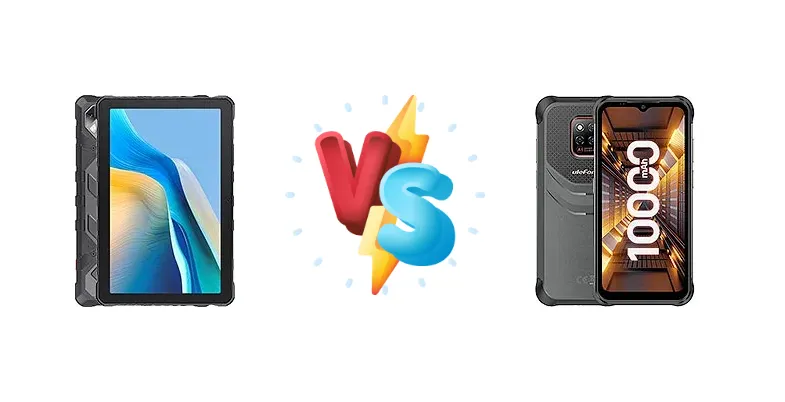
|
🏆 Quick Verdict
For the average user prioritizing sustained performance and longevity, the Cubot Tab KingKong 2 emerges as the winner. Its Helio G99 chipset, built on a more efficient 6nm process, offers a noticeable advantage over the Ulefone’s 12nm Helio G85, coupled with superior battery endurance. While the Ulefone offers wireless charging, the Cubot’s faster wired charging and overall efficiency make it the more practical choice.
| PHONES | ||
|---|---|---|
| Phone Names | Cubot Tab KingKong 2 | Ulefone Power Armor 14 Pro |
| Network | ||
|---|---|---|
| 2G bands | GSM 850 / 900 / 1800 / 1900 | GSM 850 / 900 / 1800 / 1900 |
| 3G bands | HSDPA 800 / 850 / 900 / 1700(AWS) / 1800 / 1900 / 2100 | HSDPA 850 / 900 / 1700(AWS) / 1900 / 2100 |
| 4G bands | 1, 2, 3, 4, 5, 7, 8, 12, 13, 17, 18, 19, 20, 25, 26, 28, 34, 38, 39, 40, 41, 66 | 1, 2, 3, 4, 5, 7, 8, 12, 13, 17, 18, 19, 20, 25, 26, 28, 38, 40 |
| Speed | HSPA, LTE | HSPA, LTE |
| Technology | GSM / HSPA / LTE | GSM / HSPA / LTE |
| Launch | ||
|---|---|---|
| Announced | 2024, December 01 | 2022, March 09 |
| Status | Available. Released 2024, December 01 | Available. Released 2022, March 09 |
| Body | ||
|---|---|---|
| Dimensions | 273.8 x 181.4 x 16.8 mm (10.78 x 7.14 x 0.66 in) | 175.6 x 82.5 x 17.2 mm (6.91 x 3.25 x 0.68 in) |
| SIM | Nano-SIM + Nano-SIM | Nano-SIM + Nano-SIM |
| Weight | 1055 g (2.33 lb) | 358.2 g (12.63 oz) |
| - | IP68 dust/water resistant (up to 1.5m for 30 min) Drop-to-concrete resistance from up to 1.5m MIL-STD-810G compliant | |
| Display | ||
|---|---|---|
| Protection | Panda Glass, Mohs level 5 | Corning Gorilla Glass 3 |
| Resolution | 1200 x 1920 pixels, 16:10 ratio (~207 ppi density) | 720 x 1600 pixels, 20:9 ratio (~269 ppi density) |
| Size | 10.95 inches, 347.7 cm2 (~70.0% screen-to-body ratio) | 6.52 inches, 102.6 cm2 (~70.8% screen-to-body ratio) |
| Type | IPS LCD | IPS LCD |
| Platform | ||
|---|---|---|
| CPU | Octa-core (2x2.2 GHz Cortex-A76 & 6x2.0 GHz Cortex-A55) | Octa-core (2x2.0 GHz Cortex-A75 & 6x1.8 GHz Cortex-A55) |
| Chipset | Mediatek Helio G99 (6 nm) | Mediatek MT6769Z Helio G85 (12 nm) |
| GPU | Mali-G57 MC2 | Mali-G52 MC2 |
| OS | Android 14 | Android 12 |
| Memory | ||
|---|---|---|
| Card slot | microSDXC (uses shared SIM slot) | microSDXC (uses shared SIM slot) |
| Internal | 256GB 8GB RAM | 128GB 6GB RAM, 128GB 8GB RAM |
| - | eMMC 5.1 | |
| Main Camera | ||
|---|---|---|
| Features | LED flash | LED flash, HDR, panorama |
| Single | 64 MP, PDAF | 16 MP, f/2.2 |
| Triple | - | 20 MP, f/1.8, 26mm (wide), 1/2.78", 1.0µm, PDAF 2 MP (macro) Auxiliary lens |
| Video | 1080p@30fps | 1080p@30fps |
| Selfie camera | ||
|---|---|---|
| Features | - | HDR, panorama |
| Single | 32 MP | 16 MP, f/2.2 |
| Video | 1080p@30fps | 1080p@30fps |
| Sound | ||
|---|---|---|
| 3.5mm jack | - | Yes |
| 35mm jack | No | Yes |
| Loudspeaker | Yes, with stereo speakers | Yes |
| Comms | ||
|---|---|---|
| Bluetooth | 5.2, A2DP, LE | 5.0, A2DP, LE |
| NFC | No | Yes |
| Positioning | GPS, GALILEO, GLONASS, BDS | GPS, GLONASS, GALILEO, BDS |
| Radio | Unspecified | FM radio, RDS, recording |
| USB | USB Type-C, OTG | USB Type-C 2.0, OTG |
| WLAN | Wi-Fi 802.11 a/b/g/n/ac, dual-band | Wi-Fi 802.11 a/b/g/n/ac, dual-band |
| Features | ||
|---|---|---|
| Sensors | Accelerometer, gyro, compass | Fingerprint (side-mounted), accelerometer, proximity, compass |
| Battery | ||
|---|---|---|
| Charging | 33W wired | 18W wired 15W wireless |
| Type | 20400 mAh | Li-Po 10000 mAh |
| Misc | ||
|---|---|---|
| Colors | Black | Black |
| Price | About 220 EUR | About 260 EUR |
| EU LABEL | ||
|---|---|---|
| Battery | 166:39h endurance, 1200 cycles | - |
| Energy | Class F | - |
| Free fall | Class A (208 falls) | - |
| Repairability | Class C | - |
Cubot Tab KingKong 2
- Superior chipset performance with the Helio G99
- More efficient 6nm process for better battery life
- Faster 33W wired charging
- Longer battery endurance (166:39h)
- Lacks wireless charging
- No detailed display specifications available
Ulefone Power Armor 14 Pro
- Convenience of 15W wireless charging
- Rugged design for durability
- Potentially lower price point (market dependent)
- Wired charging available
- Less powerful Helio G85 chipset
- Less efficient 12nm process
- Slower charging speeds
- Likely shorter battery life
Display Comparison
Neither device provides display specifications beyond their rugged nature. However, the chipset differences suggest the KingKong 2 will handle graphically intensive tasks on the display more smoothly. The lack of detailed display specs makes a direct comparison impossible, but the G99’s GPU is more capable, implying a better visual experience.
Camera Comparison
Both devices likely feature basic camera setups geared towards functionality rather than photography prowess, given their rugged focus. Without detailed sensor information, it’s difficult to make a definitive judgment. However, the chipset advantage of the KingKong 2 suggests potentially better image processing capabilities, leading to slightly improved image quality. The absence of detailed camera specs suggests neither device is a primary choice for serious photography.
Performance
The core difference lies in the chipsets. The Cubot Tab KingKong 2’s Mediatek Helio G99 (6nm) boasts a more modern architecture and smaller fabrication process than the Ulefone Power Armor 14 Pro’s Helio G85 (12nm). This translates to improved power efficiency and thermal performance. The G99’s Cortex-A76 cores, clocked at 2.2 GHz, are also faster than the G85’s 2.0 GHz Cortex-A75 cores. This means the KingKong 2 will exhibit quicker application loading times and smoother multitasking, particularly beneficial for users running resource-intensive apps in the field. The 6nm process also means less heat generation under load, reducing the likelihood of performance throttling during prolonged use.
Battery Life
The Cubot Tab KingKong 2 claims an impressive 166:39h endurance, suggesting a significantly larger battery capacity than the Ulefone Power Armor 14 Pro, despite the latter offering both 18W wired and 15W wireless charging. The Ulefone’s wireless charging is a convenience, but the KingKong 2’s 33W wired charging is faster, and the superior efficiency of the Helio G99 chipset means it will likely achieve a full charge quicker and maintain that charge for longer. The 1200 charge cycles claim for the Cubot also indicates a longer lifespan for the battery itself.
Buying Guide
Buy the Cubot Tab KingKong 2 if you need a tablet capable of handling demanding tasks for extended periods, such as running specialized field applications, or require a longer-lasting battery for remote work. Buy the Ulefone Power Armor 14 Pro if you prioritize the convenience of wireless charging and are willing to trade some processing power and battery endurance for that feature. The Ulefone is better suited for lighter workloads and users who value charging flexibility.