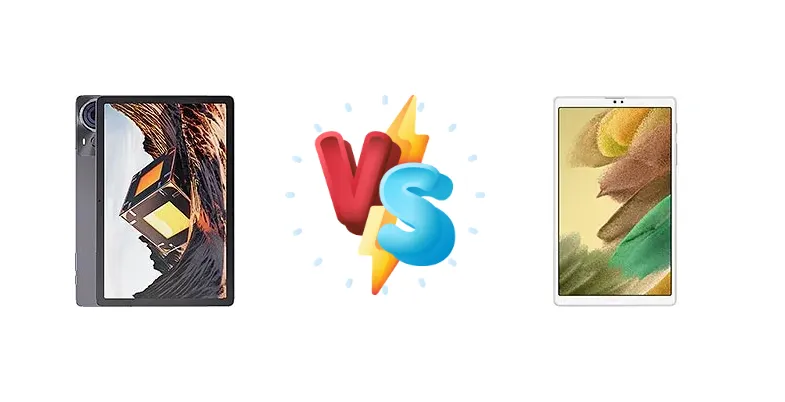
The budget tablet market is fiercely competitive, and the Cubot Tab 70 and Samsung Galaxy Tab A7 Lite represent compelling options for users seeking affordability without sacrificing essential functionality. This comparison dissects their core components, focusing on how the differing chipsets and battery strategies impact real-world performance and longevity.
🏆 Quick Verdict
For users prioritizing extended battery life and a more modern CPU architecture, the Cubot Tab 70 emerges as the winner. Its Unisoc Tiger T616 chipset and exceptional 112:07h endurance outweigh the Samsung Galaxy Tab A7 Lite’s faster charging, making it ideal for travel and prolonged use.
| Network |
|---|
| 2G bands | GSM 850 / 900 / 1800 / 1900 | GSM 850 / 900 / 1800 / 1900 |
| 3G bands | HSDPA 850 / 900 / 1700(AWS) / 1900 / 2100 | HSDPA 850 / 900 / 1700(AWS) / 1900 / 2100 |
| 4G bands | 1, 2, 3, 4, 5, 7, 8, 12, 17, 20, 28, 41 | 1, 2, 3, 4, 5, 7, 8, 12, 17, 20, 28, 38, 40, 66 |
| Speed | HSPA, LTE | HSPA, LTE - cellular model only |
| Technology | GSM / HSPA / LTE | GSM / HSPA / LTE |
| Launch |
|---|
| Announced | 2024, December 26 | 2021, May 27 |
| Status | Available. Released 2025, January 09 | Available. Released 2021, June 18 |
| Body |
|---|
| Build | - | Glass front, aluminum back, aluminum frame, plastic ends |
| Dimensions | 257.6 x 169 x 8.1 mm (10.14 x 6.65 x 0.32 in) | 212.5 x 124.7 x 8 mm (8.37 x 4.91 x 0.31 in) |
| SIM | Nano-SIM + Nano-SIM | Nano-SIM (cellular model only) |
| Weight | 555 g (1.22 lb) | 366 g (Wi-Fi), 371 g (LTE) (12.91 oz) |
| Display |
|---|
| Protection | Mohs level 6 | - |
| Resolution | 800 x 1280 pixels, 16:10 ratio (~138 ppi density) | 800 x 1340 pixels, 5:3 ratio (~179 ppi density) |
| Size | 10.95 inches, 347.7 cm2 (~79.9% screen-to-body ratio) | 8.7 inches, 214.9 cm2 (~81.1% screen-to-body ratio) |
| Type | IPS LCD | TFT LCD |
| Platform |
|---|
| CPU | Octa-core (2x2.0 GHz Cortex-A75 & 6x1.8 GHz Cortex-A55) | Octa-core (4x2.3 GHz Cortex-A53 & 4x1.8 GHz Cortex-A53) |
| Chipset | Unisoc Tiger T616 (12 nm) | Mediatek MT8768T Helio P22T (12 nm) |
| GPU | Mali-G57 MP1 | PowerVR GE8320 |
| OS | Android 14 | Android 11, upgradable to Android 14, One UI 6.1 |
| Memory |
|---|
| Card slot | microSDXC (uses shared SIM slot) | microSDXC (dedicated slot) |
| Internal | 128GB 6GB RAM | 32GB 2GB RAM, 32GB 3GB RAM, 64GB 4GB RAM |
| | - | eMMC 5.1 |
| Main Camera |
|---|
| Features | LED flash | - |
| Single | 16 MP, AF
2 MP (macro) | 8 MP, AF |
| Video | 1080p@30fps | 1080p@30fps |
| Selfie camera |
|---|
| Single | 8 MP | 2 MP |
| Video | Yes | - |
| Sound |
|---|
| 3.5mm jack | - | Yes |
| 35mm jack | Yes | Yes |
| Loudspeaker | Yes, with stereo speakers | Yes, with stereo speakers |
| Comms |
|---|
| Bluetooth | 5.0 | 5.0, A2DP, LE |
| NFC | No | No |
| Positioning | GPS, GALILEO, GLONASS, BDS | GPS, GLONASS, BDS, GALILEO - cellular model only |
| Radio | Unspecified | No |
| USB | USB Type-C, OTG | USB Type-C 2.0 |
| WLAN | Wi-Fi 802.11 a/b/g/n/ac, dual-band | Wi-Fi 802.11 a/b/g/n/ac, dual-band, Wi-Fi Direct |
| Features |
|---|
| Sensors | Accelerometer, gyro, compass | Accelerometer, compass |
| Battery |
|---|
| Charging | 10W wired | 15W wired |
| Type | 8200 mAh | Li-Po 5100 mAh |
| Misc |
|---|
| Colors | Gray | Gray, Silver |
| Models | - | SM-T225, SM-T220, SM-T225N, SM-T227U |
| Price | About 180 EUR | About 140 EUR |
| SAR | - | 0.68 W/kg (body) |
| SAR EU | - | 0.64 W/kg (head) 0.99 W/kg (body) |
| EU LABEL |
|---|
| Battery | 112:07h endurance, 1500 cycles | - |
| Energy | Class E | - |
| Free fall | Class B (156 falls) | - |
| Repairability | Class B | - |
Cubot Tab 70
- Exceptional battery life (112:07h endurance)
- More modern CPU architecture (Unisoc Tiger T616)
- Long battery lifespan (1500 charge cycles)
- Slower charging speed (10W)
- Less brand recognition
Samsung Galaxy Tab A7 Lite
- Faster charging speed (15W)
- Established brand reputation (Samsung)
- Integration with Samsung ecosystem
- Older CPU architecture (MediaTek Helio P22T)
- Significantly shorter battery life
Display Comparison
Neither device boasts a particularly standout display. Both likely utilize IPS LCD panels, common in this price bracket. Detailed specs like resolution and peak brightness are missing, but the focus here is on internal components. Bezels are expected to be noticeable on both, impacting the screen-to-body ratio. Color accuracy is likely standard for budget tablets, prioritizing cost over professional-grade color reproduction.
Camera Comparison
Camera performance is unlikely to be a deciding factor for either tablet. Details are scarce, but both will likely feature basic camera setups suitable for casual snapshots. The focus should not be on image quality, as both tablets are positioned as budget devices. Any differences in sensor size or aperture are unlikely to be substantial enough to significantly impact image quality.
Performance
The core difference lies in the chipsets. The Cubot Tab 70’s Unisoc Tiger T616 (12nm) features an octa-core configuration with 2x2.0 GHz Cortex-A75 and 6x1.8 GHz Cortex-A55 cores. This architecture is significantly more modern than the Samsung Galaxy Tab A7 Lite’s MediaTek Helio P22T (12nm) which uses 4x2.3 GHz Cortex-A53 and 4x1.8 GHz Cortex-A53 cores. While the P22T has a slightly higher peak clock speed on some cores, the A75 cores in the T616 offer superior single-core performance and improved efficiency. This translates to snappier app loading and smoother multitasking on the Cubot Tab 70. The older Cortex-A53 cores in the A7 Lite will likely struggle with more demanding tasks.
Battery Life
The Cubot Tab 70 truly shines in battery endurance, boasting an impressive 112:07h rating. This is a substantial advantage over what is typically seen in tablets. While the Samsung Galaxy Tab A7 Lite offers 15W wired charging, which is faster than the Cubot’s 10W, the sheer longevity of the Cubot’s battery mitigates the slower charging speed. The 1500 charge cycles claimed by Cubot also suggest a longer lifespan for the battery itself, reducing the need for replacement over time.
Buying Guide
Buy the Cubot Tab 70 if you need a tablet that can genuinely last through multiple days of moderate use, and if you value a CPU built on a more recent architecture for improved efficiency. Buy the Samsung Galaxy Tab A7 Lite if you prioritize brand recognition, a slightly faster charging speed, and integration within the Samsung ecosystem, even if it means more frequent charging.
Frequently Asked Questions
❓ Will the Unisoc Tiger T616 in the Cubot Tab 70 handle demanding games like PUBG Mobile?
While the T616 is a capable chipset, PUBG Mobile may require reduced graphics settings for a smooth experience. The older Helio P22T in the A7 Lite will likely struggle even more with demanding titles, making the Cubot Tab 70 the better choice for casual gaming.
❓ How long will it realistically take to fully charge the Cubot Tab 70 with its 10W charger?
Given the large battery capacity and slower charging speed, a full charge from 0% to 100% on the Cubot Tab 70 will likely take between 4-6 hours. However, the exceptional battery life means you won't need to charge it as frequently.
❓ Is the Samsung Galaxy Tab A7 Lite a better option for users heavily invested in the Samsung ecosystem?
Yes, if you frequently use Samsung phones, watches, or other devices, the Tab A7 Lite offers seamless integration with features like Quick Share and Samsung Kids. However, this convenience comes at the cost of significantly reduced battery life and a less efficient processor.
❓ Does the Cubot Tab 70 support widevine L1 for HD streaming on services like Netflix?
Information regarding Widevine L1 support for the Cubot Tab 70 is currently unavailable. This is a crucial factor for users who prioritize high-definition streaming, and potential buyers should verify this specification before purchasing.