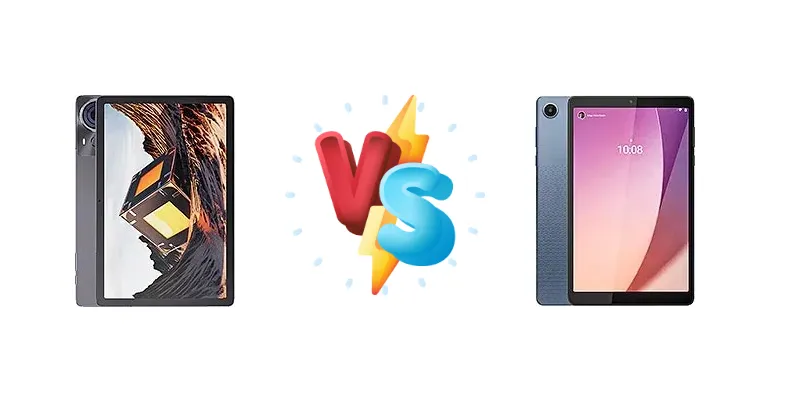
The budget tablet market is fiercely competitive, with options like the Cubot Tab 70 and Lenovo Tab M8 (4th Gen) vying for attention. Both aim to deliver an affordable Android experience, but they take different approaches to performance and longevity. This comparison dives deep into their specifications to determine which tablet offers the best value for your money.
🏆 Quick Verdict
For the average user prioritizing responsiveness and multitasking, the Cubot Tab 70 is the better choice. Its Unisoc Tiger T616 chipset, featuring Cortex-A75 cores, provides a noticeable performance advantage over the Lenovo Tab M8’s Helio A22. While both offer 10W charging, the Cubot Tab 70 boasts significantly longer battery endurance.
| Network |
|---|
| 2G bands | GSM 850 / 900 / 1800 / 1900 | GSM 850 / 900 / 1800 / 1900 |
| 3G bands | HSDPA 850 / 900 / 1700(AWS) / 1900 / 2100 | HSDPA 800 / 850 / 900 / 1900 / 2100 |
| 4G bands | 1, 2, 3, 4, 5, 7, 8, 12, 17, 20, 28, 41 | 1, 2, 3, 4, 5, 7, 8, 19, 20, 26, 28, 38, 40, 41 |
| Speed | HSPA, LTE | HSPA, LTE - cellular model only |
| Technology | GSM / HSPA / LTE | GSM / HSPA / LTE |
| Launch |
|---|
| Announced | 2024, December 26 | 2023, April 22 |
| Status | Available. Released 2025, January 09 | Available. Released 2023, May |
| Body |
|---|
| Build | - | Glass front, plastic frame, plastic back |
| Dimensions | 257.6 x 169 x 8.1 mm (10.14 x 6.65 x 0.32 in) | 197.8 x 119.8 x 9 mm (7.79 x 4.72 x 0.35 in) |
| SIM | Nano-SIM + Nano-SIM | Nano-SIM (cellular model only) |
| Weight | 555 g (1.22 lb) | 320 g (11.29 oz) |
| Display |
|---|
| Protection | Mohs level 6 | - |
| Resolution | 800 x 1280 pixels, 16:10 ratio (~138 ppi density) | 800 x 1280 pixels, 16:10 ratio (~189 ppi density) |
| Size | 10.95 inches, 347.7 cm2 (~79.9% screen-to-body ratio) | 8.0 inches, 185.6 cm2 (~78.3% screen-to-body ratio) |
| Type | IPS LCD | IPS LCD, 350 nits (typ) |
| Platform |
|---|
| CPU | Octa-core (2x2.0 GHz Cortex-A75 & 6x1.8 GHz Cortex-A55) | Octa-core (4x2.3 GHz Cortex-A53 & 4x1.6 GHz Cortex-A53) |
| Chipset | Unisoc Tiger T616 (12 nm) | Mediatek MT8768 Helio A22 (12 nm) |
| GPU | Mali-G57 MP1 | PowerVR GE8320 |
| OS | Android 14 | Android 13 |
| Memory |
|---|
| Card slot | microSDXC (uses shared SIM slot) | microSDXC (dedicated slot) |
| Internal | 128GB 6GB RAM | 32GB 3GB RAM, 64GB 4GB RAM |
| Main Camera |
|---|
| Features | LED flash | - |
| Single | 16 MP, AF
2 MP (macro) | 5 MP, AF or 8MP, AF |
| Video | 1080p@30fps | 1080p |
| Selfie camera |
|---|
| Single | 8 MP | 2 MP |
| Video | Yes | 720p |
| Sound |
|---|
| 35mm jack | Yes | Yes |
| Loudspeaker | Yes, with stereo speakers | Yes, with dual speakers |
| Comms |
|---|
| Bluetooth | 5.0 | 5.0, A2DP, LE |
| NFC | No | No |
| Positioning | GPS, GALILEO, GLONASS, BDS | GPS, GLONASS, BDS - cellular model only |
| Radio | Unspecified | FM radio |
| USB | USB Type-C, OTG | USB Type-C 2.0, OTG |
| WLAN | Wi-Fi 802.11 a/b/g/n/ac, dual-band | Wi-Fi 802.11 a/b/g/n/ac, dual-band, Wi-Fi Direct |
| Features |
|---|
| Sensors | Accelerometer, gyro, compass | Accelerometer, proximity |
| Battery |
|---|
| Charging | 10W wired | 10W wired |
| Type | 8200 mAh | Li-Po 5100 mAh |
| Misc |
|---|
| Colors | Gray | Abyss blue, Arctic grey |
| Price | About 180 EUR | About 150 EUR |
| EU LABEL |
|---|
| Battery | 112:07h endurance, 1500 cycles | - |
| Energy | Class E | - |
| Free fall | Class B (156 falls) | - |
| Repairability | Class B | - |
Cubot Tab 70
- Significantly faster processor for smoother performance
- Exceptional battery endurance (112:07h)
- Longer battery lifespan (1500 charge cycles)
- Display specifications are unknown
- Camera details are unavailable
Lenovo Tab M8 (4th Gen)
- Potentially lower price point
- Simple and easy-to-use interface
- Suitable for basic tasks
- Slower processor limits performance
- Shorter battery life
- Likely lower build quality
Display Comparison
Neither device's display specifications are provided, so a direct comparison is limited. However, given the price points, both likely utilize IPS LCD panels with 1080p resolution. The user experience will likely be similar in terms of viewing angles and color reproduction. Bezels are expected to be noticeable on both, typical of this market segment. Without specific brightness or color gamut data, it's difficult to declare a clear winner.
Camera Comparison
Camera specifications are not provided for either device. Given the target market, it’s safe to assume both tablets feature basic camera setups primarily intended for video calls and occasional snapshots. Image quality is unlikely to be a key differentiator. Without further information, a meaningful comparison is impossible.
Performance
The core difference lies in the chipsets. The Cubot Tab 70’s Unisoc Tiger T616 (12nm) utilizes a more modern architecture with 2x 2.0 GHz Cortex-A75 cores and 6x 1.8 GHz Cortex-A55 cores. This configuration provides a significant uplift in single-core and multi-core performance compared to the Lenovo Tab M8’s MediaTek Helio A22 (12nm) which features 4x 2.3 GHz Cortex-A53 and 4x 1.6 GHz Cortex-A53 cores. The A75 cores in the T616 are substantially more powerful than the A53 cores in the Helio A22, resulting in smoother app launches, faster web browsing, and improved multitasking. The T616’s architecture is better suited for handling modern Android applications and light gaming.
Battery Life
The Cubot Tab 70 shines in battery endurance, boasting 112:07 hours of usage. While both tablets utilize 10W wired charging, the Cubot Tab 70’s superior endurance, coupled with its reported 1500 charge cycles, suggests a longer lifespan and reduced need for frequent charging. The Lenovo Tab M8’s battery capacity is unknown, but the shorter endurance indicates a smaller capacity or less efficient power management. The 1500 charge cycle claim for the Cubot Tab 70 is a significant advantage, suggesting the battery will retain its capacity for a longer period.
Buying Guide
Buy the Cubot Tab 70 if you need a tablet capable of handling more demanding tasks like light gaming, video editing, or running multiple apps simultaneously. Its more powerful processor and extended battery life make it ideal for users who are constantly on the go. Buy the Lenovo Tab M8 (4th Gen) if you prioritize simplicity and basic functionality for tasks like web browsing, reading ebooks, and casual video streaming, and are looking for the absolute lowest price point.
Frequently Asked Questions
❓ Will the Unisoc Tiger T616 in the Cubot Tab 70 handle demanding games like PUBG Mobile?
While the T616 isn't a high-end gaming chip, it should be capable of running PUBG Mobile at medium settings with acceptable frame rates. The Cortex-A75 cores provide a performance boost over the Helio A22, making it a more viable option for casual gaming. Expect some frame drops during intense action.
❓ How long will it take to fully charge the Cubot Tab 70 with the 10W charger?
With a 10W charger, a full charge from 0% will likely take around 4-5 hours. While 10W is relatively slow compared to modern fast charging standards, the Cubot Tab 70’s exceptional battery endurance means you won’t need to charge it as frequently.
❓ Is the Lenovo Tab M8 (4th Gen) suitable for video conferencing?
The Lenovo Tab M8 is adequate for basic video conferencing using apps like Zoom or Google Meet. However, the Helio A22’s limited processing power may result in occasional lag or stuttering, especially with multiple participants or background noise. The camera quality is also likely to be basic.
❓ Does the Cubot Tab 70 support expandable storage via microSD card?
This information is not provided in the specifications. However, many budget tablets include a microSD card slot for expanding storage. Checking the product listing or user reviews is recommended to confirm if the Cubot Tab 70 supports expandable storage.