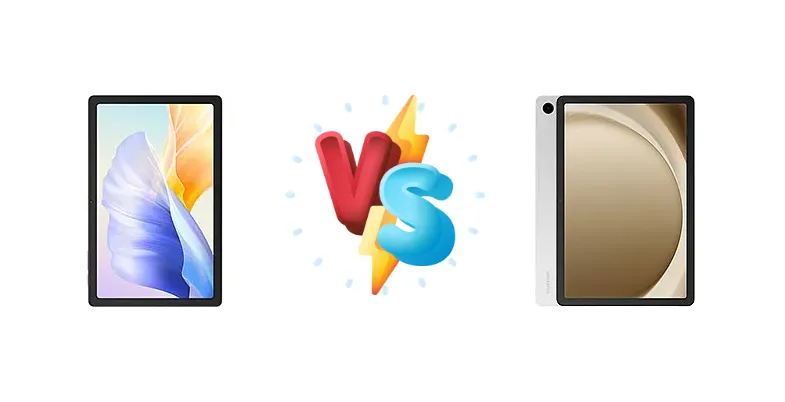
The sub-$300 tablet market is heating up, with the Cubot Tab 50 and Samsung Galaxy Tab A9+ vying for dominance. Both offer a large-screen Android experience without breaking the bank, but they take different approaches to achieving that goal. This comparison dives deep into their core components to determine which tablet delivers the best value for your money.
🏆 Quick Verdict
For most users, the Samsung Galaxy Tab A9+ is the better choice. While the Cubot Tab 50 boasts a more powerful CPU core clock speed, the Snapdragon 695’s 6nm process and Samsung’s software optimization provide a smoother, more efficient experience, especially considering the A9+'s 5G connectivity.
| Network |
|---|
| 2G bands | GSM 850 / 900 / 1800 / 1900 | GSM 850 / 900 / 1800 / 1900 |
| 3G bands | HSDPA 900 / 2100 | HSDPA 850 / 900 / 1700(AWS) / 1900 / 2100 |
| 4G bands | 1, 3, 7, 8, 20 | 1, 2, 3, 4, 5, 7, 8, 12, 13, 17, 20, 26, 28, 38, 40, 41, 66 |
| 5G bands | - | 1, 3, 5, 7, 8, 20, 28, 38, 40, 41, 66, 77, 78 SA/NSA/Sub6 |
| Speed | HSPA, LTE | HSPA, LTE, 5G - cellular model only |
| Technology | GSM / HSPA / LTE | GSM / HSPA / LTE / 5G |
| Launch |
|---|
| Announced | 2024, February 24 | 2023, October 05 |
| Status | Available. Released 2024, March | Available. Released 2023, October 17 |
| Body |
|---|
| Dimensions | 246.4 x 161.5 x 7.7 mm (9.70 x 6.36 x 0.30 in) | 257.1 x 168.7 x 6.9 mm (10.12 x 6.64 x 0.27 in) |
| SIM | Nano-SIM + Nano-SIM | Nano-SIM + eSIM (cellular model only) |
| Weight | 455 g (1.00 lb) | 480 g or 492 g (1.06 lb) |
| Display |
|---|
| Resolution | 1200 x 2000 pixels, 5:3 ratio (~224 ppi density) | 1200 x 1920 pixels, 16:10 ratio (~206 ppi density) |
| Size | 10.4 inches, 307.9 cm2 (~77.4% screen-to-body ratio) | 11.0 inches, 350.9 cm2 (~80.9% screen-to-body ratio) |
| Type | IPS LCD | TFT LCD, 90Hz |
| Platform |
|---|
| CPU | Octa-core (2x2.2 GHz Cortex-A76 & 6x2.0 GHz Cortex-A55) | Octa-core (2x2.2 GHz Kryo 660 Gold & 6x1.8 GHz Kryo 660 Silver) |
| Chipset | Mediatek Helio G99 | Qualcomm SM6375 Snapdragon 695 5G (6 nm) |
| GPU | Mali-G57 MC2 | Adreno 619 |
| OS | Android 13 | Android 13, upgradable to Android 15, One UI 7 |
| Memory |
|---|
| Card slot | microSDXC (uses shared SIM slot) | microSDXC (dedicated slot) |
| Internal | 256GB 8GB RAM | 64GB 4GB RAM, 128GB 4GB RAM, 128GB 8GB RAM, 256GB 8GB RAM |
| Main Camera |
|---|
| Features | LED flash | - |
| Single | 13 MP, AF | 8 MP, AF |
| Video | Yes | 1080p@30fps |
| Selfie camera |
|---|
| Single | 5 MP | 5 MP |
| Video | Yes | 1080p@30fps |
| Sound |
|---|
| 35mm jack | No | Yes |
| Loudspeaker | Yes, with stereo speakers (4 speakers) | Yes, with stereo speakers (4 speakers) |
| Comms |
|---|
| Bluetooth | 5.2 | 5.1, A2DP, LE |
| NFC | No | No |
| Positioning | GPS, GLONASS, GALILEO, BDS | GPS, GLONASS, GALILEO, BDS, QZSS - cellular model only |
| Radio | Unspecified | No |
| USB | USB Type-C, OTG | USB Type-C 2.0 |
| WLAN | Wi-Fi 802.11 a/b/g/n/ac, dual-band | Wi-Fi 802.11 a/b/g/n/ac, dual-band, Wi-Fi Direct |
| Features |
|---|
| Sensors | Accelerometer, gyro, compass | Accelerometer, gyro, proximity (accessories only), compass |
| Battery |
|---|
| Charging | - | 15W wired |
| Type | 7500 mAh | Li-Po 7040 mAh |
| Misc |
|---|
| Colors | Gray | Graphite, Silver, Navy |
| Models | - | SM-X210, SM-X215, SM-X216B |
| Price | - | $ 199.99 |
| SAR | - | 0.42 W/kg (body) |
| SAR EU | - | 1.19 W/kg (body) |
Cubot Tab 50
- Potentially higher peak CPU performance due to Cortex-A76 cores.
- May offer a lower price point.
- Likely supports expandable storage via microSD card.
- Less efficient chipset (Helio G99) leading to potential throttling.
- No 5G connectivity.
- Software support and updates are less certain.
Samsung Galaxy Tab A9+
- More efficient chipset (Snapdragon 695) for sustained performance.
- Integrated 5G modem for faster mobile data.
- Samsung’s software ecosystem and update support.
- Slightly lower peak CPU clock speed.
- 15W charging is relatively slow.
- May be slightly more expensive.
Display Comparison
Neither device's display specifications are provided, so we must infer. Given the price point, both likely utilize IPS LCD panels. However, Samsung typically employs better color calibration and viewing angles in its A-series tablets. The Tab A9+ likely benefits from Samsung’s display expertise, offering a more visually pleasing experience. The Cubot Tab 50, while potentially offering a similar resolution, may exhibit less accurate colors and narrower viewing angles. Bezels are expected to be substantial on both, reflecting their budget nature.
Camera Comparison
Camera details are absent for both devices. However, based on the market segment, we can expect modest camera performance. Both tablets likely feature a primary camera and a secondary depth or macro sensor. Image quality will likely be acceptable for casual snapshots and video calls, but neither device is intended for serious photography. Samsung’s image processing algorithms generally produce more natural-looking photos, while Cubot’s may lean towards more saturated colors.
Performance
The Cubot Tab 50’s Mediatek Helio G99 features a CPU with two Cortex-A76 cores clocked at 2.2 GHz, paired with six Cortex-A55 cores at 2.0 GHz. The Samsung Galaxy Tab A9+ utilizes the Qualcomm Snapdragon 695 5G, with two Kryo 660 Gold cores at 2.2 GHz and six Kryo 660 Silver cores at 1.8 GHz. While the peak clock speed is identical, the Snapdragon 695’s 6nm manufacturing process provides a significant advantage in power efficiency and thermal management. This translates to sustained performance under load, preventing the A9+ from throttling as quickly as the G99. The Snapdragon 695 also includes an integrated 5G modem, a feature absent in the Cubot Tab 50, offering faster mobile data speeds where available.
Battery Life
Battery capacity is not specified for either tablet. However, the Samsung Galaxy Tab A9+’s 15W wired charging suggests a focus on efficiency rather than rapid charging. The Cubot Tab 50’s charging speed is unknown, but a higher wattage would be beneficial given the potentially more power-hungry Helio G99 chipset. Real-world battery life will depend heavily on usage patterns, but the Snapdragon 695’s efficiency should give the A9+ an edge in longevity.
Buying Guide
Buy the Cubot Tab 50 if you prioritize raw CPU performance for demanding single-threaded tasks and are comfortable with a potentially less refined software experience. This tablet suits users who frequently sideload apps or require maximum processing power for specific applications. Buy the Samsung Galaxy Tab A9+ if you value a polished user experience, 5G connectivity for on-the-go access, and a brand with a proven track record of software updates and support. This is the better option for everyday use, streaming, and light gaming.
Frequently Asked Questions
❓ Will the Snapdragon 695 in the Tab A9+ struggle with demanding games like Genshin Impact?
While the Snapdragon 695 isn't a gaming powerhouse, it's capable of running many popular titles at medium settings. Genshin Impact will likely require significant graphical compromises to achieve playable frame rates, but the 695’s thermal efficiency will prevent excessive throttling during extended gaming sessions, unlike the Helio G99 which may struggle to maintain consistent performance.
❓ Does the Samsung Galaxy Tab A9+ support Samsung DeX for a desktop-like experience?
No, the Samsung Galaxy Tab A9+ does not support Samsung DeX. This feature is typically reserved for Samsung’s higher-end tablets like the Tab S series. However, the Tab A9+ still offers a capable multitasking experience with split-screen and pop-up view functionality.
❓ Is the lack of 5G on the Cubot Tab 50 a dealbreaker for streaming video on the go?
If you frequently rely on mobile data for streaming or working remotely, the absence of 5G on the Cubot Tab 50 is a significant drawback. While Wi-Fi is available in many locations, 5G provides a more reliable and faster connection when Wi-Fi is unavailable, making the Tab A9+ a better choice for users who prioritize mobile connectivity.