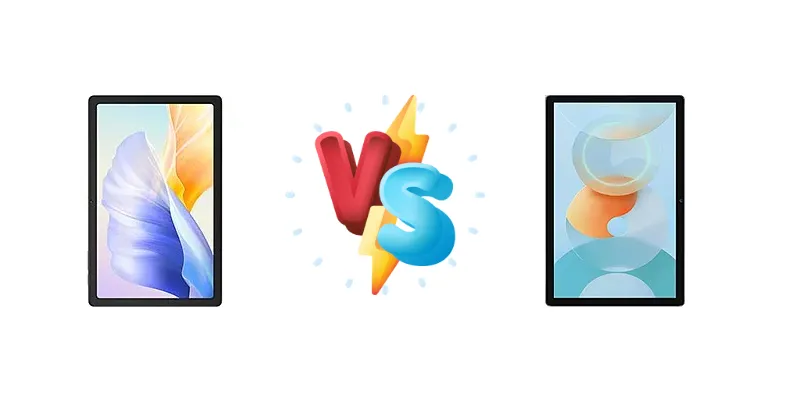
The budget Android tablet market is heating up, with the Cubot Tab 50 and Blackview Tab 13 vying for attention. Both aim to deliver a capable tablet experience without breaking the bank, but they take different approaches to achieving this. The key differentiator lies in their chipsets: the Cubot Tab 50 boasts the newer Mediatek Helio G99, while the Blackview Tab 13 utilizes the Helio G85. This comparison will dissect these differences and determine which tablet provides the best overall experience.
🏆 Quick Verdict
For most users, the Cubot Tab 50 emerges as the stronger choice. Its Helio G99 chipset, built on a more efficient process and featuring newer CPU cores, provides a noticeable performance advantage in demanding tasks and gaming. While the Blackview Tab 13 remains a viable option, the Tab 50’s superior processing power justifies the potential price difference.
| Network |
|---|
| 2G bands | GSM 850 / 900 / 1800 / 1900 | GSM 850 / 900 / 1800 / 1900 |
| 3G bands | HSDPA 900 / 2100 | HSDPA 900 / 2100 |
| 4G bands | 1, 3, 7, 8, 20 | 1, 3, 7, 8, 20, 40 |
| Speed | HSPA, LTE | HSPA, LTE |
| Technology | GSM / HSPA / LTE | GSM / HSPA / LTE |
| Launch |
|---|
| Announced | 2024, February 24 | 2022, August 20 |
| Status | Available. Released 2024, March | Available. Released 2022, August 20 |
| Body |
|---|
| Dimensions | 246.4 x 161.5 x 7.7 mm (9.70 x 6.36 x 0.30 in) | 238.8 x 157.6 x 7.7 mm (9.40 x 6.20 x 0.30 in) |
| SIM | Nano-SIM + Nano-SIM | Nano-SIM + Nano-SIM |
| Weight | 455 g (1.00 lb) | 450 g (0.99 lb) |
| Display |
|---|
| Resolution | 1200 x 2000 pixels, 5:3 ratio (~224 ppi density) | 1200 x 1920 pixels, 16:10 ratio (~224 ppi density) |
| Size | 10.4 inches, 307.9 cm2 (~77.4% screen-to-body ratio) | 10.1 inches, 295.8 cm2 (~78.6% screen-to-body ratio) |
| Type | IPS LCD | IPS LCD |
| Platform |
|---|
| CPU | Octa-core (2x2.2 GHz Cortex-A76 & 6x2.0 GHz Cortex-A55) | Octa-core (2x2.0 GHz Cortex-A75 & 6x1.8 GHz Cortex-A55) |
| Chipset | Mediatek Helio G99 | Mediatek MT6769Z Helio G85 (12 nm) |
| GPU | Mali-G57 MC2 | Mali-G52 MC2 |
| OS | Android 13 | Android 12, Doke OS_P 3.0 |
| Memory |
|---|
| Card slot | microSDXC (uses shared SIM slot) | microSDXC (uses shared SIM slot) |
| Internal | 256GB 8GB RAM | 128GB 6GB RAM |
| | - | eMMC 5.1 |
| Main Camera |
|---|
| Dual | - | 13 MP
2 MP |
| Features | LED flash | - |
| Single | 13 MP, AF | 8 MP |
| Video | Yes | 1080p@30fps |
| Selfie camera |
|---|
| Single | 5 MP | 8 MP |
| Video | Yes | Yes |
| Sound |
|---|
| 3.5mm jack | - | No |
| 35mm jack | No | No |
| Loudspeaker | Yes, with stereo speakers (4 speakers) | Yes, with stereo speakers |
| Comms |
|---|
| Bluetooth | 5.2 | 5.0, A2DP |
| NFC | No | No |
| Positioning | GPS, GLONASS, GALILEO, BDS | GPS, GLONASS, GALILEO, BDS |
| Radio | Unspecified | FM Radio |
| USB | USB Type-C, OTG | USB Type-C, OTG |
| WLAN | Wi-Fi 802.11 a/b/g/n/ac, dual-band | Wi-Fi 802.11 a/b/g/n/ac, dual-band |
| Features |
|---|
| Sensors | Accelerometer, gyro, compass | Accelerometer |
| Battery |
|---|
| Type | 7500 mAh | 7280 mAh |
| Misc |
|---|
| Colors | Gray | Twilight Blue, Space Gray, Silver |
Cubot Tab 50
- Superior chipset performance with the Helio G99
- More efficient 6nm process for better battery life
- Newer CPU architecture (Cortex-A76) for snappier responsiveness
- Potentially higher price point
- Display specifications are unknown
Blackview Tab 13
- Likely more affordable price
- Sufficient performance for basic tasks
- Acceptable for media consumption
- Older and less efficient Helio G85 chipset
- Less capable CPU architecture (Cortex-A75)
- May struggle with demanding games and multitasking
Display Comparison
Unfortunately, detailed display specifications are unavailable. However, given the price points, both tablets likely utilize IPS LCD panels. The crucial difference will be in color accuracy and peak brightness. We can infer that the Tab 50, being a slightly newer device, *may* benefit from improved panel calibration. Bezels are likely comparable, typical of this market segment. Without specific nit ratings, it's difficult to definitively declare a winner, but the Tab 50’s newer chipset suggests potential for more advanced display processing.
Camera Comparison
Camera details are limited. Both tablets likely feature a primary camera and potentially a secondary depth or macro sensor. Given the market segment, image quality will be adequate for casual snapshots but shouldn’t be expected to compete with flagship smartphones. The larger sensor size, if present on either device, will be the most significant factor in low-light performance. Without specific sensor details, it’s difficult to assess which tablet has the better camera system. The inclusion of Optical Image Stabilization (OIS) would be a significant advantage, but is unlikely on either device.
Performance
The core of the difference lies in the chipsets. The Cubot Tab 50’s Mediatek Helio G99 utilizes a 6nm process, offering improved power efficiency compared to the Blackview Tab 13’s Helio G85 (12nm). More importantly, the G99 features two Cortex-A76 cores clocked at 2.2 GHz, versus the G85’s Cortex-A75 cores clocked at 2.0 GHz. The A76 architecture represents a significant improvement in single-core performance, translating to snappier app launches and smoother multitasking. While both are octa-core CPUs, the G99’s architecture provides a clear advantage. The G99 also benefits from a more modern GPU, further enhancing gaming performance. The Tab 50 will likely exhibit less thermal throttling under sustained load.
Battery Life
Battery capacity is not specified. However, the Helio G99’s 6nm process should contribute to better battery life compared to the G85, even with a similar capacity battery. The G99’s efficiency gains mean it consumes less power for the same level of performance. Charging wattage is also unknown, but faster charging would be a significant benefit. The Tab 50’s more efficient chipset could offset a slightly smaller battery capacity, resulting in comparable real-world battery life.
Buying Guide
Buy the Cubot Tab 50 if you prioritize performance for gaming, multitasking, or demanding applications. Its Helio G99 chipset will provide a smoother and more responsive experience. Buy the Blackview Tab 13 if you are looking for the absolute lowest price point and your usage is primarily focused on basic tasks like web browsing, video streaming, and light productivity. The G85 is sufficient for these scenarios, and the Tab 13 may offer a more attractive price.
Frequently Asked Questions
❓ Will the Cubot Tab 50 handle demanding games like Genshin Impact or Call of Duty Mobile?
The Helio G99 is a capable chipset, but don't expect flagship-level performance. Genshin Impact will likely require low to medium settings for a playable experience. Call of Duty Mobile should run reasonably well at medium settings. The G99’s improved GPU compared to the G85 will provide a noticeable advantage.
❓ Is the Blackview Tab 13 suitable for video streaming and web browsing?
Yes, the Blackview Tab 13 is perfectly adequate for video streaming (YouTube, Netflix) and web browsing. The Helio G85 is sufficient for these tasks, and you shouldn't experience any significant lag or slowdowns. However, multitasking with numerous browser tabs open may reveal its limitations.
❓ What type of storage does each tablet use, and is it expandable?
Storage type and expandability are not specified. However, budget tablets often utilize eMMC storage, which is slower than UFS. Expandability via microSD card is highly probable on both devices, given their target market, but needs to be verified.
❓ How does the RAM capacity affect performance on these tablets?
RAM capacity is not specified. However, 4GB of RAM is a common configuration for tablets in this price range. 6GB or 8GB would be preferable for smoother multitasking and improved performance. Insufficient RAM can lead to frequent app reloading and slowdowns.