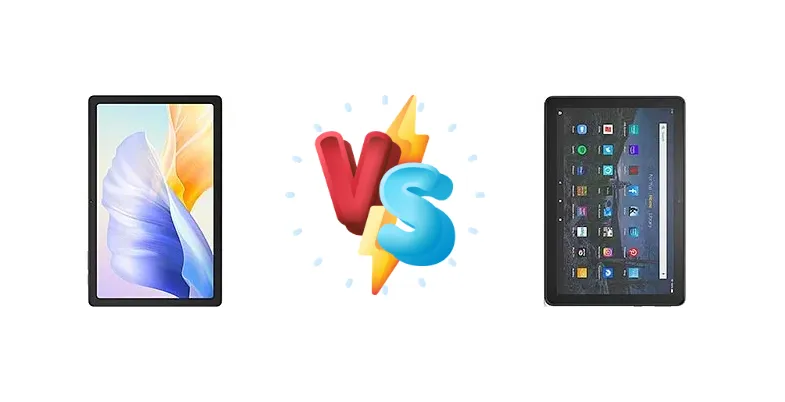
The tablet market offers a wide range of options, but finding the right balance between price and performance can be challenging. We pit the Cubot Tab 50, powered by the newer MediaTek Helio G99, against the Amazon Fire HD 10 Plus (2021), a long-standing favorite known for its affordability and integration with Amazon's ecosystem. This comparison dives deep into the core differences to determine which tablet delivers the best experience for your needs.
🏆 Quick Verdict
For users prioritizing raw performance and a more open Android experience, the Cubot Tab 50 emerges as the winner. Its Helio G99 chipset offers a noticeable performance leap over the Fire HD 10 Plus's Helio P60T. However, the Fire HD 10 Plus remains a compelling option for those heavily invested in the Amazon ecosystem and value wireless charging.
| Network |
|---|
| 2G bands | GSM 850 / 900 / 1800 / 1900 | N/A |
| 3G bands | HSDPA 900 / 2100 | - |
| 4G bands | 1, 3, 7, 8, 20 | - |
| EDGE | - | No |
| GPRS | - | No |
| Speed | HSPA, LTE | - |
| Technology | GSM / HSPA / LTE | No cellular connectivity |
| Launch |
|---|
| Announced | 2024, February 24 | 2021, April 27. Released 2021, May 26 |
| Status | Available. Released 2024, March | Discontinued |
| Body |
|---|
| Dimensions | 246.4 x 161.5 x 7.7 mm (9.70 x 6.36 x 0.30 in) | 247 x 166 x 9.2 mm (9.72 x 6.54 x 0.36 in) |
| SIM | Nano-SIM + Nano-SIM | No |
| Weight | 455 g (1.00 lb) | 468 g (1.03 lb) |
| Display |
|---|
| Protection | - | Aluminosilicate glass |
| Resolution | 1200 x 2000 pixels, 5:3 ratio (~224 ppi density) | 1920 x 1200 pixels, 16:10 ratio (~224 ppi density) |
| Size | 10.4 inches, 307.9 cm2 (~77.4% screen-to-body ratio) | 10.1 inches, 295.8 cm2 (~72.1% screen-to-body ratio) |
| Type | IPS LCD | IPS LCD |
| Platform |
|---|
| CPU | Octa-core (2x2.2 GHz Cortex-A76 & 6x2.0 GHz Cortex-A55) | Octa-core (4x2.0 GHz Cortex-A73 & 4x2.0 GHz Cortex-A53) |
| Chipset | Mediatek Helio G99 | Mediatek MT8183 Helio P60T (12 nm) |
| GPU | Mali-G57 MC2 | Mali-G72 MP3 |
| OS | Android 13 | Android 9.0 (Pie), Fire OS 7 |
| Memory |
|---|
| Card slot | microSDXC (uses shared SIM slot) | microSDXC (dedicated slot) |
| Internal | 256GB 8GB RAM | 32GB 4GB RAM, 64GB 4GB RAM |
| | - | eMMC 5.1 |
| Main Camera |
|---|
| Features | LED flash | - |
| Single | 13 MP, AF | 5 MP |
| Video | Yes | 720p |
| Selfie camera |
|---|
| Single | 5 MP | 2 MP |
| Video | Yes | 720p |
| Sound |
|---|
| 3.5mm jack | - | Yes |
| 35mm jack | No | Yes |
| Loudspeaker | Yes, with stereo speakers (4 speakers) | Yes, with stereo speakers |
| Comms |
|---|
| Bluetooth | 5.2 | 5.0, A2DP, LE |
| NFC | No | No |
| Positioning | GPS, GLONASS, GALILEO, BDS | No |
| Radio | Unspecified | No |
| USB | USB Type-C, OTG | USB Type-C 2.0, OTG |
| WLAN | Wi-Fi 802.11 a/b/g/n/ac, dual-band | Wi-Fi 802.11 a/b/g/n/ac, dual-band |
| Features |
|---|
| Sensors | Accelerometer, gyro, compass | Accelerometer |
| | - | Text-to-Speech English-language content reader |
| Battery |
|---|
| Charging | - | Wireless |
| Type | 7500 mAh | Li-Ion |
| Misc |
|---|
| Colors | Gray | Slate |
| Models | - | T76N2P |
| Price | - | About 150 EUR |
Cubot Tab 50
- Significantly faster processor (Helio G99)
- More efficient chipset for longer battery life during demanding tasks
- Standard Android experience offers greater customization
- Lacks wireless charging
- Camera performance likely similar to Fire HD 10 Plus
Amazon Fire HD 10 Plus (2021)
- Wireless charging for added convenience
- Seamless integration with Amazon services (Prime Video, Kindle)
- Generally lower price point
- Older, less powerful processor (Helio P60T)
- Fire OS is a heavily customized Android experience with limitations
Display Comparison
Neither device boasts a cutting-edge display. Both likely utilize IPS LCD panels, but specifics like resolution and peak brightness are missing. The Fire HD 10 Plus benefits from wireless charging, a feature absent on the Cubot Tab 50. While the Fire HD 10 Plus's display is adequate for media consumption, the Cubot Tab 50's potential for a higher refresh rate (dependent on panel implementation, not specified) could offer a smoother visual experience. Bezels are likely comparable, typical of this price segment.
Camera Comparison
Camera performance is unlikely to be a deciding factor for either tablet. Both are likely equipped with basic cameras suitable for video calls and casual snapshots. Without specific sensor details, it's difficult to make a direct comparison. However, the Cubot Tab 50's newer chipset may offer slightly improved image processing capabilities. Focusing on megapixel counts would be misleading; image quality depends more on sensor size and software optimization.
Performance
The core difference lies in the chipsets. The Cubot Tab 50's MediaTek Helio G99, built on a more modern architecture (Cortex-A76 vs A73), significantly outperforms the Fire HD 10 Plus's Helio P60T. The G99's CPU features two high-performance Cortex-A76 cores clocked at 2.2 GHz, alongside six efficiency cores, compared to the P60T's four Cortex-A73 cores at 2.0 GHz. This translates to faster app loading times, smoother multitasking, and improved gaming performance. The G99's GPU is also superior, offering a more enjoyable gaming experience. While RAM configurations aren't specified, the G99's efficiency allows it to handle more demanding tasks with the same amount of RAM.
Battery Life
Battery capacity isn't specified for either device. However, the Fire HD 10 Plus's inclusion of wireless charging provides a convenience factor. The Helio G99 in the Cubot Tab 50 is more power-efficient than the Helio P60T, potentially offsetting a smaller battery capacity. Real-world battery life will depend heavily on usage patterns, but the G99's efficiency gives the Cubot Tab 50 an edge in sustained performance without rapid battery drain.
Buying Guide
Buy the Cubot Tab 50 if you need a tablet for demanding tasks like gaming, multitasking, or running resource-intensive applications, and prefer a standard Android experience. Buy the Amazon Fire HD 10 Plus (2021) if you primarily consume media, rely on Amazon services (Prime Video, Kindle), and appreciate the convenience of wireless charging, even at the cost of processing power.
Frequently Asked Questions
❓ Will the Cubot Tab 50 handle graphically intensive games like PUBG Mobile?
The Helio G99 chipset in the Cubot Tab 50 is capable of running PUBG Mobile, but expect to adjust graphics settings to medium or low for a smooth experience. The P60T in the Fire HD 10 Plus will struggle with consistent frame rates at even lower settings.
❓ How much does the Amazon Fire OS restrict app availability compared to standard Android on the Cubot Tab 50?
Amazon Fire OS relies on the Amazon Appstore, which has a smaller selection of apps compared to the Google Play Store available on the Cubot Tab 50. While many popular apps are available, you may encounter limitations or need to sideload apps from other sources on the Fire HD 10 Plus.
❓ Can I easily stream Netflix and other video services on both tablets?
Both tablets support popular streaming services like Netflix, YouTube, and Disney+. However, the Cubot Tab 50's more powerful processor may offer smoother playback of high-resolution content and faster loading times for streaming apps.
❓ Is the difference in performance between the Helio G99 and Helio P60T noticeable for everyday tasks like browsing and email?
Yes, the difference is noticeable. The Cubot Tab 50 will feel snappier and more responsive when switching between apps, opening web pages, and performing general tasks due to the G99's superior CPU and GPU.