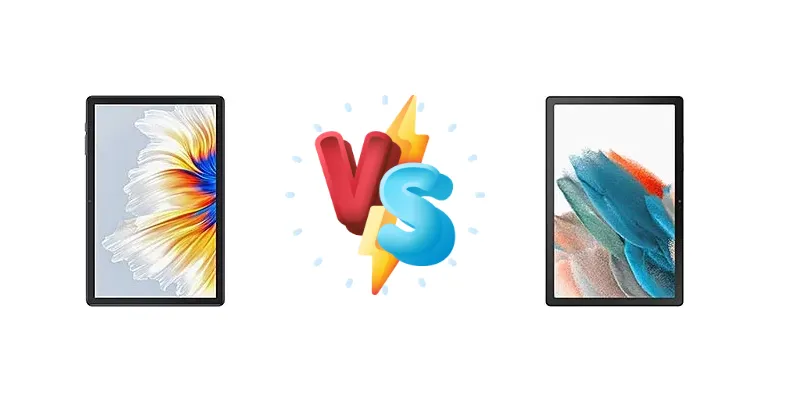
The budget tablet market is fiercely competitive, and the Cubot Tab 30 and Samsung Galaxy Tab A8 10.5 (2021) represent compelling options for users seeking affordable Android experiences. Both tablets utilize the Unisoc T618 chipset, but subtle differences in implementation and Samsung’s brand recognition create a nuanced choice. This comparison dives deep into the specifics to determine which tablet delivers the best value.
🏆 Quick Verdict
For the average user prioritizing brand reliability and slightly faster CPU performance, the Samsung Galaxy Tab A8 10.5 (2021) is the better choice. However, the Cubot Tab 30 offers a competitive package, and may appeal to those seeking maximum value and willing to trade brand prestige for potential savings.
| Network |
|---|
| 2G bands | GSM 850 / 900 / 1800 / 1900 | GSM 850 / 900 / 1800 / 1900 |
| 3G bands | HSDPA 900 / 2100 | HSDPA 850 / 900 / 1700(AWS) / 1900 / 2100 |
| 4G bands | 1, 3, 7, 8, 20 | 1, 2, 3, 4, 5, 7, 8, 12, 17, 20, 28, 38, 40, 41, 66 |
| Speed | HSPA, LTE | HSPA, LTE - cellular model only |
| Technology | GSM / HSPA / LTE | GSM / HSPA / LTE |
| Launch |
|---|
| Announced | 2022 | 2021, December 15 |
| Status | Available. Released 2022 | Available. Released 2022, January 17 |
| Body |
|---|
| Dimensions | 237.5 x 157.5 x 8 mm (9.35 x 6.20 x 0.31 in) | 246.8 x 161.9 x 6.9 mm (9.72 x 6.37 x 0.27 in) |
| SIM | Nano-SIM + Nano-SIM | Nano-SIM (cellular model only) |
| Weight | 421 g (14.85 oz) | 508 g (1.12 lb) |
| Display |
|---|
| Resolution | 1200 x 1920 pixels, 16:10 ratio (~224 ppi density) | 1200 x 1920 pixels, 16:10 ratio (~216 ppi density) |
| Size | 10.1 inches, 295.8 cm2 (~79.1% screen-to-body ratio) | 10.5 inches, 319.7 cm2 (~80.0% screen-to-body ratio) |
| Type | IPS LCD | TFT LCD |
| Platform |
|---|
| CPU | Octa-core | Octa-core (2x2.0 GHz Cortex-A75 & 6x2.0 GHz Cortex-A55) |
| Chipset | Unisoc T618 | Unisoc Tiger T618 (12 nm) |
| GPU | - | Mali G52 MP2 |
| OS | Android 11 | Android 11, upgradable to Android 14, One UI 6 |
| Memory |
|---|
| Card slot | microSDXC (uses shared SIM slot) | microSDXC (dedicated slot) |
| Internal | 128GB 4GB RAM | 32GB 2GB RAM, 32GB 3GB RAM, 64GB 2GB RAM, 64GB 3GB RAM, 64GB 4GB RAM, 128GB 3GB RAM, 128GB 4GB RAM |
| Main Camera |
|---|
| Features | LED flash | - |
| Single | 13 MP, AF | 8 MP, AF |
| Video | Yes | 1080p@30fps |
| Selfie camera |
|---|
| Single | 5 MP | 5 MP |
| Video | Yes | 1080p@30fps |
| Sound |
|---|
| 3.5mm jack | - | Yes |
| 35mm jack | Unspecified | Yes |
| Loudspeaker | Yes, with stereo speakers | Yes, with stereo speakers (4 speakers) |
| Comms |
|---|
| Bluetooth | 5.0 | 5.0, A2DP, LE |
| NFC | No | No |
| Positioning | GPS, GLONASS, GALILEO | GPS, GLONASS, BDS, GALILEO, QZSS - cellular model only |
| Radio | Unspecified | No |
| USB | USB Type-C, magnetic connector | USB Type-C 2.0 |
| WLAN | Wi-Fi 802.11 a/b/g/n/ac, dual-band | Wi-Fi 802.11 a/b/g/n/ac, dual-band, Wi-Fi Direct |
| Features |
|---|
| Sensors | Accelerometer, gyro | Accelerometer, gyro, proximity, compass |
| Battery |
|---|
| Charging | - | 15W wired |
| Type | 6580 mAh | Li-Po 7040 mAh |
| Misc |
|---|
| Colors | Gray | Gray, Silver, Pink Gold |
| Models | - | SM-X200, SM-X205 |
| Price | - | About 230 EUR |
| SAR EU | - | 0.92 W/kg (body) |
Cubot Tab 30
- Potentially lower price point
- Unisoc T618 chipset offers adequate performance for basic tasks
- Likely lightweight and portable
- Less established brand reputation
- Battery capacity and charging speed are unknown
- Software updates may be less frequent
Samsung Galaxy Tab A8 10.5 (2021)
- Samsung brand reliability and software support
- 7040mAh battery with 15W charging
- Potentially brighter display and refined software
- Higher price compared to the Cubot Tab 30
- Unisoc T618 chipset is not a high-performance solution
- Substantial bezels around the display
Display Comparison
Both tablets likely feature IPS LCD panels, common in this price bracket. While neither manufacturer specifies peak brightness, Samsung’s history suggests a slightly brighter display, enhancing outdoor visibility. The Galaxy Tab A8’s 10.5-inch screen offers a marginally larger viewing area. Crucially, neither device details refresh rates, implying a standard 60Hz panel on both. Bezels are expected to be substantial on both, reflecting their budget positioning. Color accuracy is likely similar, with both targeting the sRGB color space, but Samsung’s calibration is typically more refined.
Camera Comparison
Camera performance is unlikely to be a key differentiator. Both tablets will likely feature basic camera setups, adequate for video calls and casual snapshots. Details are sparse, but expect a primary sensor on both, potentially paired with a low-resolution depth or macro sensor. Image processing will likely be simpler on the Cubot Tab 30, while Samsung’s software algorithms may offer slightly more refined results. Focusing on megapixel counts would be misleading; sensor size and image processing are far more important at this price point.
Performance
Both the Cubot Tab 30 and Samsung Galaxy Tab A8 are powered by the Unisoc T618, an octa-core chipset. However, the Samsung Tab A8’s Unisoc Tiger T618 is specified as a 12nm process, while the Cubot Tab 30’s is not. This smaller process node *potentially* translates to improved power efficiency and slightly higher sustained performance under load. The Galaxy Tab A8’s CPU configuration (2x2.0 GHz Cortex-A75 & 6x2.0 GHz Cortex-A55) is explicitly stated, suggesting a focus on balancing performance and efficiency. While both use an octa-core CPU, the A75 cores in the Samsung offer a performance advantage over potentially all A55 cores in the Cubot. RAM configurations are not specified, but will heavily influence multitasking capabilities.
Battery Life
Battery capacity is not specified for the Cubot Tab 30, but the Samsung Galaxy Tab A8 features a 7040mAh battery. The Galaxy Tab A8 supports 15W wired charging. Without knowing the Cubot Tab 30’s battery size, it’s difficult to directly compare endurance. However, the Samsung’s larger battery and 15W charging provide a tangible advantage, offering longer usage times and quicker top-ups. The Unisoc T618’s power efficiency will play a role, but the larger battery capacity of the Samsung is a significant factor.
Buying Guide
Buy the Cubot Tab 30 if you need a highly affordable tablet for basic tasks like web browsing, video streaming, and light productivity, and are comfortable with a less established brand. Buy the Samsung Galaxy Tab A8 10.5 (2021) if you prefer a more polished software experience, benefit from Samsung’s ecosystem integration, and value the slightly improved CPU performance offered by its specific T618 configuration.
Frequently Asked Questions
❓ Will the Unisoc T618 in the Samsung Galaxy Tab A8 handle demanding games like PUBG Mobile?
While the Unisoc T618 can run PUBG Mobile, expect to play at lower graphics settings and frame rates to maintain a smooth experience. It’s not a gaming-focused chipset, and sustained performance may be limited due to thermal constraints. The Samsung’s 12nm process *may* help with sustained performance compared to the Cubot.
❓ How reliable is software support for the Cubot Tab 30 compared to the Samsung Galaxy Tab A8?
Samsung has a strong track record of providing software updates and security patches for its tablets. Cubot, as a less established brand, may offer fewer updates and a shorter support lifecycle. This is a key consideration for users who prioritize long-term software security and feature enhancements.
❓ Does the Samsung Galaxy Tab A8 support Samsung DeX?
No, the Samsung Galaxy Tab A8 does not support Samsung DeX. DeX is typically reserved for higher-end Samsung tablets and phones, offering a desktop-like experience when connected to an external display.