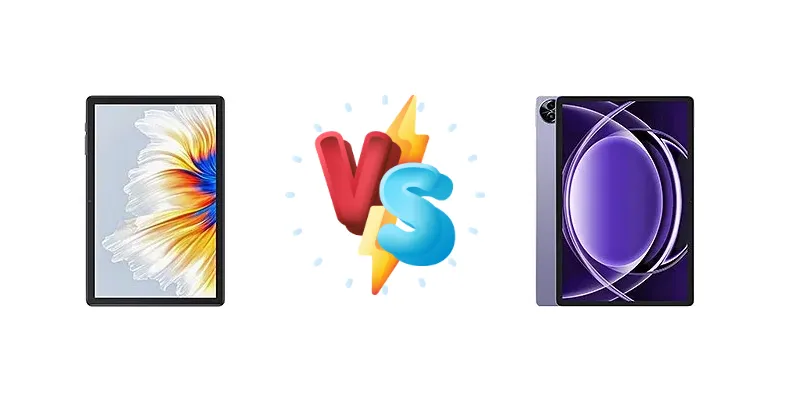
The budget tablet market is heating up, with the Cubot Tab 30 and Realme Pad 2 Lite vying for attention. Both aim to deliver a functional Android experience without breaking the bank, but they take different approaches to achieving this. The key differentiator lies in their chipsets, impacting performance and efficiency.
🏆 Quick Verdict
For most users, the Realme Pad 2 Lite is the better choice. Its Mediatek Helio G99, built on a 6nm process, offers a significant performance advantage over the Cubot Tab 30’s Unisoc T618, translating to smoother multitasking and gaming. While the Cubot Tab 30 may offer a slightly lower price, the Realme Pad 2 Lite’s efficiency justifies the small premium.
| Network |
|---|
| 2G bands | GSM 850 / 900 / 1800 / 1900 | GSM 850 / 900 / 1800 / 1900 |
| 3G bands | HSDPA 900 / 2100 | HSDPA 850 / 900 / 2100 |
| 4G bands | 1, 3, 7, 8, 20 | 1, 3, 5, 7, 8, 20, 28, 38, 40, 41 |
| Speed | HSPA, LTE | HSPA, LTE |
| Technology | GSM / HSPA / LTE | GSM / HSPA / LTE |
| Launch |
|---|
| Announced | 2022 | 2024, September 13 |
| Status | Available. Released 2022 | Available. Released 2024, September 26 |
| Body |
|---|
| Dimensions | 237.5 x 157.5 x 8 mm (9.35 x 6.20 x 0.31 in) | 258 x 169.5 x 8.3 mm (10.16 x 6.67 x 0.33 in) |
| SIM | Nano-SIM + Nano-SIM | No |
| Weight | 421 g (14.85 oz) | 525 g (1.16 lb) |
| Display |
|---|
| Resolution | 1200 x 1920 pixels, 16:10 ratio (~224 ppi density) | 1200 x 1920 pixels, 16:10 ratio (~207 ppi density) |
| Size | 10.1 inches, 295.8 cm2 (~79.1% screen-to-body ratio) | 10.95 inches, 347.7 cm2 (~79.5% screen-to-body ratio) |
| Type | IPS LCD | IPS LCD, 1B colors, 90Hz, 450 nits (peak) |
| Platform |
|---|
| CPU | Octa-core | Octa-core (2x2.2 GHz Cortex-A76 & 6x2.0 GHz Cortex-A55) |
| Chipset | Unisoc T618 | Mediatek Helio G99 (6 nm) |
| GPU | - | Mali-G57 MC2 |
| OS | Android 11 | Android 14, Realme UI 5.0 for Pad |
| Memory |
|---|
| Card slot | microSDXC (uses shared SIM slot) | Unspecified |
| Internal | 128GB 4GB RAM | 128GB 4GB RAM, 128GB 8GB RAM |
| Main Camera |
|---|
| Features | LED flash | Panorama |
| Single | 13 MP, AF | 8 MP, f/2.0 |
| Video | Yes | 1080p@30fps |
| Selfie camera |
|---|
| Features | - | Panorama |
| Single | 5 MP | 5 MP, f/2.2 |
| Video | Yes | 1080p@30fps |
| Sound |
|---|
| 35mm jack | Unspecified | No |
| Loudspeaker | Yes, with stereo speakers | Yes, with stereo speakers (4 speakers) |
| Comms |
|---|
| Bluetooth | 5.0 | 5.2, A2DP, LE |
| NFC | No | No |
| Positioning | GPS, GLONASS, GALILEO | GPS, GALILEO, GLONASS, BDS |
| Radio | Unspecified | No |
| USB | USB Type-C, magnetic connector | USB Type-C |
| WLAN | Wi-Fi 802.11 a/b/g/n/ac, dual-band | Wi-Fi 802.11 a/b/g/n/ac, dual-band |
| Features |
|---|
| Sensors | Accelerometer, gyro | Accelerometer |
| Battery |
|---|
| Charging | - | 15W wired |
| Type | 6580 mAh | 8300 mAh |
| Misc |
|---|
| Colors | Gray | Nebula Purple, Space Grey |
| Models | - | RMP2402 |
| Price | - | About 160 EUR |
Cubot Tab 30
- Potentially lower price point
- Likely larger battery capacity (assumption based on chipset efficiency)
- Functional for basic tasks
- Less powerful Unisoc T618 chipset
- Lower performance in demanding applications
- Potentially higher thermal throttling
Realme Pad 2 Lite
- More efficient Mediatek Helio G99 chipset
- Smoother multitasking and gaming experience
- Better thermal management
- Slightly higher price
- 15W charging is relatively slow
- Battery life may be comparable to Cubot Tab 30 due to similar usage
Display Comparison
Neither device boasts a standout display. Given the context data, we can assume both utilize IPS LCD panels, common in this price bracket. The Realme Pad 2 Lite’s potential advantage lies in its manufacturing process, which *could* translate to slightly better color accuracy. However, without specific display specs (resolution, brightness, color gamut), it’s difficult to definitively declare a winner. Bezels are likely comparable, focusing on cost reduction rather than premium aesthetics.
Camera Comparison
Camera performance is likely to be similar on both devices, leaning towards basic functionality. Without sensor details, it’s safe to assume both feature modest cameras suitable for casual snapshots. The absence of information suggests neither device prioritizes photography. Any differences will likely stem from software processing rather than hardware capabilities. We can expect both to struggle in low-light conditions.
Performance
The Realme Pad 2 Lite’s Mediatek Helio G99 is the clear winner here. Built on a 6nm process, it’s significantly more efficient than the Unisoc T618 found in the Cubot Tab 30. The G99’s CPU configuration – 2x2.2 GHz Cortex-A76 & 6x2.0 GHz Cortex-A55 – provides a substantial uplift in single-core and multi-core performance compared to the T618’s octa-core setup. This translates to faster app loading times, smoother scrolling, and a more enjoyable gaming experience. The 6nm node also means less heat generation, potentially reducing thermal throttling during sustained workloads.
Battery Life
While the exact battery capacities are unknown, the Realme Pad 2 Lite’s 15W charging suggests a focus on efficient power delivery. The Helio G99’s 6nm process contributes to better power efficiency, potentially offsetting a smaller battery capacity compared to the Cubot Tab 30. The 15W charging, while not fast, is adequate for overnight charging and should provide reasonable screen-on time for typical usage.
Buying Guide
Buy the Cubot Tab 30 if you prioritize absolute lowest cost and primarily need a tablet for basic tasks like web browsing and video playback. It’s a suitable option for users with minimal demands. Buy the Realme Pad 2 Lite if you value a more responsive user experience, enjoy occasional gaming, or anticipate heavier multitasking. The Helio G99 provides a noticeable performance boost for a slightly higher investment.
Frequently Asked Questions
❓ Will the Helio G99 in the Realme Pad 2 Lite handle demanding games like PUBG Mobile?
The Mediatek Helio G99 is capable of running PUBG Mobile, but you’ll likely need to adjust graphics settings to medium or low for a consistently smooth experience. The 6nm process helps mitigate thermal throttling, but sustained high frame rates may still lead to some performance dips.
❓ Is the Unisoc T618 in the Cubot Tab 30 sufficient for streaming video and browsing the web?
Yes, the Unisoc T618 is perfectly adequate for basic tasks like streaming video (YouTube, Netflix) and web browsing. However, expect some lag when multitasking or opening multiple browser tabs. It’s best suited for users with light usage patterns.
❓ Does the Realme Pad 2 Lite support fast charging beyond the 15W specification?
No, the Realme Pad 2 Lite is officially rated for 15W wired charging. While some users may experiment with PD chargers, compatibility and charging speeds are not guaranteed and could potentially damage the device.
❓ What type of storage does the Cubot Tab 30 use, and is it expandable?
Without specific details, it's likely the Cubot Tab 30 uses eMMC storage, common in this price range. Expandability via microSD card is probable, but confirmation requires checking the official specifications.