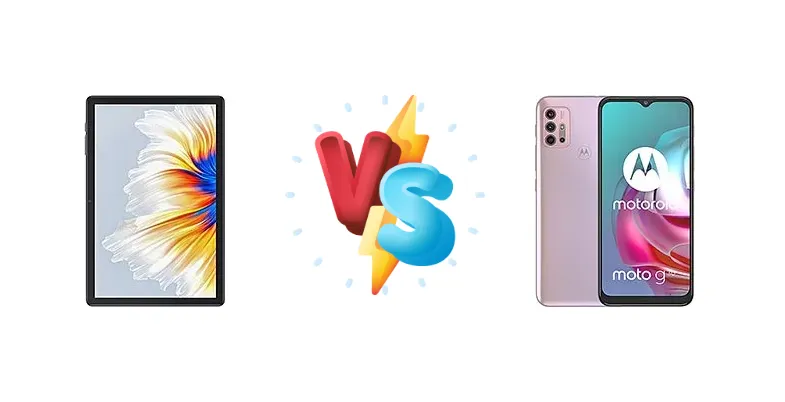
The budget tablet and smartphone space is fiercely competitive. The Cubot Tab 30 and Motorola Moto G30 both aim to deliver essential functionality at an accessible price point, but they take different approaches. The Tab 30 leverages the Unisoc T618 chipset, while the Moto G30 relies on Qualcomm’s Snapdragon 662. This comparison dissects their key differences to determine which device best suits your needs.
🏆 Quick Verdict
For most users, the Motorola Moto G30 emerges as the better choice. While both devices offer similar battery endurance (131h), the Snapdragon 662 provides a noticeable performance advantage over the Unisoc T618, translating to smoother multitasking and a more responsive user experience. The G30's display also boasts slightly better contrast.
| Network |
|---|
| 2G bands | GSM 850 / 900 / 1800 / 1900 | GSM 850 / 900 / 1800 / 1900 |
| 3G bands | HSDPA 900 / 2100 | HSDPA 850 / 900 / 1700(AWS) / 1900 / 2100 |
| 4G bands | 1, 3, 7, 8, 20 | 1, 2, 3, 5, 7, 8, 18, 19, 20, 26, 28, 38, 40, 41 - International |
| Speed | HSPA, LTE | HSPA 42.2/5.76 Mbps, LTE Cat4 150/50 Mbps |
| Technology | GSM / HSPA / LTE | GSM / HSPA / LTE |
| | - | 1, 2, 3, 4, 5, 7, 8, 20, 38, 40, 41 - India |
| Launch |
|---|
| Announced | 2022 | 2021, February 16 |
| Status | Available. Released 2022 | Available. Released 2021, March 17 |
| Body |
|---|
| Build | - | Glass front, plastic back, plastic frame |
| Dimensions | 237.5 x 157.5 x 8 mm (9.35 x 6.20 x 0.31 in) | 165.2 x 75.7 x 9.1 mm (6.50 x 2.98 x 0.36 in) |
| SIM | Nano-SIM + Nano-SIM | · Nano-SIM· Nano-SIM + Nano-SIM |
| Weight | 421 g (14.85 oz) | 200 g (7.05 oz) |
| | - | Water-repellent design |
| Display |
|---|
| Resolution | 1200 x 1920 pixels, 16:10 ratio (~224 ppi density) | 720 x 1600 pixels, 20:9 ratio (~269 ppi density) |
| Size | 10.1 inches, 295.8 cm2 (~79.1% screen-to-body ratio) | 6.5 inches, 102.8 cm2 (~82.2% screen-to-body ratio) |
| Type | IPS LCD | IPS LCD, 90Hz |
| Platform |
|---|
| CPU | Octa-core | Octa-core (4x2.0 GHz Kryo 260 Gold & 4x1.8 GHz Kryo 260 Silver) |
| Chipset | Unisoc T618 | Qualcomm SM6115 Snapdragon 662 (11 nm) |
| GPU | - | Adreno 610 |
| OS | Android 11 | Android 11, upgradable to Android 12 |
| Memory |
|---|
| Card slot | microSDXC (uses shared SIM slot) | microSDXC (uses shared SIM slot) |
| Internal | 128GB 4GB RAM | 64GB 4GB RAM, 128GB 4GB RAM, 128GB 6GB RAM |
| | - | eMMC 5.1 |
| Main Camera |
|---|
| Features | LED flash | LED flash, HDR, panorama |
| Quad | - | 64 MP, f/1.7, 26mm (wide), 1/1.97", 0.7µm, PDAF
8 MP, f/2.2, 118˚ (ultrawide), 1/4.0", 1.12µm
2 MP (macro)
Auxiliary lens |
| Single | 13 MP, AF | - |
| Video | Yes | 1080p@30/60fps |
| Selfie camera |
|---|
| Features | - | HDR |
| Single | 5 MP | 13 MP, f/2.2, (wide), 1/3.1", 1.12µm |
| Video | Yes | 1080p@30fps |
| Sound |
|---|
| 3.5mm jack | - | Yes |
| 35mm jack | Unspecified | Yes |
| Loudspeaker | Yes, with stereo speakers | Yes |
| Comms |
|---|
| Bluetooth | 5.0 | 5.0, A2DP, LE |
| NFC | No | Yes (market/region dependent) |
| Positioning | GPS, GLONASS, GALILEO | GPS, GLONASS, GALILEO |
| Radio | Unspecified | FM radio, RDS, recording |
| USB | USB Type-C, magnetic connector | USB Type-C 2.0, OTG |
| WLAN | Wi-Fi 802.11 a/b/g/n/ac, dual-band | Wi-Fi 802.11 a/b/g/n/ac, dual-band, Wi-Fi Direct |
| Features |
|---|
| Sensors | Accelerometer, gyro | Fingerprint (rear-mounted), accelerometer, gyro, proximity |
| Battery |
|---|
| Charging | - | 15W / 20W wired (market dependent) |
| Type | 6580 mAh | Li-Po 5000 mAh |
| Misc |
|---|
| Colors | Gray | Phantom Black (Dark Pearl), Pastel Sky |
| Models | - | XT2129-1, XT2129-2, PAML0000IN |
| Price | - | About 170 EUR |
| SAR | - | 1.11 W/kg (head) 1.32 W/kg (body) |
| Tests |
|---|
| Battery life | - |
Endurance rating 131h
|
| Camera | - |
Photo / Video |
| Display | - |
Contrast ratio: 1984:1 (nominal) |
| Loudspeaker | - |
-28.7 LUFS (Average)
|
| Performance | - |
AnTuTu: 170968 (v8)
GeekBench: 1265 (v5.1)
GFXBench: 13fps (ES 3.1 onscreen) |
Cubot Tab 30
- Potentially larger screen size (typical of tablets)
- Competitive price point
- Long battery endurance (131h)
- Unisoc T618 chipset offers lower performance
- Display specifications are unknown
- Camera details are lacking
Motorola Moto G30
- Qualcomm Snapdragon 662 provides better performance
- Brighter and higher contrast display (468 nits, 1975:1)
- Faster charging (15W/20W)
- Battery life is similar to the Cubot Tab 30
- Camera details are limited
- Smaller screen size compared to the Tab 30
Display Comparison
The Motorola Moto G30’s display exhibits a measured maximum brightness of 468 nits and a 1975:1 contrast ratio, offering a visually pleasing experience. The Cubot Tab 30’s display specifications are not provided, but given its tablet form factor, it likely prioritizes screen size over peak brightness or contrast. The Moto G30’s 1984:1 nominal contrast ratio is marginally better, suggesting deeper blacks and more vibrant colors. The G30’s brightness is sufficient for indoor use and even moderate outdoor visibility, while the Tab 30’s display performance remains unknown without further data.
Camera Comparison
Both devices are listed as having 'Photo / Video' capabilities, but lack specific details regarding sensor size, aperture, or features like Optical Image Stabilization (OIS). This suggests both devices target casual photography rather than enthusiast-level image capture. Without further information, it’s difficult to assess the camera quality beyond basic functionality. The absence of details implies neither device will excel in low-light conditions or offer advanced photographic features.
Performance
The Motorola Moto G30’s Qualcomm Snapdragon 662 (11nm) chipset is a clear advantage over the Cubot Tab 30’s Unisoc T618. The Snapdragon 662 utilizes a Kryo CPU architecture with a split core configuration (4x2.0 GHz Gold & 4x1.8 GHz Silver), offering a more efficient and powerful processing experience. The 11nm manufacturing process also contributes to better thermal management, reducing the likelihood of performance throttling during sustained workloads. While both are octa-core CPUs, the Snapdragon 662’s architecture and process node provide a tangible performance edge, particularly in gaming and demanding applications.
Battery Life
Both the Cubot Tab 30 and Motorola Moto G30 achieve an impressive endurance rating of 131 hours, indicating comparable battery life under similar usage conditions. The Moto G30 supports 15W/20W wired charging (market dependent), offering a reasonable charging speed. The Tab 30’s charging specifications are not provided. The similar endurance ratings suggest that despite potential differences in battery capacity, both devices are optimized for efficient power consumption. The Moto G30’s faster charging capability provides a slight convenience advantage.
Buying Guide
Buy the Cubot Tab 30 if you prioritize a larger screen experience and are primarily focused on media consumption with light tasks. It’s a good option for those needing a basic tablet for reading, video streaming, and simple web browsing. Buy the Motorola Moto G30 if you value overall performance, a more refined software experience, and a slightly brighter, higher-contrast display. It’s better suited for users who multitask, play mobile games occasionally, and want a more responsive device.
Frequently Asked Questions
❓ Is the Unisoc T618 in the Cubot Tab 30 sufficient for playing demanding games like PUBG Mobile?
While the Unisoc T618 can run PUBG Mobile, expect to play at lower graphics settings and potentially experience frame drops during intense action. The Snapdragon 662 in the Moto G30 offers a smoother gaming experience with more consistent frame rates.
❓ How does the battery life of the Motorola Moto G30 translate to real-world usage?
The 131-hour endurance rating suggests the Moto G30 can easily last a full day of moderate use, including web browsing, social media, and video streaming. Heavy users may still need to charge it daily, but it offers excellent battery longevity.
❓ Does the Motorola Moto G30 support fast charging, and how long does it take to fully charge?
The Moto G30 supports 15W/20W wired charging, depending on the market. A full charge from 0% to 100% typically takes around 2-3 hours with a compatible charger.
❓ Given the limited camera information, should I expect good photo quality from either device?
Both devices likely offer adequate photo quality for casual snapshots in good lighting conditions. However, don't expect exceptional performance in low-light environments or advanced features like optical image stabilization.