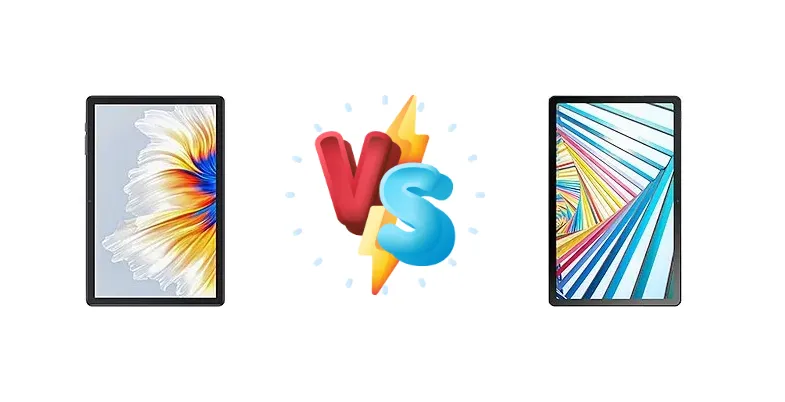
The budget tablet market is fiercely competitive, offering a range of options for users seeking entertainment, productivity, or a simple browsing experience. The Cubot Tab 30 and Lenovo Tab M10 Plus (3rd Gen) both aim to deliver value, but they take different approaches. The Cubot relies on a Unisoc chipset, while the Lenovo offers a choice between a Qualcomm Snapdragon or MediaTek Helio processor, creating a key divergence in performance and features.
🏆 Quick Verdict
For the average user prioritizing consistent performance and future-proofing, the Lenovo Tab M10 Plus (3rd Gen) with the Snapdragon 680 is the better choice. Its 6nm fabrication process and Kryo CPU architecture provide a noticeable advantage in multitasking and demanding applications, despite the Cubot Tab 30's lower price point.
| Network |
|---|
| 2G bands | GSM 850 / 900 / 1800 / 1900 | GSM 850 / 900 / 1800 / 1900 |
| 3G bands | HSDPA 900 / 2100 | HSDPA 800 / 850 / 900 / 1900 / 2100 |
| 4G bands | 1, 3, 7, 8, 20 | 1, 2, 3, 4, 5, 7, 8, 19, 20, 26, 28, 28, 38, 40, 41 |
| Speed | HSPA, LTE | HSPA 42.2/5.76 Mbps, LTE Cat13 390/75 Mbps - cellular model only |
| Technology | GSM / HSPA / LTE | GSM / HSPA / LTE |
| Launch |
|---|
| Announced | 2022 | 2022, May |
| Status | Available. Released 2022 | Available. Released 2022, May |
| Body |
|---|
| Dimensions | 237.5 x 157.5 x 8 mm (9.35 x 6.20 x 0.31 in) | 251.2 x 158.8 x 7.5 mm (9.89 x 6.25 x 0.30 in) |
| SIM | Nano-SIM + Nano-SIM | Nano-SIM (cellular model only) |
| Weight | 421 g (14.85 oz) | 465 g (1.03 lb) |
| | - | Stylus support |
| Display |
|---|
| Resolution | 1200 x 1920 pixels, 16:10 ratio (~224 ppi density) | 1200 x 2000 pixels, 5:3 ratio (~220 ppi density) |
| Size | 10.1 inches, 295.8 cm2 (~79.1% screen-to-body ratio) | 10.61 inches, 320.4 cm2 (~80.3% screen-to-body ratio) |
| Type | IPS LCD | IPS LCD, 400 nits (typ) |
| Platform |
|---|
| CPU | Octa-core | Octa-core (4x2.4 GHz Kryo 265 Gold & 4x1.9 GHz Kryo 265 Silver) - LTE model Octa-core (2x2.0 GHz Cortex-A75 & 6x1.8 GHz Cortex-A55) - Wi-Fi only model |
| Chipset | Unisoc T618 | Qualcomm SM6225 Snapdragon 680 4G (6 nm) - LTE model Mediatek MT6769V/CU Helio G80 (12 nm) - Wi-Fi only model |
| GPU | - | Adreno 610 - LTE model Mali-G52 MC2 - Wi-Fi only model |
| OS | Android 11 | Android 12 |
| Memory |
|---|
| Card slot | microSDXC (uses shared SIM slot) | microSDXC (dedicated slot) |
| Internal | 128GB 4GB RAM | 32GB 3GB RAM, 64GB 4GB RAM, 128GB 4GB RAM, 128GB 6GB RAM |
| | - | eMCP/uMCP |
| Main Camera |
|---|
| Features | LED flash | - |
| Single | 13 MP, AF | 8 MP, AF |
| Video | Yes | 1080p |
| Selfie camera |
|---|
| Single | 5 MP | 8 MP |
| Video | Yes | - |
| Sound |
|---|
| 3.5mm jack | - | Yes |
| 35mm jack | Unspecified | Yes |
| Loudspeaker | Yes, with stereo speakers | Yes, with stereo speakers (4 speakers) |
| Comms |
|---|
| Bluetooth | 5.0 | 5.0, A2DP, LE |
| NFC | No | No |
| Positioning | GPS, GLONASS, GALILEO | GPS, GLONASS, BDS - cellular model only |
| Radio | Unspecified | FM Radio |
| USB | USB Type-C, magnetic connector | USB Type-C 2.0 |
| WLAN | Wi-Fi 802.11 a/b/g/n/ac, dual-band | Wi-Fi 802.11 a/b/g/n/ac, dual-band, Wi-Fi Direct |
| Features |
|---|
| Sensors | Accelerometer, gyro | Accelerometer, proximity, gyro |
| Battery |
|---|
| Charging | - | 20W wired |
| Type | 6580 mAh | Li-Po 7700 mAh |
| Misc |
|---|
| Colors | Gray | Storm Grey, Frost Blue |
| Price | - | About 260 EUR |
Cubot Tab 30
- More affordable price point
- Octa-core processor for basic multitasking
- Likely lightweight and portable
- Unisoc T618 chipset offers lower performance
- Potentially slower charging speeds
- Display quality likely inferior to Lenovo
Lenovo Tab M10 Plus (3rd Gen)
- Snapdragon 680 (LTE model) offers superior performance and efficiency
- 20W fast charging
- Higher resolution display for sharper visuals
- Higher price compared to Cubot Tab 30
- Helio G80 (Wi-Fi model) performance is less significant upgrade
- Camera quality is basic
Display Comparison
Neither device boasts a particularly standout display. Specifications are missing for the Cubot Tab 30's panel, but given its price point, it likely utilizes a standard IPS LCD. The Lenovo Tab M10 Plus (3rd Gen) also features an IPS LCD, but its resolution of 1920x1200 provides a sharper image than what is typically found in this price bracket. The absence of high refresh rates or advanced features like LTPO on either device suggests a focus on cost-effectiveness over visual fidelity. Bezels are likely comparable, being moderate on both sides, prioritizing screen real estate without aiming for a premium edge-to-edge design.
Camera Comparison
Camera performance is unlikely to be a deciding factor for either tablet. Both devices likely feature basic camera setups geared towards casual snapshots. Details on the Cubot Tab 30's camera are unavailable, but it's reasonable to expect a simple configuration. The Lenovo Tab M10 Plus (3rd Gen) typically includes an 8MP main camera, which is adequate for basic photography in good lighting conditions. Neither tablet is expected to excel in low-light scenarios or offer advanced camera features. The inclusion of a 2MP macro camera on some Lenovo configurations is largely a marketing tactic, offering limited practical benefit due to its low resolution.
Performance
This is where the most significant difference lies. The Lenovo Tab M10 Plus (3rd Gen) offers two chipset options: the Qualcomm Snapdragon 680 (6nm) in the 4G LTE model and the MediaTek Helio G80 (12nm) in the Wi-Fi only version. The Snapdragon 680, built on a 6nm process, provides superior power efficiency and thermal performance compared to the Unisoc T618 in the Cubot Tab 30 and the Helio G80. The Snapdragon’s Kryo 265 Gold & Silver CPU architecture offers a more refined balance between performance and power consumption. The Unisoc T618, while an octa-core processor, lacks the architectural advantages and process node efficiency of the Snapdragon, resulting in potentially noticeable slowdowns during multitasking or graphically intensive tasks. The Wi-Fi only Lenovo model with the Helio G80 will offer a performance level closer to the Cubot, but still benefits from potentially better software optimization.
Battery Life
Battery life will depend heavily on usage patterns. While specific mAh capacities are missing for the Cubot Tab 30, it's likely in the 5000-6000 mAh range, similar to the Lenovo Tab M10 Plus (3rd Gen). However, the Snapdragon 680's 6nm process efficiency gives the Lenovo an advantage in power consumption. Furthermore, the Lenovo Tab M10 Plus (3rd Gen) supports 20W wired charging, allowing for faster replenishment compared to the likely slower charging speeds of the Cubot Tab 30. This faster charging capability translates to less downtime and a more convenient user experience.
Buying Guide
Buy the Cubot Tab 30 if you need a highly affordable tablet for basic tasks like web browsing, video playback, and light social media use, and are willing to accept some performance limitations. Buy the Lenovo Tab M10 Plus (3rd Gen) if you prefer a smoother, more responsive experience for multitasking, gaming, and running more demanding apps, and value the benefits of 4G connectivity (LTE model) and faster 20W charging.
Frequently Asked Questions
❓ Will the Unisoc T618 in the Cubot Tab 30 struggle with multiple apps open simultaneously?
Yes, the Unisoc T618 is likely to exhibit slowdowns when running several apps concurrently, especially more demanding ones. Its architecture and process node are less efficient than the Snapdragon 680, leading to reduced multitasking capabilities.
❓ Does the Lenovo Tab M10 Plus (3rd Gen) Snapdragon 680 model support expandable storage via microSD card?
Yes, the Lenovo Tab M10 Plus (3rd Gen) typically includes a microSD card slot, allowing you to expand the internal storage for additional files, photos, and videos. This is a valuable feature for users who plan to store a large amount of content on their tablet.
❓ Is the difference between the Snapdragon 680 and Helio G80 versions of the Lenovo Tab M10 Plus (3rd Gen) significant enough to justify the price difference?
The Snapdragon 680 offers a noticeable performance and efficiency advantage over the Helio G80. If you prioritize smooth multitasking, gaming, and longer battery life, the Snapdragon model is worth the extra investment. However, for basic tasks, the Helio G80 version remains a capable option.