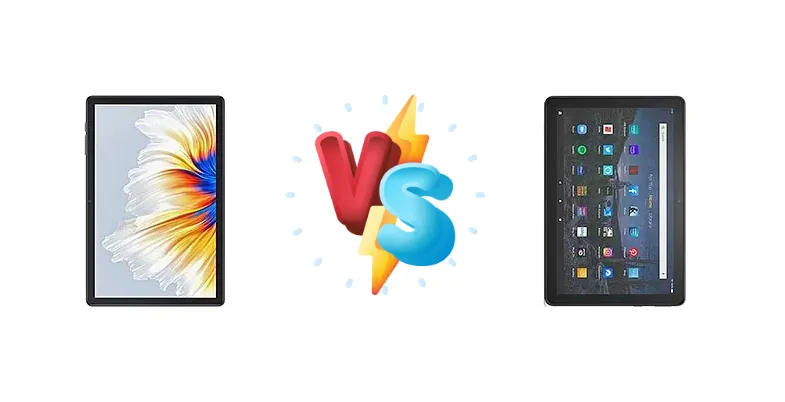
The budget tablet market is fiercely competitive, offering options for casual users and media consumers. We pit the Cubot Tab 30, powered by a Unisoc T618, against the Amazon Fire HD 10 Plus (2021) with its MediaTek Helio P60T to determine which delivers the best experience for the price. This comparison focuses on real-world performance implications, not just raw specifications.
🏆 Quick Verdict
For users prioritizing a more open Android experience and potentially better long-term software support, the Cubot Tab 30 is the stronger choice. However, the Amazon Fire HD 10 Plus (2021) wins for those deeply embedded in the Amazon ecosystem and value the convenience of wireless charging.
| Network |
|---|
| 2G bands | GSM 850 / 900 / 1800 / 1900 | N/A |
| 3G bands | HSDPA 900 / 2100 | - |
| 4G bands | 1, 3, 7, 8, 20 | - |
| EDGE | - | No |
| GPRS | - | No |
| Speed | HSPA, LTE | - |
| Technology | GSM / HSPA / LTE | No cellular connectivity |
| Launch |
|---|
| Announced | 2022 | 2021, April 27. Released 2021, May 26 |
| Status | Available. Released 2022 | Discontinued |
| Body |
|---|
| Dimensions | 237.5 x 157.5 x 8 mm (9.35 x 6.20 x 0.31 in) | 247 x 166 x 9.2 mm (9.72 x 6.54 x 0.36 in) |
| SIM | Nano-SIM + Nano-SIM | No |
| Weight | 421 g (14.85 oz) | 468 g (1.03 lb) |
| Display |
|---|
| Protection | - | Aluminosilicate glass |
| Resolution | 1200 x 1920 pixels, 16:10 ratio (~224 ppi density) | 1920 x 1200 pixels, 16:10 ratio (~224 ppi density) |
| Size | 10.1 inches, 295.8 cm2 (~79.1% screen-to-body ratio) | 10.1 inches, 295.8 cm2 (~72.1% screen-to-body ratio) |
| Type | IPS LCD | IPS LCD |
| Platform |
|---|
| CPU | Octa-core | Octa-core (4x2.0 GHz Cortex-A73 & 4x2.0 GHz Cortex-A53) |
| Chipset | Unisoc T618 | Mediatek MT8183 Helio P60T (12 nm) |
| GPU | - | Mali-G72 MP3 |
| OS | Android 11 | Android 9.0 (Pie), Fire OS 7 |
| Memory |
|---|
| Card slot | microSDXC (uses shared SIM slot) | microSDXC (dedicated slot) |
| Internal | 128GB 4GB RAM | 32GB 4GB RAM, 64GB 4GB RAM |
| | - | eMMC 5.1 |
| Main Camera |
|---|
| Features | LED flash | - |
| Single | 13 MP, AF | 5 MP |
| Video | Yes | 720p |
| Selfie camera |
|---|
| Single | 5 MP | 2 MP |
| Video | Yes | 720p |
| Sound |
|---|
| 3.5mm jack | - | Yes |
| 35mm jack | Unspecified | Yes |
| Loudspeaker | Yes, with stereo speakers | Yes, with stereo speakers |
| Comms |
|---|
| Bluetooth | 5.0 | 5.0, A2DP, LE |
| NFC | No | No |
| Positioning | GPS, GLONASS, GALILEO | No |
| Radio | Unspecified | No |
| USB | USB Type-C, magnetic connector | USB Type-C 2.0, OTG |
| WLAN | Wi-Fi 802.11 a/b/g/n/ac, dual-band | Wi-Fi 802.11 a/b/g/n/ac, dual-band |
| Features |
|---|
| Sensors | Accelerometer, gyro | Accelerometer |
| | - | Text-to-Speech English-language content reader |
| Battery |
|---|
| Charging | - | Wireless |
| Type | 6580 mAh | Li-Ion |
| Misc |
|---|
| Colors | Gray | Slate |
| Models | - | T76N2P |
| Price | - | About 150 EUR |
Cubot Tab 30
- Standard Android OS for full app compatibility
- Potentially better long-term software support
- Likely more customization options
- Unspecified RAM capacity
- No wireless charging
Amazon Fire HD 10 Plus (2021)
- Wireless charging for added convenience
- MediaTek Helio P60T offers efficient performance
- Tight integration with Amazon services
- Fire OS is restrictive and lacks full Google Play Store access
- Potentially limited software updates
Display Comparison
Neither device boasts a cutting-edge display. Both likely utilize IPS LCD panels, common in this price bracket. The Fire HD 10 Plus (2021) benefits from a 10.1-inch screen, while the Cubot Tab 30’s size is unspecified, but likely similar. The key difference isn’t panel quality, but software. Amazon’s Fire OS heavily modifies the Android experience, impacting color calibration and responsiveness. The Cubot Tab 30, running a closer-to-stock Android, offers more control over display settings and potentially more accurate color reproduction. Bezels are expected to be substantial on both devices, typical for budget tablets.
Camera Comparison
Camera performance is unlikely to be a deciding factor for either tablet. Both devices likely feature basic camera setups geared towards video calls rather than photography. Detailed camera specs are unavailable for the Cubot Tab 30, but the Fire HD 10 Plus (2021) features a 5MP front and rear camera. Image quality will be adequate for basic tasks, but don't expect impressive detail or low-light performance. Focusing on the chipset’s ISP (Image Signal Processor) capabilities, the MediaTek Helio P60T likely has a more mature ISP, potentially resulting in slightly better image processing.
Performance
The performance gap is where things get interesting. The Amazon Fire HD 10 Plus (2021) utilizes the MediaTek Helio P60T (12nm), featuring a Cortex-A73/A53 configuration. This architecture, while older, is generally more efficient than the Unisoc T618 in the Cubot Tab 30. The P60T’s Cortex-A73 cores provide a performance boost in single-threaded tasks, beneficial for app loading and general navigation. However, the Unisoc T618’s octa-core design may offer competitive multi-core performance. The 12nm process node of the Helio P60T suggests better thermal efficiency, potentially leading to less throttling during sustained workloads. The Fire HD 10 Plus’s 3GB or 4GB of RAM (depending on configuration) versus the Cubot Tab 30’s unspecified RAM capacity will also impact multitasking capabilities.
Battery Life
Battery life will depend heavily on usage patterns. The Amazon Fire HD 10 Plus (2021) offers the convenience of wireless charging, a significant advantage for users who prefer cable-free charging. While the Cubot Tab 30’s battery capacity is unknown, the Unisoc T618’s efficiency could offset a potentially smaller battery size. The Fire HD 10 Plus’s charging wattage is also unspecified, but likely around 5W-10W via USB-C. Wireless charging will be slower, typically taking several hours for a full charge. The lack of fast charging on either device means 0-100% times will be relatively long.
Buying Guide
Buy the Cubot Tab 30 if you need a tablet running a standard Android OS, allowing for full Google Play Store access and customization. This is ideal for users who want to install a wider range of apps and aren't tied to Amazon's services. Buy the Amazon Fire HD 10 Plus (2021) if you prefer a tightly integrated experience with Amazon's services – Prime Video, Kindle, and Alexa – and appreciate the added convenience of wireless charging, even if it means a more restricted operating system.
Frequently Asked Questions
❓ Does the Amazon Fire HD 10 Plus (2021) suffer from noticeable throttling during extended gaming sessions?
The MediaTek Helio P60T’s 12nm process node and integrated thermal management should mitigate throttling to some extent. However, demanding games will likely cause performance to dip after prolonged play. The Fire HD 10 Plus isn’t designed for intensive gaming, and users should expect some performance limitations.
❓ Can I easily sideload apps onto the Amazon Fire HD 10 Plus (2021) if they aren't available in the Amazon Appstore?
Sideloading apps onto the Fire HD 10 Plus is possible, but it's not straightforward. It requires enabling 'Apps from Unknown Sources' and manually installing APK files. Amazon actively discourages this practice, and compatibility isn't guaranteed. The process is more complex than installing apps from the Google Play Store on a standard Android tablet.
❓ What kind of storage options are available on the Cubot Tab 30, and is it expandable?
Storage specifications for the Cubot Tab 30 are currently unavailable. However, budget tablets often include 32GB or 64GB of internal storage. The presence of a microSD card slot for expandable storage is likely, but not confirmed. This would be a significant advantage for users who plan to store a large number of files or apps.