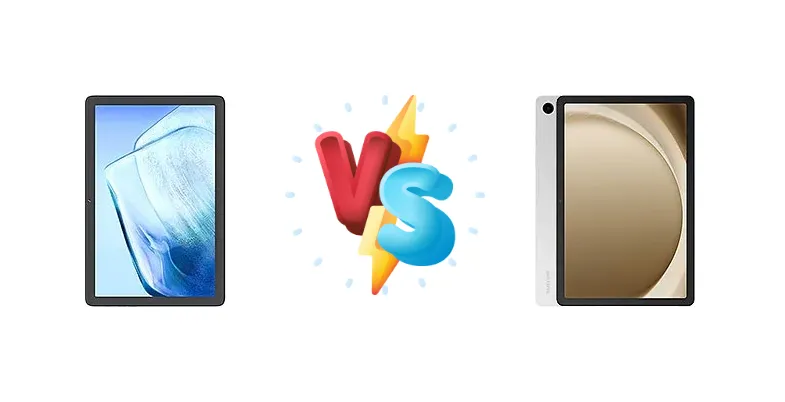
The budget tablet market is heating up, with options like the Cubot Tab 20 and Samsung Galaxy Tab A9+ vying for your attention. While both aim to deliver an affordable Android experience, they take drastically different approaches to achieving that goal. The Cubot Tab 20 relies on a more economical Unisoc chipset, while the Samsung Tab A9+ leverages Qualcomm's Snapdragon 695 5G. This comparison dives deep into the specifics to determine which tablet offers the best balance of performance, features, and value.
🏆 Quick Verdict
For the average user prioritizing consistent performance and future-proofing, the Samsung Galaxy Tab A9+ is the better choice. Its Snapdragon 695 chipset, built on a 6nm process, provides a significant performance advantage over the Cubot Tab 20’s Unisoc SC9863A, despite the Cubot’s lower price point. While the Tab 20 offers a compelling entry price, the A9+ delivers a smoother, more responsive experience.
| Network |
|---|
| 2G bands | GSM 850 / 900 / 1800 / 1900 | GSM 850 / 900 / 1800 / 1900 |
| 3G bands | HSDPA 900 / 2100 | HSDPA 850 / 900 / 1700(AWS) / 1900 / 2100 |
| 4G bands | 1, 3, 7, 8, 20 | 1, 2, 3, 4, 5, 7, 8, 12, 13, 17, 20, 26, 28, 38, 40, 41, 66 |
| 5G bands | - | 1, 3, 5, 7, 8, 20, 28, 38, 40, 41, 66, 77, 78 SA/NSA/Sub6 |
| Speed | HSPA, LTE | HSPA, LTE, 5G - cellular model only |
| Technology | GSM / HSPA / LTE | GSM / HSPA / LTE / 5G |
| Launch |
|---|
| Announced | 2023 | 2023, October 05 |
| Status | Available. Released 2023 | Available. Released 2023, October 17 |
| Body |
|---|
| Dimensions | 241.4 x 160.2 x 8.3 mm (9.50 x 6.31 x 0.33 in) | 257.1 x 168.7 x 6.9 mm (10.12 x 6.64 x 0.27 in) |
| SIM | Nano-SIM + Nano-SIM | Nano-SIM + eSIM (cellular model only) |
| Weight | 530 g (1.17 lb) | 480 g or 492 g (1.06 lb) |
| Display |
|---|
| Resolution | 800 x 1280 pixels, 16:10 ratio (~149 ppi density) | 1200 x 1920 pixels, 16:10 ratio (~206 ppi density) |
| Size | 10.1 inches, 295.8 cm2 (~76.5% screen-to-body ratio) | 11.0 inches, 350.9 cm2 (~80.9% screen-to-body ratio) |
| Type | IPS LCD | TFT LCD, 90Hz |
| Platform |
|---|
| CPU | Octa-core (4x1.6 GHz Cortex-A55 & 4x1.2 GHz Cortex-A55) | Octa-core (2x2.2 GHz Kryo 660 Gold & 6x1.8 GHz Kryo 660 Silver) |
| Chipset | Unisoc SC9863A (28 nm) | Qualcomm SM6375 Snapdragon 695 5G (6 nm) |
| GPU | IMG8322 | Adreno 619 |
| OS | Android 13 | Android 13, upgradable to Android 15, One UI 7 |
| Memory |
|---|
| Card slot | microSDXC (uses shared SIM slot) | microSDXC (dedicated slot) |
| Internal | 64GB 4GB RAM | 64GB 4GB RAM, 128GB 4GB RAM, 128GB 8GB RAM, 256GB 8GB RAM |
| Main Camera |
|---|
| Features | LED flash | - |
| Single | 13 MP, AF | 8 MP, AF |
| Video | Yes | 1080p@30fps |
| Selfie camera |
|---|
| Single | 5 MP | 5 MP |
| Video | Yes | 1080p@30fps |
| Sound |
|---|
| 35mm jack | Unspecified | Yes |
| Loudspeaker | Yes | Yes, with stereo speakers (4 speakers) |
| Comms |
|---|
| Bluetooth | 4.0 | 5.1, A2DP, LE |
| NFC | No | No |
| Positioning | GPS, GLONASS, GALILEO | GPS, GLONASS, GALILEO, BDS, QZSS - cellular model only |
| Radio | Unspecified | No |
| USB | USB Type-C | USB Type-C 2.0 |
| WLAN | Wi-Fi 802.11 b/g/n | Wi-Fi 802.11 a/b/g/n/ac, dual-band, Wi-Fi Direct |
| Features |
|---|
| Sensors | - | Accelerometer, gyro, proximity (accessories only), compass |
| Battery |
|---|
| Charging | - | 15W wired |
| Type | 6000 mAh | Li-Po 7040 mAh |
| Misc |
|---|
| Colors | Dark Purple | Graphite, Silver, Navy |
| Models | - | SM-X210, SM-X215, SM-X216B |
| Price | - | $ 199.99 |
| SAR | - | 0.42 W/kg (body) |
| SAR EU | - | 1.19 W/kg (body) |
Cubot Tab 20
- Lower Price Point
- Functional for Basic Tasks
- Potentially Longer Battery Life (due to less powerful processor)
- Significantly Slower Performance
- Less Efficient Processor
- Limited Future-Proofing
Samsung Galaxy Tab A9+
- Faster and More Responsive Performance
- 5G Connectivity
- More Efficient Processor (6nm)
- Higher Price
- Slower Charging (15W)
- May Require More Frequent Charging (due to more powerful processor)
Display Comparison
Neither device boasts a premium display. The Cubot Tab 20’s display specifications are unavailable, but given its price point, it likely utilizes an IPS LCD panel with a standard 60Hz refresh rate. The Samsung Galaxy Tab A9+ also features an IPS LCD, but its larger size and potentially higher peak brightness (specifications unavailable, but typical for Samsung’s A-series) offer a more immersive viewing experience. The lack of information regarding PWM dimming rates on both devices makes it difficult to assess their suitability for users sensitive to flicker. Bezels are expected to be relatively thick on both models, consistent with their budget positioning.
Camera Comparison
Camera performance is unlikely to be a deciding factor for either tablet. Both devices likely feature basic camera setups geared towards casual snapshots. The Cubot Tab 20’s camera specifications are unavailable, but it’s reasonable to expect a single rear camera and a front-facing camera for video calls. The Samsung Galaxy Tab A9+’s camera details are also limited, but Samsung’s image processing algorithms generally provide a more polished result than those found on lesser-known brands. Focusing on megapixel counts would be misleading; image quality is more dependent on sensor size and software optimization, both of which are unknown for these devices.
Performance
This is where the most significant difference lies. The Samsung Galaxy Tab A9+’s Qualcomm Snapdragon 695 5G (6nm) is a substantial upgrade over the Cubot Tab 20’s Unisoc SC9863A (28nm). The 6nm fabrication process of the Snapdragon 695 translates to significantly improved power efficiency and thermal management, reducing the likelihood of performance throttling during sustained workloads. The Snapdragon 695’s CPU configuration – 2x2.2 GHz Kryo 660 Gold & 6x1.8 GHz Kryo 660 Silver – offers a clear advantage in both single-core and multi-core performance compared to the Cubot’s Octa-core (4x1.6 GHz Cortex-A55 & 4x1.2 GHz Cortex-A55). This means faster app loading times, smoother multitasking, and a more responsive user interface on the A9+. The A9+ also benefits from 5G connectivity, a feature absent on the Tab 20.
Battery Life
Battery life will depend heavily on usage patterns. The Samsung Galaxy Tab A9+ includes 15W wired charging, which is relatively slow by modern standards. The Cubot Tab 20’s battery capacity and charging speed are unknown. However, the more efficient Snapdragon 695 in the A9+ should translate to longer battery life despite potentially having a similar capacity battery to the Tab 20. The 6nm process allows for more work to be done per watt of energy consumed, extending the time between charges.
Buying Guide
Buy the Cubot Tab 20 if you need a basic tablet for light tasks like reading ebooks, browsing the web, and occasional video playback, and your budget is extremely limited. It’s a functional device for those prioritizing cost above all else. Buy the Samsung Galaxy Tab A9+ if you prefer a more responsive and versatile tablet experience, capable of handling multitasking, streaming, and light gaming with greater ease. The A9+ is ideal for users who want a tablet that will remain usable for longer and offers 5G connectivity for on-the-go access.
Frequently Asked Questions
❓ Will the Samsung Galaxy Tab A9+ handle demanding games like PUBG Mobile?
While the Snapdragon 695 isn't a gaming powerhouse, the Tab A9+ should be capable of running PUBG Mobile at medium settings with acceptable frame rates. However, don't expect a consistently smooth experience at the highest graphical settings. The Unisoc SC9863A in the Cubot Tab 20 will struggle with even moderate gaming demands.
❓ Does the Samsung Galaxy Tab A9+ support expandable storage via microSD card?
Yes, the Samsung Galaxy Tab A9+ does support expandable storage via microSD card, allowing you to increase the internal storage capacity. The Cubot Tab 20’s microSD card support is unknown, but it’s a common feature in budget tablets.
❓ Is the 5G connectivity on the Samsung Galaxy Tab A9+ worth the extra cost if I have Wi-Fi at home?
The value of 5G depends on your usage. If you frequently travel or need internet access in areas without reliable Wi-Fi, the 5G connectivity is a significant benefit. However, if you primarily use the tablet at home or in locations with Wi-Fi, the 5G feature may not be worth the price premium.