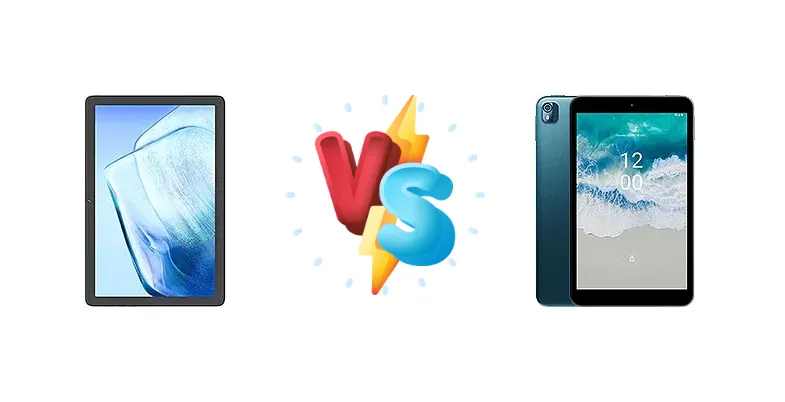
The budget tablet market is fiercely competitive, with options like the Cubot Tab 20 and Nokia T10 vying for attention. Both tablets aim to deliver an affordable Android experience, but they differ significantly under the hood. This comparison focuses on the core performance differences stemming from their respective Unisoc chipsets, and how those translate to real-world usability.
🏆 Quick Verdict
For the average user prioritizing overall efficiency and a slightly smoother experience, the Nokia T10 is the better choice. Its Unisoc T606, built on a 12nm process, offers a performance advantage over the Cubot Tab 20’s older 28nm Unisoc SC9863A, despite similar clock speeds. However, the Tab 20 may offer a lower price point.
| Network |
|---|
| 2G bands | GSM 850 / 900 / 1800 / 1900 | GSM 850 / 900 / 1800 / 1900 |
| 3G bands | HSDPA 900 / 2100 | HSDPA 850 / 900 / 2100 |
| 4G bands | 1, 3, 7, 8, 20 | 1, 3, 5, 7, 8, 20, 28, 38, 40, 41 |
| Speed | HSPA, LTE | HSPA 42.2/5.76 Mbps, LTE Cat4 150/50 Mbps |
| Technology | GSM / HSPA / LTE | GSM / HSPA / LTE |
| Launch |
|---|
| Announced | 2023 | 2022, July 12 |
| Status | Available. Released 2023 | Available. Released 2022, August 20 |
| Body |
|---|
| Build | - | Glass front, plastic back, plastic frame |
| Dimensions | 241.4 x 160.2 x 8.3 mm (9.50 x 6.31 x 0.33 in) | 208 x 123.2 x 9 mm (8.19 x 4.85 x 0.35 in) |
| SIM | Nano-SIM + Nano-SIM | Nano-SIM |
| Weight | 530 g (1.17 lb) | 375 g (13.23 oz) |
| | - | Splash resistant |
| Display |
|---|
| Resolution | 800 x 1280 pixels, 16:10 ratio (~149 ppi density) | 800 x 1280 pixels, 16:10 ratio (~189 ppi density) |
| Size | 10.1 inches, 295.8 cm2 (~76.5% screen-to-body ratio) | 8.0 inches, 185.6 cm2 (~72.4% screen-to-body ratio) |
| Type | IPS LCD | IPS LCD, 360 nits (typ), 450 nits (peak) |
| Platform |
|---|
| CPU | Octa-core (4x1.6 GHz Cortex-A55 & 4x1.2 GHz Cortex-A55) | Octa-core (2x1.6 GHz Cortex-A75 & 6x1.6 GHz Cortex-A55) |
| Chipset | Unisoc SC9863A (28 nm) | Unisoc T606 (12 nm) |
| GPU | IMG8322 | Mali-G57 MP1 |
| OS | Android 13 | Android 12, upgradable to Android 13 |
| Memory |
|---|
| Card slot | microSDXC (uses shared SIM slot) | microSDXC |
| Internal | 64GB 4GB RAM | 32GB 3GB RAM, 64GB 4GB RAM |
| Main Camera |
|---|
| Features | LED flash | LED flash |
| Single | 13 MP, AF | 8 MP, 1/4.0", 1.12µm, AF |
| Video | Yes | 1080p |
| Selfie camera |
|---|
| Single | 5 MP | 2 MP, 1/5.0", 1.65µm |
| Video | Yes | 720p |
| Sound |
|---|
| 3.5mm jack | - | Yes |
| 35mm jack | Unspecified | Yes |
| Loudspeaker | Yes | Yes, with stereo speakers |
| Comms |
|---|
| Bluetooth | 4.0 | 5.0, A2DP, LE |
| NFC | No | No |
| Positioning | GPS, GLONASS, GALILEO | GPS, GLONASS, GALILEO |
| Radio | Unspecified | No |
| USB | USB Type-C | USB Type-C 2.0, OTG |
| WLAN | Wi-Fi 802.11 b/g/n | Wi-Fi 802.11 a/b/g/n/ac, dual-band |
| Features |
|---|
| Sensors | - | Accelerometer, proximity |
| Battery |
|---|
| Charging | - | 10W wired |
| Type | 6000 mAh | Li-Po 5250 mAh |
| Misc |
|---|
| Colors | Dark Purple | Ocean Blue |
| Models | - | TA-1503, TA-1472, TA-1462, TA-1457 |
| Price | - | About 160 EUR |
| SAR | - | 1.19 W/kg (body) |
| SAR EU | - | 0.27 W/kg (head) 1.57 W/kg (body) |
Cubot Tab 20
- Potentially lower price point
- May offer larger storage options
- Simple and straightforward Android experience
- Less efficient chipset (28nm)
- Likely slower performance
- Potential for thermal throttling
Nokia T10
- More efficient chipset (12nm)
- Faster CPU cores (Cortex-A75)
- Better multitasking performance
- Slower 10W charging
- May be slightly more expensive
- Limited RAM options
Display Comparison
Neither device boasts a standout display. Specifications are unavailable for both, so we must rely on market positioning. Given the price point, expect both to utilize IPS LCD panels with 1080p resolution. The Nokia T10, being a slightly more recent release, *may* benefit from improved color calibration. Bezels are likely to be substantial on both, and neither is expected to feature high refresh rates or advanced features like LTPO.
Camera Comparison
Camera performance is unlikely to be a key differentiator in this segment. Without specific sensor details, it’s safe to assume both tablets feature basic camera setups geared towards casual snapshots. Image quality will likely be acceptable in good lighting conditions, but struggle in low light. Focusing on megapixel counts would be misleading; image processing and sensor size are far more important, and data is unavailable for either device.
Performance
The core difference lies in the chipsets. The Nokia T10’s Unisoc T606 (12nm) utilizes two Cortex-A75 cores alongside six A55 cores, while the Cubot Tab 20’s Unisoc SC9863A (28nm) features eight Cortex-A55 cores. The A75 cores in the T10 provide a significant boost in single-core performance, crucial for app launch speeds and general responsiveness. The 28nm fabrication process of the SC9863A is considerably less efficient, meaning the Tab 20 will likely run warmer and potentially throttle performance under sustained load. While both have octa-core CPUs, the architectural difference is substantial.
Battery Life
Battery capacity is not specified for the Cubot Tab 20. The Nokia T10 features a 5250mAh battery and supports 10W wired charging. The T606’s 12nm process contributes to better power efficiency, meaning the Nokia T10 will likely offer longer battery life than the Cubot Tab 20, even if the Tab 20 has a larger capacity battery. The 10W charging on the T10 is slow by modern standards, but adequate for overnight charging.
Buying Guide
Buy the Cubot Tab 20 if your primary need is a very basic tablet for static tasks like reading ebooks or simple video playback, and price is the absolute deciding factor. Buy the Nokia T10 if you anticipate multitasking, light gaming, or want a more responsive user interface, and value a more modern, efficient chipset.
Frequently Asked Questions
❓ Will the Cubot Tab 20 struggle with multiple apps open simultaneously?
Yes, the Cubot Tab 20’s Unisoc SC9863A chipset, with its eight Cortex-A55 cores and older 28nm process, is likely to exhibit slowdowns when multitasking. The lack of high-performance cores will limit its ability to handle demanding applications concurrently.
❓ Is the 10W charging on the Nokia T10 a significant drawback?
While 10W charging is slow compared to modern standards, it’s typical for tablets in this price range. The Nokia T10’s more efficient chipset means you won’t need to charge it as frequently, mitigating the impact of the slower charging speed. Overnight charging is a practical solution.
❓ Can either of these tablets handle basic mobile games like Candy Crush or Angry Birds?
Both tablets should be capable of running less demanding mobile games like Candy Crush or Angry Birds. However, the Nokia T10 will likely provide a smoother and more consistent gaming experience due to its more powerful CPU and GPU.
❓ What type of storage do these tablets use, and is it expandable?
Storage type and expandability are not specified. However, budget tablets typically utilize eMMC storage. It's highly probable that both devices offer a microSD card slot for storage expansion, but this should be verified before purchase.