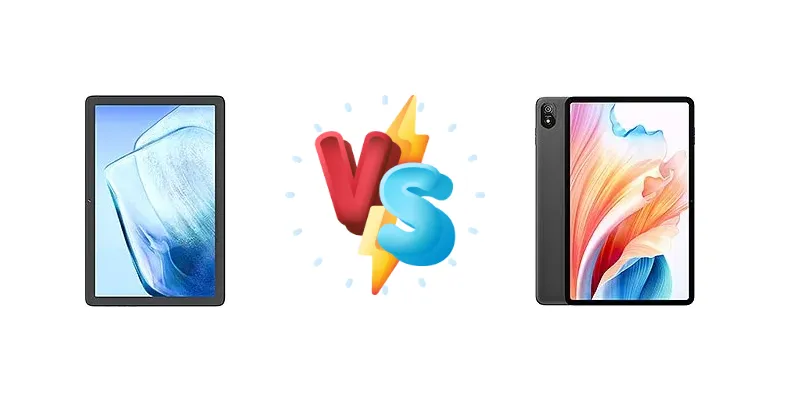
The budget tablet market is fiercely competitive, and the Cubot Tab 20 and Blackview Tab 18 represent compelling options for users seeking affordable Android experiences. However, a significant disparity in their core processing power dictates very different use cases. This comparison will dissect the key differences, focusing on the impact of their respective chipsets and features.
🏆 Quick Verdict
For the average user prioritizing responsiveness and multitasking, the Blackview Tab 18 is the clear winner. Its Mediatek Helio G99 chipset delivers substantially better performance than the Cubot Tab 20’s Unisoc SC9863A, making it more suitable for gaming, demanding apps, and future-proofing. The 33W charging is a bonus.
| Network |
|---|
| 2G bands | GSM 850 / 900 / 1800 / 1900 | GSM 850 / 900 / 1800 / 1900 |
| 3G bands | HSDPA 900 / 2100 | HSDPA 900 / 2100 |
| 4G bands | 1, 3, 7, 8, 20 | 1, 3, 7, 8, 20, 40 |
| Speed | HSPA, LTE | HSPA, LTE |
| Technology | GSM / HSPA / LTE | GSM / HSPA / LTE |
| Launch |
|---|
| Announced | 2023 | 2023, November |
| Status | Available. Released 2023 | Available. Released 2023, November |
| Body |
|---|
| Dimensions | 241.4 x 160.2 x 8.3 mm (9.50 x 6.31 x 0.33 in) | 277.6 x 173.2 x 7.9 mm (10.93 x 6.82 x 0.31 in) |
| SIM | Nano-SIM + Nano-SIM | Nano-SIM + Nano-SIM |
| Weight | 530 g (1.17 lb) | 632 g (1.39 lb) |
| Display |
|---|
| Resolution | 800 x 1280 pixels, 16:10 ratio (~149 ppi density) | 1200 x 2000 pixels, 5:3 ratio (~194 ppi density) |
| Size | 10.1 inches, 295.8 cm2 (~76.5% screen-to-body ratio) | 12.0 inches, 409.9 cm2 (~85.2% screen-to-body ratio) |
| Type | IPS LCD | IPS LCD, 350 nits |
| Platform |
|---|
| CPU | Octa-core (4x1.6 GHz Cortex-A55 & 4x1.2 GHz Cortex-A55) | Octa-core (2x2.2 GHz Cortex-A76 & 6x2.0 GHz Cortex-A55) |
| Chipset | Unisoc SC9863A (28 nm) | Mediatek Helio G99 (6 nm) |
| GPU | IMG8322 | Mali-G57 MC2 |
| OS | Android 13 | Android 13, Doke OS_P 4.0 |
| Memory |
|---|
| Card slot | microSDXC (uses shared SIM slot) | microSDXC (uses shared SIM slot) |
| Internal | 64GB 4GB RAM | 256GB 12GB RAM |
| Main Camera |
|---|
| Features | LED flash | LED flash |
| Single | 13 MP, AF | 16 MP |
| Video | Yes | 1080p@30fps |
| Selfie camera |
|---|
| Single | 5 MP | 8 MP |
| Video | Yes | Yes |
| Sound |
|---|
| 35mm jack | Unspecified | No |
| Loudspeaker | Yes | Yes, with stereo speakers (4 speakers) |
| Comms |
|---|
| Bluetooth | 4.0 | 5.1, A2DP, LE |
| NFC | No | No |
| Positioning | GPS, GLONASS, GALILEO | GPS, GLONASS, GALILEO, BDS |
| Radio | Unspecified | FM Radio |
| USB | USB Type-C | USB Type-C, OTG |
| WLAN | Wi-Fi 802.11 b/g/n | Wi-Fi 802.11 a/b/g/n/ac, dual-band |
| Features |
|---|
| Sensors | - | Fingerprint (side-mounted), accelerometer, gyro, proximity, compass |
| Battery |
|---|
| Charging | - | 33W wired |
| Type | 6000 mAh | 8800 mAh |
| Misc |
|---|
| Colors | Dark Purple | Turquoise Green, Glacier Blue, Space Grey |
Cubot Tab 20
- Potentially lower price point
- May offer longer battery life during *light* use
- Simple and straightforward Android experience
- Significantly weaker performance
- Likely struggles with multitasking
- Slower charging speeds
Blackview Tab 18
- Much faster and more responsive performance
- 33W fast charging
- Better thermal management
- Potentially higher price
- May have slightly shorter battery life under heavy load
- Software experience may vary
Display Comparison
Neither device's display specifications are provided, so a direct comparison is limited. However, given the Tab 18's focus on performance, it's reasonable to assume it may feature a slightly higher resolution or refresh rate panel. The absence of details like peak brightness (nits) or panel technology (IPS, VA, or LTPO) makes a definitive assessment impossible. Bezels are likely similar across both devices, targeting the budget segment.
Camera Comparison
Without specific camera sensor details, a comparison is difficult. However, it’s common for tablets in this price range to prioritize quantity over quality. We can assume both devices will feature a primary camera and potentially a secondary depth or macro sensor. The absence of information regarding sensor size, aperture, or optical image stabilization (OIS) suggests neither device will excel in low-light photography. Image processing will likely be basic on both, relying heavily on software algorithms.
Performance
The core difference lies in the chipsets. The Blackview Tab 18’s Mediatek Helio G99, fabricated on a 6nm process, represents a significant leap over the Cubot Tab 20’s Unisoc SC9863A (28nm). The G99’s CPU configuration – 2x2.2 GHz Cortex-A76 and 6x2.0 GHz Cortex-A55 – provides substantially more processing power than the SC9863A’s 4x1.6 GHz Cortex-A55 & 4x1.2 GHz Cortex-A55. The 6nm process also translates to improved thermal efficiency, reducing the likelihood of performance throttling during sustained workloads. This means the Tab 18 will handle multitasking, gaming, and demanding applications with greater ease. The Tab 20 will struggle with anything beyond basic tasks.
Battery Life
Battery capacity isn't specified for either device. However, the Blackview Tab 18’s 33W wired charging is a significant advantage. This will allow for much faster charging times compared to the Cubot Tab 20, which likely supports a slower charging standard. Even if the Tab 20 has a slightly larger battery, the Tab 18’s faster charging will minimize downtime and provide a more convenient user experience. The G99's 6nm efficiency also contributes to potentially better battery life under load.
Buying Guide
Buy the Cubot Tab 20 if you need a basic tablet for light tasks like reading ebooks, browsing the web, and occasional video playback, and your budget is extremely limited. Buy the Blackview Tab 18 if you prefer a smoother, more responsive experience for multitasking, gaming, and running more demanding applications, and value faster charging capabilities. The Tab 18 is the better choice for users who anticipate using their tablet for more than just basic consumption.
Frequently Asked Questions
❓ Will the Blackview Tab 18's Helio G99 overheat during extended gaming sessions?
The Mediatek Helio G99 is designed with thermal efficiency in mind, thanks to its 6nm fabrication process. While some heat generation is inevitable during gaming, it's less likely to throttle performance compared to the older 28nm Unisoc SC9863A in the Cubot Tab 20. The Tab 18 should provide a more consistent gaming experience.
❓ Is the performance difference between the Helio G99 and SC9863A noticeable for everyday tasks like browsing and video streaming?
Yes, the difference is quite noticeable. While both tablets can handle basic tasks, the Helio G99 offers a significantly smoother and more responsive experience. Web pages will load faster, app switching will be quicker, and video playback will be less prone to stuttering. The Tab 18 feels more 'premium' in everyday use.
❓ Does the Blackview Tab 18 support external storage via microSD card?
While not explicitly stated in the provided specifications, Blackview tablets typically include a microSD card slot for expandable storage. This is a common feature in budget tablets, allowing users to increase storage capacity beyond the internal memory.
❓ What type of USB port do these tablets use?
Without specific details, it's highly probable both tablets utilize a USB-C port for charging and data transfer. This is the current standard for most Android devices, offering faster data transfer speeds and reversible connectivity.