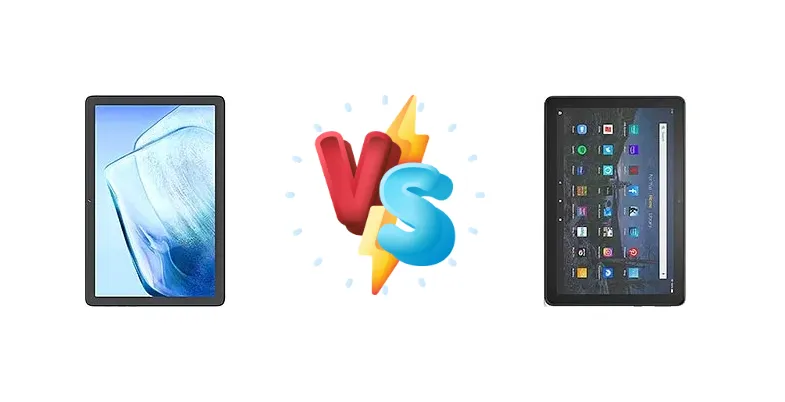
The budget tablet market is fiercely competitive, with options like the Cubot Tab 20 and Amazon Fire HD 10 Plus (2021) vying for attention. While both aim to deliver an affordable tablet experience, they take distinctly different approaches to hardware and software. This comparison dissects their core components to determine which tablet best suits your needs.
🏆 Quick Verdict
For users prioritizing raw processing power and a more standard Android experience, the Amazon Fire HD 10 Plus (2021) emerges as the better choice. Its Mediatek Helio P60T chipset, built on a smaller 12nm process, offers a significant performance advantage over the Cubot Tab 20’s Unisoc SC9863A. However, the Fire HD 10 Plus’s software experience is heavily customized.
| Network |
|---|
| 2G bands | GSM 850 / 900 / 1800 / 1900 | N/A |
| 3G bands | HSDPA 900 / 2100 | - |
| 4G bands | 1, 3, 7, 8, 20 | - |
| EDGE | - | No |
| GPRS | - | No |
| Speed | HSPA, LTE | - |
| Technology | GSM / HSPA / LTE | No cellular connectivity |
| Launch |
|---|
| Announced | 2023 | 2021, April 27. Released 2021, May 26 |
| Status | Available. Released 2023 | Discontinued |
| Body |
|---|
| Dimensions | 241.4 x 160.2 x 8.3 mm (9.50 x 6.31 x 0.33 in) | 247 x 166 x 9.2 mm (9.72 x 6.54 x 0.36 in) |
| SIM | Nano-SIM + Nano-SIM | No |
| Weight | 530 g (1.17 lb) | 468 g (1.03 lb) |
| Display |
|---|
| Protection | - | Aluminosilicate glass |
| Resolution | 800 x 1280 pixels, 16:10 ratio (~149 ppi density) | 1920 x 1200 pixels, 16:10 ratio (~224 ppi density) |
| Size | 10.1 inches, 295.8 cm2 (~76.5% screen-to-body ratio) | 10.1 inches, 295.8 cm2 (~72.1% screen-to-body ratio) |
| Type | IPS LCD | IPS LCD |
| Platform |
|---|
| CPU | Octa-core (4x1.6 GHz Cortex-A55 & 4x1.2 GHz Cortex-A55) | Octa-core (4x2.0 GHz Cortex-A73 & 4x2.0 GHz Cortex-A53) |
| Chipset | Unisoc SC9863A (28 nm) | Mediatek MT8183 Helio P60T (12 nm) |
| GPU | IMG8322 | Mali-G72 MP3 |
| OS | Android 13 | Android 9.0 (Pie), Fire OS 7 |
| Memory |
|---|
| Card slot | microSDXC (uses shared SIM slot) | microSDXC (dedicated slot) |
| Internal | 64GB 4GB RAM | 32GB 4GB RAM, 64GB 4GB RAM |
| | - | eMMC 5.1 |
| Main Camera |
|---|
| Features | LED flash | - |
| Single | 13 MP, AF | 5 MP |
| Video | Yes | 720p |
| Selfie camera |
|---|
| Single | 5 MP | 2 MP |
| Video | Yes | 720p |
| Sound |
|---|
| 3.5mm jack | - | Yes |
| 35mm jack | Unspecified | Yes |
| Loudspeaker | Yes | Yes, with stereo speakers |
| Comms |
|---|
| Bluetooth | 4.0 | 5.0, A2DP, LE |
| NFC | No | No |
| Positioning | GPS, GLONASS, GALILEO | No |
| Radio | Unspecified | No |
| USB | USB Type-C | USB Type-C 2.0, OTG |
| WLAN | Wi-Fi 802.11 b/g/n | Wi-Fi 802.11 a/b/g/n/ac, dual-band |
| Features |
|---|
| Sensors | - | Accelerometer |
| | - | Text-to-Speech English-language content reader |
| Battery |
|---|
| Charging | - | Wireless |
| Type | 6000 mAh | Li-Ion |
| Misc |
|---|
| Colors | Dark Purple | Slate |
| Models | - | T76N2P |
| Price | - | About 150 EUR |
Cubot Tab 20
- Cleaner Android experience (less bloatware)
- Potentially longer battery life during light use
- More affordable price point (likely)
- Significantly weaker processor performance
- Less responsive user interface
- Limited gaming capabilities
Amazon Fire HD 10 Plus (2021)
- Faster and more powerful processor (Helio P60T)
- Wireless charging support
- Better multitasking and gaming performance
- Amazon Fire OS (heavily customized)
- More Amazon integration (may be undesirable for some)
- Potentially shorter battery life under heavy load
Display Comparison
Neither device boasts a particularly high-end display. Both likely utilize IPS LCD panels, common in this price bracket. However, the key difference lies in the underlying silicon. The Cubot Tab 20’s Unisoc chipset likely drives a lower-resolution display to conserve power. The Fire HD 10 Plus, with its more powerful Helio P60T, can comfortably handle its 1920x1200 resolution. While neither manufacturer specifies peak brightness, the Fire HD 10 Plus’s more efficient chipset allows for potentially higher sustained brightness levels, improving outdoor visibility.
Camera Comparison
Camera quality is unlikely to be a primary concern for buyers in this segment. Both tablets likely feature basic camera setups. Given the context data, detailed analysis is limited. However, it’s safe to assume the Fire HD 10 Plus, benefiting from its more powerful ISP (Image Signal Processor) within the Helio P60T, will produce slightly better image quality, particularly in challenging lighting conditions. Any 2MP macro cameras on either device should be considered largely for marketing purposes.
Performance
The performance gap is the most significant differentiator. The Mediatek Helio P60T (12nm) in the Fire HD 10 Plus is a substantial upgrade over the Unisoc SC9863A (28nm) found in the Cubot Tab 20. The Helio P60T’s Cortex-A73 cores, clocked at 2.0 GHz, offer significantly better single-core performance than the Cortex-A55 cores (1.6 GHz and 1.2 GHz) in the Unisoc chip. This translates to snappier app launches, smoother multitasking, and a more responsive user experience. The 12nm manufacturing process also contributes to better thermal efficiency, reducing the likelihood of performance throttling under sustained load. The Fire HD 10 Plus is the clear winner for users who intend to play games or run demanding applications.
Battery Life
Battery life will depend heavily on usage patterns. While the Cubot Tab 20’s battery capacity is not specified, its less powerful chipset will likely result in longer battery life during light tasks like reading. The Fire HD 10 Plus (2021) offers the convenience of wireless charging, a feature absent on the Cubot Tab 20. This adds flexibility, but wireless charging is typically less efficient than wired charging. The Fire HD 10 Plus’s more efficient chipset may offset a potentially smaller battery capacity, providing comparable real-world battery life for moderate usage.
Buying Guide
Buy the Cubot Tab 20 if you need a basic, unadulterated Android tablet for light tasks like reading ebooks, browsing the web, and simple video playback, and prefer a cleaner software experience. Buy the Amazon Fire HD 10 Plus (2021) if you prioritize performance for streaming, gaming, and multitasking, and are comfortable with Amazon’s Fire OS, including its integration with Amazon services and parental controls.
Frequently Asked Questions
❓ Does the Unisoc SC9863A chipset struggle with multitasking?
Yes, the Unisoc SC9863A is a low-end chipset. Expect noticeable slowdowns and app reloading when switching between multiple applications. It's best suited for running one app at a time.
❓ How much does Amazon’s Fire OS restrict access to Google services?
Fire OS is heavily customized and does not include the Google Play Store. While you can sideload the Play Store, it's not officially supported and can be complex. Access to Google apps like Gmail and YouTube is primarily through web browsers or Amazon's app store alternatives.
❓ Is the wireless charging on the Fire HD 10 Plus particularly fast?
No, the wireless charging on the Fire HD 10 Plus is relatively slow, typically around 5-7.5W. It's more about convenience than speed. Wired charging is significantly faster.
❓ Can I use the Cubot Tab 20 for video editing or graphic design?
The Cubot Tab 20 is not suitable for demanding tasks like video editing or graphic design. Its processor lacks the power and its RAM is likely insufficient to handle these workloads effectively.