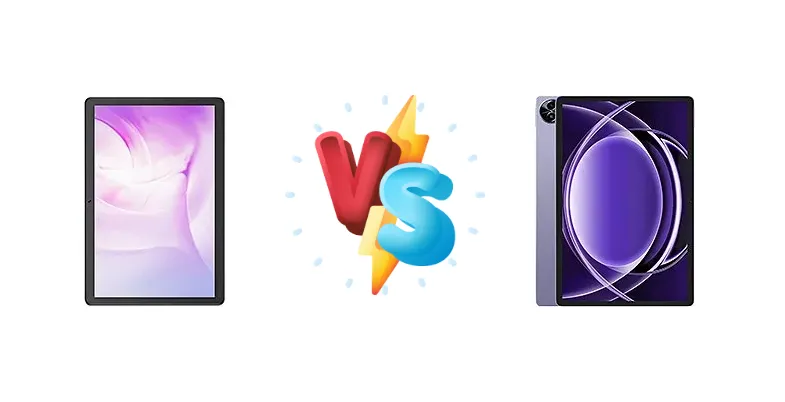
The budget tablet market is heating up, with options like the Cubot Tab 10 and Realme Pad 2 Lite vying for attention. While both aim to deliver an affordable Android experience, they take drastically different approaches to core components, particularly the chipset. This comparison dives deep into the architectural differences and real-world implications of these choices.
🏆 Quick Verdict
For the average user, the Realme Pad 2 Lite is the clear winner. Its Mediatek Helio G99 chipset, built on a 6nm process, provides a substantial performance advantage over the Cubot Tab 10’s older Unisoc SC9863A. While the Cubot Tab 10 may be slightly cheaper, the performance gains and efficiency of the Realme Pad 2 Lite justify the price difference.
| Network |
|---|
| 2G bands | GSM 850 / 900 / 1800 / 1900 | GSM 850 / 900 / 1800 / 1900 |
| 3G bands | HSDPA 900 / 2100 | HSDPA 850 / 900 / 2100 |
| 4G bands | 1, 3, 7, 8, 20 | 1, 3, 5, 7, 8, 20, 28, 38, 40, 41 |
| Speed | HSPA, LTE | HSPA, LTE |
| Technology | GSM / HSPA / LTE | GSM / HSPA / LTE |
| Launch |
|---|
| Announced | 2021 | 2024, September 13 |
| Status | Available. Released 2021 | Available. Released 2024, September 26 |
| Body |
|---|
| Dimensions | 243.5 x 164 x 8.8 mm (9.59 x 6.46 x 0.35 in) | 258 x 169.5 x 8.3 mm (10.16 x 6.67 x 0.33 in) |
| SIM | Micro-SIM | No |
| Weight | 575 g (1.27 lb) | 525 g (1.16 lb) |
| Display |
|---|
| Resolution | 1200 x 1920 pixels, 16:10 ratio (~224 ppi density) | 1200 x 1920 pixels, 16:10 ratio (~207 ppi density) |
| Size | 10.1 inches, 295.8 cm2 (~74.1% screen-to-body ratio) | 10.95 inches, 347.7 cm2 (~79.5% screen-to-body ratio) |
| Type | IPS LCD | IPS LCD, 1B colors, 90Hz, 450 nits (peak) |
| Platform |
|---|
| CPU | Octa-core (4x1.6 GHz Cortex-A55 & 4x1.2 GHz Cortex-A55) | Octa-core (2x2.2 GHz Cortex-A76 & 6x2.0 GHz Cortex-A55) |
| Chipset | Unisoc SC9863A (28 nm) | Mediatek Helio G99 (6 nm) |
| GPU | IMG8322 | Mali-G57 MC2 |
| OS | Android 11 | Android 14, Realme UI 5.0 for Pad |
| Memory |
|---|
| Card slot | microSDXC (dedicated slot) | Unspecified |
| Internal | 64GB 4GB RAM | 128GB 4GB RAM, 128GB 8GB RAM |
| Main Camera |
|---|
| Features | LED flash | Panorama |
| Single | 13 MP, AF | 8 MP, f/2.0 |
| Video | Yes | 1080p@30fps |
| Selfie camera |
|---|
| Features | - | Panorama |
| Single | 5 MP | 5 MP, f/2.2 |
| Video | Yes | 1080p@30fps |
| Sound |
|---|
| 35mm jack | Unspecified | No |
| Loudspeaker | Yes | Yes, with stereo speakers (4 speakers) |
| Comms |
|---|
| Bluetooth | 4.2, A2DP | 5.2, A2DP, LE |
| NFC | No | No |
| Positioning | GPS, GLONASS | GPS, GALILEO, GLONASS, BDS |
| Radio | Unspecified | No |
| USB | USB Type-C | USB Type-C |
| WLAN | Wi-Fi 802.11 b/g/n | Wi-Fi 802.11 a/b/g/n/ac, dual-band |
| Features |
|---|
| Sensors | Accelerometer | Accelerometer |
| Battery |
|---|
| Charging | - | 15W wired |
| Type | 6000 mAh | 8300 mAh |
| Misc |
|---|
| Colors | Gray | Nebula Purple, Space Grey |
| Models | - | RMP2402 |
| Price | - | About 160 EUR |
Cubot Tab 10
- Potentially lower price point
- May offer longer battery life due to less powerful chipset
- Sufficient for basic tasks
- Significantly slower performance
- Older, less efficient chipset
- Likely limited multitasking capabilities
Realme Pad 2 Lite
- Much faster performance thanks to Helio G99
- More efficient 6nm process
- 15W fast charging
- Better multitasking and app responsiveness
- Slightly higher price
- Potentially shorter battery life under heavy load (though efficiency mitigates this)
Display Comparison
Neither device's display specifications are provided, so a direct comparison is limited. However, given the Realme Pad 2 Lite's positioning, it likely features an IPS LCD panel with a standard 60Hz refresh rate. The Cubot Tab 10, being a more budget-focused device, likely uses a similar panel. Without knowing resolution or brightness levels, it's difficult to declare a winner, but Realme generally focuses on display quality even in their budget offerings, suggesting a potentially better viewing experience.
Camera Comparison
Without specific camera sensor details, a meaningful comparison is impossible. Both tablets likely feature basic camera setups geared towards video calls rather than photography. It's safe to assume both will include a rear-facing camera and a front-facing camera for video conferencing. The Realme Pad 2 Lite, benefiting from its overall higher positioning, *may* have a slightly better camera module, but this is speculative without further information.
Performance
The core difference lies in the chipsets. The Realme Pad 2 Lite’s Mediatek Helio G99 (6nm) is a modern processor featuring two Cortex-A76 cores clocked at 2.2 GHz, paired with six Cortex-A55 cores at 2.0 GHz. This architecture provides a significant leap in performance compared to the Cubot Tab 10’s Unisoc SC9863A (28nm). The Unisoc chip uses four Cortex-A55 cores at 1.6 GHz and four at 1.2 GHz. The 6nm fabrication process of the Helio G99 is far more efficient, resulting in lower power consumption and less heat generation, translating to sustained performance. The A76 cores in the G99 offer a substantial IPC (Instructions Per Clock) improvement over the A55 cores in the SC9863A, making the Realme Pad 2 Lite noticeably faster in everyday tasks and gaming.
Battery Life
Battery capacity isn't specified for either device. However, the Realme Pad 2 Lite’s 15W wired charging is a key differentiator. The Unisoc SC9863A’s lower power demands *could* result in comparable battery life to the Helio G99, but the G99’s efficiency gains will likely still provide a longer runtime for similar usage. The 15W charging on the Realme Pad 2 Lite will also allow for quicker top-ups, a convenience the Cubot Tab 10 likely won’t match.
Buying Guide
Buy the Cubot Tab 10 if you prioritize absolute lowest cost and only need a tablet for very basic tasks like web browsing and light video consumption. Its Unisoc chipset is sufficient for these limited workloads. Buy the Realme Pad 2 Lite if you value responsiveness, smoother multitasking, and the ability to handle more demanding apps and occasional gaming. The Helio G99 offers a significantly better user experience for a small price premium.
Frequently Asked Questions
❓ Will the Unisoc SC9863A in the Cubot Tab 10 struggle with multiple apps open simultaneously?
Yes, the Unisoc SC9863A is a relatively low-powered chipset. Running several apps concurrently will likely result in noticeable lag and slowdowns, as it has limited RAM management capabilities and processing power.
❓ Is the Mediatek Helio G99 in the Realme Pad 2 Lite capable of playing demanding games like PUBG Mobile?
The Helio G99 is capable of playing PUBG Mobile, but you'll likely need to lower the graphics settings to medium or low to achieve a smooth and consistent frame rate. It's not a dedicated gaming chipset, but it offers a significantly better gaming experience than the Unisoc SC9863A.
❓ Does the Realme Pad 2 Lite support reverse charging or OTG functionality?
Unfortunately, specific details regarding reverse charging or OTG support for the Realme Pad 2 Lite are not available. However, Realme often includes OTG support in their tablets, so it's worth checking the official specifications or user forums for confirmation.
❓ What type of storage does the Cubot Tab 10 use, and is it expandable?
The storage type for the Cubot Tab 10 is not specified. However, given its budget nature, it likely uses eMMC storage, which is slower than UFS. Expandability via microSD card is also unknown, but common in this price range.