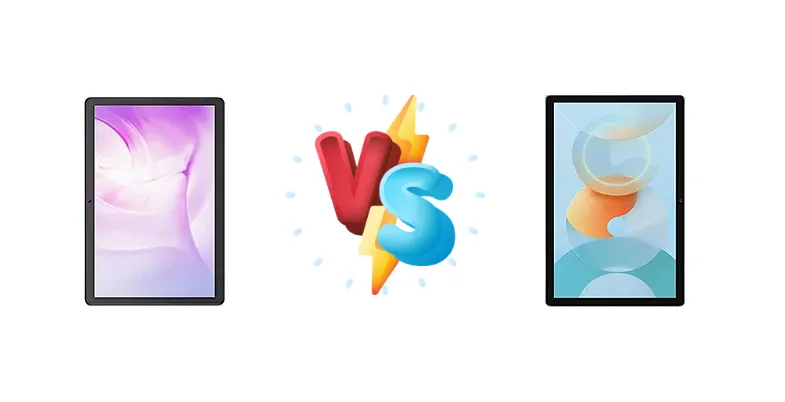
The budget tablet market is fiercely competitive, and the Cubot Tab 10 and Blackview Tab 13 represent compelling options for users seeking affordable Android experiences. However, beneath the similar price points lie significant differences in their core hardware, particularly in their chipsets. This comparison dissects those differences to determine which tablet delivers the best performance and overall value.
🏆 Quick Verdict
For most users, the Blackview Tab 13 emerges as the superior choice. Its Mediatek Helio G85 chipset, built on a more efficient 12nm process, provides a noticeable performance uplift over the Cubot Tab 10’s Unisoc SC9863A, making it better suited for gaming and multitasking. While the Cubot Tab 10 offers a functional experience, the Blackview Tab 13 delivers a smoother, more responsive user experience.
| Network |
|---|
| 2G bands | GSM 850 / 900 / 1800 / 1900 | GSM 850 / 900 / 1800 / 1900 |
| 3G bands | HSDPA 900 / 2100 | HSDPA 900 / 2100 |
| 4G bands | 1, 3, 7, 8, 20 | 1, 3, 7, 8, 20, 40 |
| Speed | HSPA, LTE | HSPA, LTE |
| Technology | GSM / HSPA / LTE | GSM / HSPA / LTE |
| Launch |
|---|
| Announced | 2021 | 2022, August 20 |
| Status | Available. Released 2021 | Available. Released 2022, August 20 |
| Body |
|---|
| Dimensions | 243.5 x 164 x 8.8 mm (9.59 x 6.46 x 0.35 in) | 238.8 x 157.6 x 7.7 mm (9.40 x 6.20 x 0.30 in) |
| SIM | Micro-SIM | Nano-SIM + Nano-SIM |
| Weight | 575 g (1.27 lb) | 450 g (0.99 lb) |
| Display |
|---|
| Resolution | 1200 x 1920 pixels, 16:10 ratio (~224 ppi density) | 1200 x 1920 pixels, 16:10 ratio (~224 ppi density) |
| Size | 10.1 inches, 295.8 cm2 (~74.1% screen-to-body ratio) | 10.1 inches, 295.8 cm2 (~78.6% screen-to-body ratio) |
| Type | IPS LCD | IPS LCD |
| Platform |
|---|
| CPU | Octa-core (4x1.6 GHz Cortex-A55 & 4x1.2 GHz Cortex-A55) | Octa-core (2x2.0 GHz Cortex-A75 & 6x1.8 GHz Cortex-A55) |
| Chipset | Unisoc SC9863A (28 nm) | Mediatek MT6769Z Helio G85 (12 nm) |
| GPU | IMG8322 | Mali-G52 MC2 |
| OS | Android 11 | Android 12, Doke OS_P 3.0 |
| Memory |
|---|
| Card slot | microSDXC (dedicated slot) | microSDXC (uses shared SIM slot) |
| Internal | 64GB 4GB RAM | 128GB 6GB RAM |
| | - | eMMC 5.1 |
| Main Camera |
|---|
| Dual | - | 13 MP
2 MP |
| Features | LED flash | - |
| Single | 13 MP, AF | 8 MP |
| Video | Yes | 1080p@30fps |
| Selfie camera |
|---|
| Single | 5 MP | 8 MP |
| Video | Yes | Yes |
| Sound |
|---|
| 3.5mm jack | - | No |
| 35mm jack | Unspecified | No |
| Loudspeaker | Yes | Yes, with stereo speakers |
| Comms |
|---|
| Bluetooth | 4.2, A2DP | 5.0, A2DP |
| NFC | No | No |
| Positioning | GPS, GLONASS | GPS, GLONASS, GALILEO, BDS |
| Radio | Unspecified | FM Radio |
| USB | USB Type-C | USB Type-C, OTG |
| WLAN | Wi-Fi 802.11 b/g/n | Wi-Fi 802.11 a/b/g/n/ac, dual-band |
| Features |
|---|
| Sensors | Accelerometer | Accelerometer |
| Battery |
|---|
| Type | 6000 mAh | 7280 mAh |
| Misc |
|---|
| Colors | Gray | Twilight Blue, Space Gray, Silver |
Cubot Tab 10
- Potentially lower price point
- Functional for basic tasks
- Acceptable for light usage
- Outdated Unisoc SC9863A chipset
- Limited performance for gaming and multitasking
- Less efficient 28nm process
Blackview Tab 13
- More powerful Mediatek Helio G85 chipset
- Improved power efficiency with 12nm process
- Better performance for gaming and multitasking
- Smoother user experience
- May be slightly more expensive
- Camera quality likely similar to Cubot Tab 10
Display Comparison
Neither device’s display specifications are provided, so a direct comparison is limited. However, given the target market, both likely utilize IPS LCD panels. The Blackview Tab 13, positioned slightly higher, may benefit from a higher resolution or improved color calibration. The absence of information regarding refresh rates suggests both are likely capped at 60Hz. Bezels are expected to be relatively substantial on both devices, consistent with their price bracket.
Camera Comparison
Without specific camera sensor details, a detailed comparison is difficult. However, it’s reasonable to assume both tablets feature basic camera setups geared towards casual use. The presence of a 2MP macro camera on either device is largely a marketing tactic, offering limited practical benefit due to the small sensor size and low resolution. Image processing will likely be basic on both, relying heavily on software algorithms to enhance image quality. The Blackview Tab 13 may have a slight advantage if it incorporates a larger primary sensor.
Performance
The core difference lies in the chipsets. The Blackview Tab 13’s Mediatek Helio G85 (12nm) is a significant upgrade over the Cubot Tab 10’s Unisoc SC9863A (28nm). The 12nm process node of the Helio G85 translates to improved power efficiency and reduced heat generation. Architecturally, the Helio G85 features two Cortex-A75 cores clocked at 2.0 GHz, providing a substantial boost in single-core performance compared to the four Cortex-A55 cores at 1.6 GHz in the Cubot Tab 10. The remaining six Cortex-A55 cores on the Helio G85, clocked at 1.8 GHz, further enhance multi-core performance. This means the Blackview Tab 13 will handle demanding applications and multitasking with greater ease.
Battery Life
Battery capacity and charging wattage are not specified. Given the performance difference, the Blackview Tab 13’s more efficient Helio G85 chipset will likely result in comparable or even better battery life despite potentially having a similar capacity battery to the Cubot Tab 10. Faster charging speeds, if present on the Blackview Tab 13, would further enhance its usability, reducing downtime between charges.
Buying Guide
Buy the Cubot Tab 10 if you prioritize extreme affordability and primarily need a tablet for basic tasks like web browsing, reading, and light video consumption. It’s a suitable option for users on a very tight budget. Buy the Blackview Tab 13 if you value performance, enjoy mobile gaming, or frequently multitask between applications. The Helio G85 provides a more future-proof experience and a smoother overall user experience.
Frequently Asked Questions
❓ Will the Helio G85 in the Blackview Tab 13 overheat during extended gaming sessions?
The Helio G85 is a relatively efficient chipset, and the 12nm process helps mitigate heat generation. While some throttling is possible during prolonged, demanding gaming, it's unlikely to be a significant issue, especially compared to the older, less efficient Unisoc SC9863A in the Cubot Tab 10.
❓ Is the performance difference between the two tablets noticeable for everyday tasks like browsing and video streaming?
Yes, the difference is noticeable. The Blackview Tab 13’s Helio G85 provides a smoother and more responsive experience when navigating the user interface, opening applications, and switching between tasks. While the Cubot Tab 10 is adequate for basic tasks, the Blackview Tab 13 offers a more fluid and enjoyable experience.
❓ Can either tablet handle popular mobile games like PUBG Mobile or Call of Duty Mobile?
The Blackview Tab 13 is better equipped to handle these games. While neither tablet will deliver a flagship-level gaming experience, the Helio G85 allows for playable frame rates at medium settings. The Cubot Tab 10 will likely struggle with these titles, even at the lowest settings.