
Cubot Quest vs. Ulefone Armor 10 5G: A Deep Dive into Performance and Ruggedness
| Phones Images | |||||
|---|---|---|---|---|---|
|
🏆 Quick Verdict
For the average user, the Ulefone Armor 10 5G is the clear winner. While the Cubot Quest offers a lower entry price, the Armor 10 5G’s Mediatek Dimensity 800 chipset provides a substantial performance uplift, future-proofing it for demanding applications and 5G networks. The added benefit of wireless charging further sweetens the deal.
| PHONES | ||
|---|---|---|
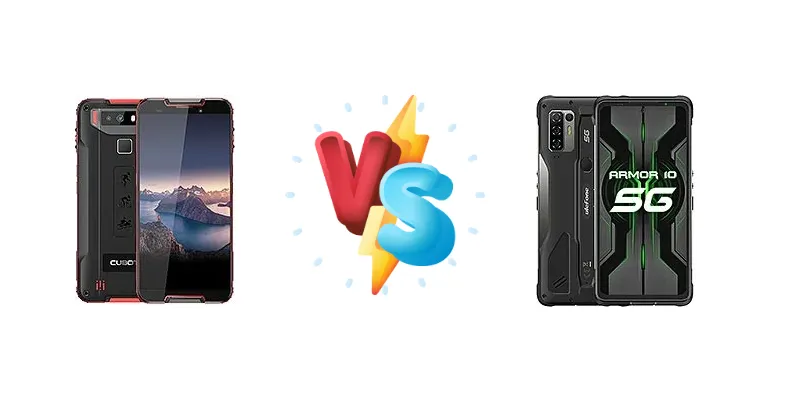
| Phone Names | Cubot Quest | Ulefone Armor 10 5G |
| Network | ||
|---|---|---|
| 2G bands | GSM 850 / 900 / 1800 / 1900 | GSM 850 / 900 / 1800 / 1900 |
| 3G bands | HSDPA 850 / 900 / 1700(AWS) / 1900 / 2100 | HSDPA 850 / 900 / 1700(AWS) / 1900 / 2100 |
| 4G bands | 1, 2, 3, 4, 5, 7, 8, 12, 17, 20 | 1, 2, 3, 4, 5, 7, 8, 12, 13, 17, 18, 19, 20, 25, 26, 28, 34, 38, 39, 40, 41, 66 |
| 5G bands | - | 1, 3, 41, 77, 78, 79 SA/NSA |
| Speed | HSPA, LTE | HSPA, LTE, 5G |
| Technology | GSM / HSPA / LTE | GSM / CDMA / HSPA / EVDO / LTE / 5G |
| - | CDMA2000 1xEV-DO | |
| Launch | ||
|---|---|---|
| Announced | 2020. Released 2020 | 2020, November 17. Released 2020, December 07 |
| Status | Discontinued | Discontinued |
| Body | ||
|---|---|---|
| Build | - | Front glass, aluminum back with rubber, aluminum frame |
| Dimensions | 157 x 73.7 x 8.8 mm (6.18 x 2.90 x 0.35 in) | 176.5 x 82.8 x 14.6 mm (6.95 x 3.26 x 0.57 in) |
| SIM | Nano-SIM + Nano-SIM | Nano-SIM + Nano-SIM |
| Weight | 216 g (7.62 oz) | 328 g (11.57 oz) |
| - | IP68 dust/water resistant (up to 1.5m for 30 min) Drop-to-concrete resistance from up to 1.2m MIL-STD-810G compliant | |
| Display | ||
|---|---|---|
| Protection | Corning Gorilla Glass 5 | Scratch-resistant glass, oleophobic coating |
| Resolution | 720 x 1440 pixels, 18:9 ratio (~293 ppi density) | 1080 x 2400 pixels, 20:9 ratio (~395 ppi density) |
| Size | 5.5 inches, 78.1 cm2 (~67.5% screen-to-body ratio) | 6.67 inches, 107.4 cm2 (~73.5% screen-to-body ratio) |
| Type | IPS LCD | IPS LCD |
| Platform | ||
|---|---|---|
| CPU | Octa-core (4x2.0 GHz Cortex-A53 & 4x1.5 GHz Cortex-A53) | Octa-core (4x2.0 GHz Cortex-A76 & 4x2.0 GHz Cortex-A55) |
| Chipset | Mediatek MT6762 Helio P22 (12 nm) | Mediatek Dimensity 800 (7 nm) |
| GPU | PowerVR GE8320 | Mali-G57 MP4 |
| OS | Android 9.0 (Pie) | Android 10, planned upgrade to Android 11 |
| Memory | ||
|---|---|---|
| Card slot | microSDXC (uses shared SIM slot) | microSDXC (uses shared SIM slot) |
| Internal | 64GB 4GB RAM | 128GB 8GB RAM |
| Main Camera | ||
|---|---|---|
| Dual | 12 MP, f/1.8, (wide), 1/2.9", PDAF 2 MP | - |
| Features | Dual-LED flash | LED flash, Panorama, HDR |
| Quad | - | 64 MP, f/1.9, 26mm (wide), 1/1.72", 0.8µm, PDAF 8 MP, f/2.2, 119˚ (ultrawide) 5 MP (macro) Auxiliary lens |
| Video | Yes | 4K@30fps, 1080p@30fps |
| Selfie camera | ||
|---|---|---|
| Single | 8 MP | 16 MP, f/2.2 |
| Video | Yes | 1080p@30fps |
| Sound | ||
|---|---|---|
| 3.5mm jack | - | Yes |
| 35mm jack | Unspecified | Yes |
| Loudspeaker | Yes | Yes |
| Comms | ||
|---|---|---|
| Bluetooth | 4.2, A2DP | 5.2, A2DP, LE |
| NFC | Yes | Yes |
| Positioning | GPS | GPS, GLONASS, GALILEO, BDS |
| Radio | Unspecified | FM radio, RDS, recording |
| USB | USB Type-C | USB Type-C 2.0, OTG |
| WLAN | Wi-Fi 802.11 a/b/g/n | Wi-Fi 802.11 a/b/g/n/ac, Wi-Fi Direct |
| Features | ||
|---|---|---|
| Sensors | Fingerprint (rear-mounted), accelerometer, gyro, proximity, compass | Fingerprint (side-mounted), accelerometer, gyro, proximity, compass, baroceptor, coulombmeter |
| Battery | ||
|---|---|---|
| Charging | - | 15W wired 15W wireless |
| Type | 4000 mAh | Li-Po 5800 mAh |
| Misc | ||
|---|---|---|
| Colors | Red/Black, Black | Black |
| Price | - | About 420 EUR |
Cubot Quest
- Lower price point makes it accessible.
- Potentially longer battery life due to less powerful chipset (depending on capacity).
- Simpler software experience may appeal to some users.
- Significantly weaker performance compared to the Armor 10 5G.
- Limited 5G connectivity.
- Likely lower-quality display and camera.
Ulefone Armor 10 5G
- Powerful Mediatek Dimensity 800 chipset for smooth performance.
- 5G connectivity for faster data speeds.
- Wireless charging for added convenience.
- Higher price point.
- 15W charging is relatively slow.
- Rugged design may add bulk.
Display Comparison
Neither device's display specifications are provided, so a direct comparison is limited. However, given the Armor 10 5G's positioning as a more premium device, it likely features a higher-quality panel with better color accuracy and potentially higher brightness. The Cubot Quest, aiming for a lower price point, likely utilizes a more basic LCD panel. Bezels are expected to be larger on the Quest to minimize production costs.
Camera Comparison
Without detailed camera specifications, a precise comparison is difficult. However, the Armor 10 5G, being a more expensive device, likely features a more capable primary sensor and potentially optical image stabilization (OIS). The Quest likely relies on a simpler camera setup. The presence of a 2MP macro camera on either device is unlikely to significantly impact image quality; these sensors are often included for marketing purposes rather than practical benefit. Image processing capabilities will also likely be superior on the Armor 10 5G, resulting in better dynamic range and low-light performance.
Performance
The core difference lies in the chipsets. The Ulefone Armor 10 5G’s Mediatek Dimensity 800 (7nm) is a significant leap over the Cubot Quest’s Mediatek MT6762 Helio P22 (12nm). The Dimensity 800 utilizes Cortex-A76 cores alongside A55 cores, offering substantially improved single-core and multi-core performance compared to the Quest’s Cortex-A53 cores. The 7nm process node also translates to better power efficiency and reduced thermal throttling. This means the Armor 10 5G will handle demanding apps and games with greater ease and maintain performance for longer periods. The Helio P22 is adequate for basic tasks but will struggle with resource-intensive applications.
Battery Life
Battery capacity isn't specified for the Cubot Quest, but the Ulefone Armor 10 5G offers both 15W wired and 15W wireless charging. While 15W isn't particularly fast by today's standards, the inclusion of wireless charging is a convenience feature absent on the Quest. The Dimensity 800’s 7nm process contributes to better power efficiency, potentially offsetting a smaller battery capacity compared to the Quest. Real-world battery life will depend on usage patterns, but the Armor 10 5G’s efficiency advantage is a key factor.
Buying Guide
Buy the Cubot Quest if you need a basic smartphone for essential tasks like calling, texting, and light social media use, and your budget is extremely limited. You'll be sacrificing performance and future-proofing. Buy the Ulefone Armor 10 5G if you prioritize 5G connectivity, smoother multitasking, gaming capabilities, and a rugged build quality that can withstand drops and harsh environments. It's a worthwhile investment for those needing a durable and capable device.