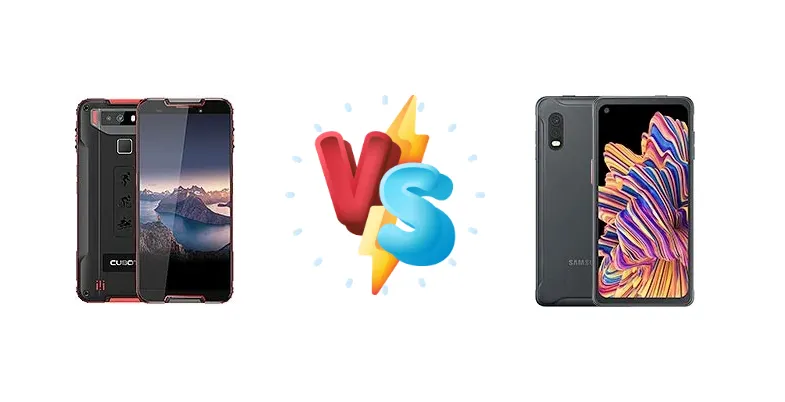
The rugged smartphone market caters to a specific need: durability. Both the Cubot Quest and the Samsung Galaxy XCover Pro aim to deliver on that promise, but they approach it with significantly different internal hardware. This comparison dissects the core differences – specifically the chipset – to determine which device offers the best balance of performance, features, and value for demanding users.
🏆 Quick Verdict
For the average user prioritizing a balance of affordability and reliable performance, the Samsung Galaxy XCover Pro emerges as the stronger choice. Its Exynos 9611 chipset, built on a more efficient 10nm process, provides a noticeable performance uplift over the Cubot Quest’s Helio P22, despite the Quest’s lower price point.
| Network |
|---|
| 2G bands | GSM 850 / 900 / 1800 / 1900 | GSM 850 / 900 / 1800 / 1900 |
| 3G bands | HSDPA 850 / 900 / 1700(AWS) / 1900 / 2100 | HSDPA 850 / 900 / 1900 / 2100 - International |
| 4G bands | 1, 2, 3, 4, 5, 7, 8, 12, 17, 20 | 1, 2, 3, 5, 7, 8, 20, 28, 38, 40, 41 - International |
| Speed | HSPA, LTE | HSPA 42.2/5.76 Mbps, LTE (3CA) Cat11 600/50 Mbps |
| Technology | GSM / HSPA / LTE | GSM / HSPA / LTE |
| | - | 1, 2, 3, 4, 5, 7, 12, 13, 14, 20, 29, 38, 40, 41, 66 - Canada |
| Launch |
|---|
| Announced | 2020. Released 2020 | 2020, January |
| Status | Discontinued | Available. Released 2020, January |
| Body |
|---|
| Dimensions | 157 x 73.7 x 8.8 mm (6.18 x 2.90 x 0.35 in) | 159.9 x 76.7 x 10 mm (6.30 x 3.02 x 0.39 in) |
| SIM | Nano-SIM + Nano-SIM | · Nano-SIM· Nano-SIM + Nano-SIM |
| Weight | 216 g (7.62 oz) | 218 g (7.69 oz) |
| | - | IP68 dust/water resistant (up to 1.5m for 35 min)
Drop-to-concrete resistance from up to 1.5m
MIL-STD-810G compliant*
*does not guarantee ruggedness or use in extreme conditions |
| Display |
|---|
| Protection | Corning Gorilla Glass 5 | Corning Gorilla Glass 5 |
| Resolution | 720 x 1440 pixels, 18:9 ratio (~293 ppi density) | 1080 x 2340 pixels, 19.5:9 ratio (~409 ppi density) |
| Size | 5.5 inches, 78.1 cm2 (~67.5% screen-to-body ratio) | 6.3 inches, 97.4 cm2 (~79.4% screen-to-body ratio) |
| Type | IPS LCD | IPS LCD |
| Platform |
|---|
| CPU | Octa-core (4x2.0 GHz Cortex-A53 & 4x1.5 GHz Cortex-A53) | Octa-core (4x2.3 GHz Cortex-A73 & 4x1.7 GHz Cortex-A53) |
| Chipset | Mediatek MT6762 Helio P22 (12 nm) | Exynos 9611 (10 nm) |
| GPU | PowerVR GE8320 | Mali-G72 MP3 |
| OS | Android 9.0 (Pie) | Android 10, upgradable to Android 13, One UI 5 |
| Memory |
|---|
| Card slot | microSDXC (uses shared SIM slot) | microSDXC (dedicated slot) |
| Internal | 64GB 4GB RAM | 64GB 4GB RAM |
| Main Camera |
|---|
| Dual | 12 MP, f/1.8, (wide), 1/2.9", PDAF
2 MP | 25 MP, f/1.7, 26mm (wide), PDAF
8 MP, f/2.2, 123˚ (ultrawide), 1/4.0", 1.12µm |
| Features | Dual-LED flash | Dual-LED flash, HDR, panorama |
| Video | Yes | 1080p@30fps |
| Selfie camera |
|---|
| Features | - | HDR |
| Single | 8 MP | 13 MP, f/2.0, (wide), 1/3.1", 1.12µm |
| Video | Yes | 1080p@30fps |
| Sound |
|---|
| 3.5mm jack | - | Yes |
| 35mm jack | Unspecified | Yes |
| Loudspeaker | Yes | Yes |
| Comms |
|---|
| Bluetooth | 4.2, A2DP | 5.0, A2DP, LE |
| NFC | Yes | Yes |
| Positioning | GPS | GPS, GLONASS, GALILEO, BDS |
| Radio | Unspecified | FM radio (market/region dependent) |
| USB | USB Type-C | USB Type-C 2.0 |
| WLAN | Wi-Fi 802.11 a/b/g/n | Wi-Fi 802.11 a/b/g/n/ac/k/v/r, dual-band, Wi-Fi Direct |
| Features |
|---|
| Sensors | Fingerprint (rear-mounted), accelerometer, gyro, proximity, compass | Fingerprint (side-mounted), accelerometer, gyro, proximity, compass |
| | - | ANT+ |
| Battery |
|---|
| Charging | - | 15W wired |
| Type | 4000 mAh | Li-Po 4050 mAh, removable |
| Misc |
|---|
| Colors | Red/Black, Black | Black |
| Models | - | SM-G715FN/DS, SM-G715FN, SM-G715F, SM-G715W, SM-G715U, SM-G715U1 |
| Price | - | About 120 EUR |
| SAR EU | - | 0.47 W/kg (head) 1.23 W/kg (body) |
Cubot Quest
- Significantly lower price point
- Potentially larger battery capacity (unconfirmed)
- Rugged design for durability
- Inferior chipset performance (Helio P22)
- Less efficient processor (12nm)
- Likely slower software updates
Samsung Galaxy XCover Pro
- More powerful chipset (Exynos 9611)
- More efficient processor (10nm)
- Samsung’s software and support
- Higher price point
- Slower charging speed (15W)
- LCD display lacks vibrancy
Display Comparison
Neither device boasts a cutting-edge display. Details on panel type and resolution are missing for the Cubot Quest, suggesting a basic LCD. The Samsung Galaxy XCover Pro also utilizes an LCD, prioritizing visibility and durability over vibrant colors. The lack of high refresh rates or advanced features like LTPO on either device reflects their focus on practicality over premium aesthetics. Bezels are likely to be substantial on both, contributing to their ruggedized design.
Camera Comparison
Camera details are sparse for both devices, but the XCover Pro likely offers a more refined imaging experience. While both may feature multiple rear cameras, the image signal processor (ISP) within the Exynos 9611 is more capable than the one in the Helio P22. Expect better dynamic range and noise reduction from the Samsung. The presence of a dedicated Night Mode on the XCover Pro, a common feature on Exynos-powered devices, is also probable. Any 2MP macro cameras on either device should be considered marketing filler rather than a significant photographic asset.
Performance
The core difference lies in the chipsets. The Samsung Galaxy XCover Pro’s Exynos 9611 (10nm) significantly outperforms the Cubot Quest’s MediaTek Helio P22 (12nm). The Exynos utilizes a more modern CPU architecture – Cortex-A73 cores clocked at 2.3GHz versus the Quest’s Cortex-A53 cores at 2.0GHz. This translates to faster app loading times, smoother multitasking, and a more responsive user experience. The 10nm fabrication process of the Exynos also contributes to better thermal efficiency, potentially reducing throttling during sustained workloads. While both are octa-core, the architectural advantage of the Exynos is substantial.
Battery Life
Battery capacity details are missing for the Cubot Quest, but the Samsung Galaxy XCover Pro supports 15W wired charging. The Exynos 9611’s 10nm process contributes to better power efficiency, potentially offsetting a smaller battery capacity compared to the Quest. While 15W isn’t fast charging by today’s standards, it’s adequate for a device geared towards all-day use. The Quest’s larger process node (12nm) suggests it may require more power for the same tasks, potentially impacting battery life despite a larger capacity.
Buying Guide
Buy the Cubot Quest if you need an extremely budget-friendly, durable phone for basic communication and light tasks, and are willing to accept compromises in processing power. Buy the Samsung Galaxy XCover Pro if you prefer a more responsive experience, better multitasking capabilities, and the added benefits of Samsung’s software ecosystem, even at a higher price. The XCover Pro is ideal for field workers who rely on their phone throughout the day.
Frequently Asked Questions
❓ Does the Exynos 9611 in the Galaxy XCover Pro tend to overheat during prolonged use, like gaming?
While not a flagship-level chip, the Exynos 9611 benefits from a 10nm process, which aids in thermal management. It's unlikely to overheat severely during typical use. However, demanding games at high settings for extended periods may cause some throttling to maintain safe operating temperatures. The Quest's Helio P22 will likely throttle more aggressively due to its less efficient 12nm process.
❓ Is the Cubot Quest a viable option for running productivity apps like Microsoft Office or Google Workspace?
The Cubot Quest’s Helio P22 chipset is sufficient for basic productivity tasks like document editing and email. However, expect slower loading times and potential lag when multitasking with multiple apps open. The Samsung Galaxy XCover Pro, with its more powerful Exynos 9611, will provide a significantly smoother and more responsive experience for productivity workflows.
❓ How does the ruggedness of the XCover Pro compare to the Cubot Quest in terms of certifications?
The Samsung Galaxy XCover Pro is typically certified to MIL-STD-810H standards, indicating resistance to drops, shocks, vibrations, and extreme temperatures. Details on the Cubot Quest’s ruggedization certifications are less readily available, suggesting a potentially lower level of protection. The XCover Pro also boasts an IP68 rating for dust and water resistance, a feature likely absent on the Quest.